
Quick Pasqualina pie with phyllo: a light, crispy recipe for Easter and Easter Monday
Pasqualina pie with phyllo: how to achieve endless crispiness without the bottom getting soggy
This version of the Pasqualina pie is the perfect synthesis of tradition and practicality. While the classic Ligurian recipe requires patience and skill to work dozens of thin pastry layers, phyllo allows us to obtain a visually identical and even crispier result in half the time.
It’s the ideal dish for Easter lunch or for an Easter Monday outing, because it keeps its crispness even when cold.
Preparing it with these technical tips will not only save you time, but will bring an unexpected lightness to the table that will win over everyone, from tradition purists to more modern palates.
A sprinkle of Parmesan between one layer and the next and you’re done: your Easter will sound completely different.
The most frustrating problem when preparing Pasqualina, especially a modern version, is the contrast between the crust and the filling: often the base becomes soft and rubbery because of the moisture released by the chard and the ricotta, losing all its appeal.
Another dilemma concerns phyllo dough: being extremely thin, it tends to burn on the surface before the eggs inside are perfectly cooked.
In this recipe we solve both problems: I’ll show you how to correctly layer the phyllo sheets to create an impermeable, crunchy barrier, and how to treat the vegetables so the filling stays compact and creamy.
You will obtain a show-stopping Pasqualina pie, with that characteristic flake-crunch at the first bite, enclosing a soft, colorful heart where the eggs remain whole and dramatic.
Follow the instructions below to prepare this mini Pasqualina with phyllo—a tasty appetizer for the Easter menu and if you are still undecided about your EASTER MENU:
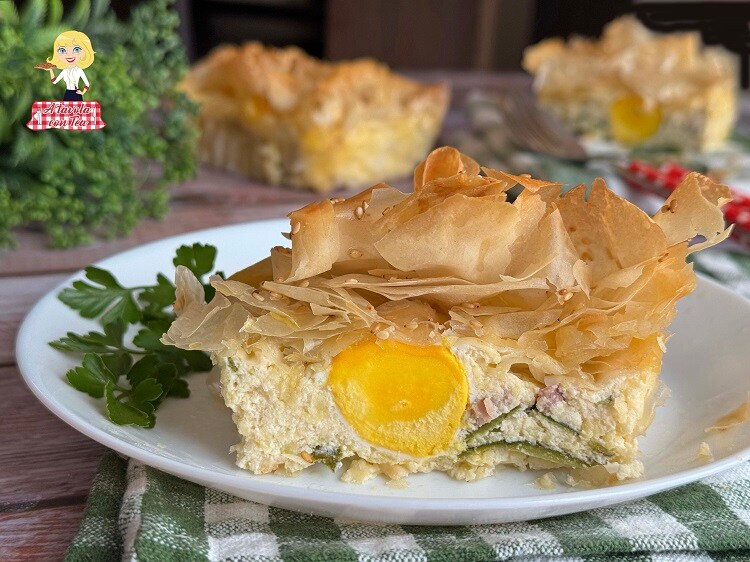
- Difficulty: Very easy
- Cost: Medium
- Preparation time: 20 Minutes
- Cooking time: 25 Minutes
- Portions: 4
- Cooking methods: Oven
- Cuisine: Italian
- Seasonality: Easter Monday, Easter
- Energy 376.21 (Kcal)
- Carbohydrates 5.63 (g) of which sugars 0.16 (g)
- Proteins 28.42 (g)
- Fat 27.08 (g) of which saturated 13.81 (g)of which unsaturated 12.61 (g)
- Fibers 0.86 (g)
- Sodium 789.88 (mg)
Indicative values for a portion of 200 g processed in an automated way starting from the nutritional information available on the CREA* and FoodData Central** databases. It is not food and / or nutritional advice.
* CREATES Food and Nutrition Research Center: https://www.crea.gov.it/alimenti-e-nutrizione https://www.alimentinutrizione.it ** U.S. Department of Agriculture, Agricultural Research Service. FoodData Central, 2019. https://fdc.nal.usda.gov
Ingredients for Pasqualina recipe
- 8 sheets phyllo dough
- 4 eggs (chicken or quail)
- butter (for brushing the phyllo)
- 2 cups zucchini (or chard or Swiss chard)
- 2 eggs
- 1 cup grated Parmesan cheese
- 7 oz ricotta
- 4.4 oz pancetta (smoked or sweet)
- to taste salt
- 1 pinch black pepper (ground)
- extra virgin olive oil
Tools
- Grater
- Frying pan
- Bowl
- Containers
RECIPE Quick Pasqualina pie with phyllo
Wash the zucchini, trim the ends and grate them julienne-style.
Cook them in a pan over high heat, seasoning with salt and pepper.
Stir in the diced pancetta. Cook until the zucchini are soft and the pancetta is golden.
Critical step: At the end of cooking the pan should be almost dry so the phyllo doesn’t get soggy. Turn off the heat and let everything cool completely.Meanwhile, prepare the filling. In a bowl put the eggs, the grated cheese, the ricotta, salt and pepper and mix with a fork.
Add the cooled zucchini and pancetta to the egg mixture. Stir with a spoon to combine all the flavors.
Take a sheet of phyllo, unroll it and brush it with melted butter or oil.
Cut it in half, stack the two rectangles and cut again lengthwise: this way you’ll get 4 rectangles from each sheet. Continue the same way with the remaining sheets.Take the aluminum tray (dimensions 5.9×4.9 in). Place one phyllo rectangle inside starting from the long side and brush with butter; overlap 3 more rectangles, always brushing between them.
Repeat the operation from the short side.
Pour part of the zucchini mixture. Using a teaspoon, make a small well in the center and slide an egg yolk into it, being careful not to break it.
Fold the edges of the phyllo inward to create a rim and brush again with butter.Bake in a preheated conventional oven at 392°F for about 25–30 minutes, or until the phyllo is nicely golden and crisp.
Remove from the oven and serve hot or at room temperature.
Ingredients: notes and substitutions
The Zucchini: Grate them julienne, not too thinly, to keep some texture after cooking in the pan.
The Pancetta: You can use sweet or smoked pancetta depending on your taste; smoked will give the ricotta a stronger flavor.
The Trays: Classic single-portion aluminum trays (5.9×4.9 in) are ideal for even baking of the phyllo.
Storage
They keep well for 24 hours. To restore the crispness of the phyllo, heat them for a minute in an air fryer or in a very hot oven.
Variations
You can replace pancetta with julienned speck or add cubes of provola cheese to the filling for an even more melty effect.
Tips
Don’t skip brushing between one phyllo rectangle and the next: it’s the oil (or butter) that allows the sheets to separate during baking, creating the crunchy “millefeuille” effect.
Why You’ll Love This Crispy Pasqualina Pie
Irresistible Lightness: Forget heavy pies; phyllo and zucchini make it surprisingly light and perfect for spring.
Unique Crispness: Phyllo gives a fragrant, golden texture that elevates every bite.
Fresh, Delicate Flavor: Zucchini blend harmoniously with ricotta and eggs for a pleasant, spring-like taste.
Easy to Make (Despite the Phyllo!): Making this pie is easier than you think, ideal even for non-experts.
An Original Touch for Your Easter Table: Surprise your guests with a creative take on a classic without giving up tradition.
Perfect Vegetarian Option: If you omit the pancetta, it remains a complete and tasty dish that satisfies everyone, even non-meat eaters.
Versatile for Any Occasion: Great for Easter, but also ideal for brunches, picnics or a light dinner.
NOTE
In this recipe I chose to make single-portion pasqualine but you can easily make a whole pie using a single mold. Obviously in that case the baking times will change, increasing slightly depending on the size of the pan and the height of the filling.
VARIATIONS & SUBSTITUTIONS
ZUCCHINI: I chose to grate the zucchini so they cook faster and more evenly, but you can also dice them or cut into rounds.
PANCETTA: Instead of pancetta you can add shredded cured ham, diced cooked ham or speck strips: whichever you choose, the result will be delicious!
VEGETARIAN: This recipe includes a cured meat in the filling, but if you prefer a fully vegetarian version omit it and perhaps add a melty cheese.
FILLING: Instead of zucchini you can use chard, swiss chard or spinach and for a stronger flavor replace cow ricotta with sheep ricotta. Omit the pancetta for a fully vegetarian version.
BUTTER: You can brush the phyllo sheets with oil or, alternatively to butter, with a little water.
FAQ (Questions & Answers)
What’s the difference between puff pastry and phyllo dough?
People often confuse phyllo and puff pastry. The main difference is that phyllo is made with oil instead of butter, making it lighter. Also, phyllo cooks much faster thanks to its extremely thin layers which are normally stacked.
What ingredients are in phyllo dough?
Phyllo dough is typically made using only water (about 40%) and flour (about 60%). From that dough you get a block from which very thin layers—called sheets—are rolled out, alternated with a cotton sheet to absorb moisture.
What can I substitute for phyllo dough?
If you want to substitute phyllo, the most common alternatives depending on the recipe are puff pastry, shortcrust pastry (pasta brisée) or rice paper sheets. Each will have different usage and baking methods. In terms of taste and texture, puff pastry is the closest, although generally fattier and less crispy than phyllo.
How many phyllo sheets should I use?
Because it’s very thin, it’s advisable to always overlap at least two or three sheets rather than using a single one. To shape it as desired you should brush it with oil, melted butter or a little water.
Why is it called phyllo?
Phyllo derives from the Greek phyllo, meaning “leaf.” This dough has its origins between Greece and Turkey and from there spread throughout the Middle East and the Balkans. The most representative recipe is Baklava, an Ottoman dessert made with honey and nuts.
How many sheets are in a package of phyllo?
Normally a ready-made pack of phyllo from the supermarket fridge contains 10 to 12 sheets.
Can I use whole eggs instead of only yolks in the center?
Yes, but the yolk alone gives a creamier center and a much more dramatic yellow color when cut.
Phyllo is tearing, what can I do?
Always keep it covered with a slightly damp cloth while preparing the trays: dry air is phyllo’s number one enemy.
The zucchini released water, can I fix it?
If after the pan they are still watery, drain them in a colander for a minute before combining with the ricotta: you’ll preserve the crispness of the base.
