
How to make soft focaccia at home: the brine trick for a tall, fluffy, and aerated result
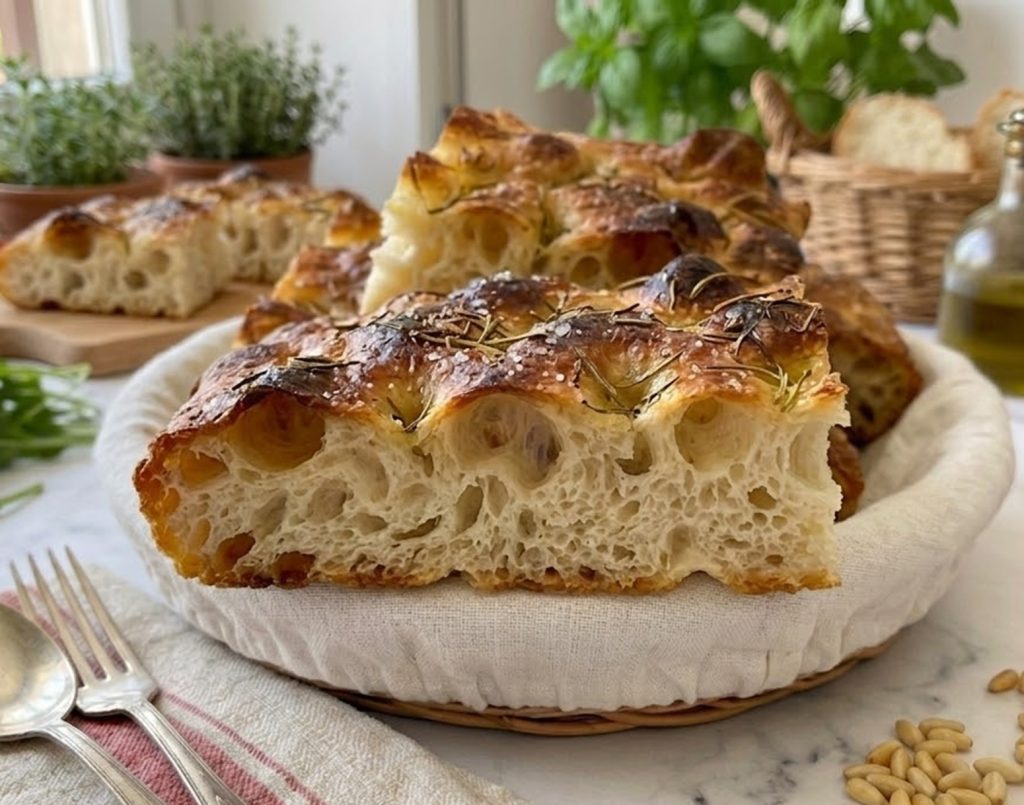
SOFT ROSEMARY FOCACCIA: TALL AND SOFT AS A CLOUD
There’s something deeply therapeutic about sinking your fingers into a risen, soft, living dough that smells wonderful even before it goes into the oven.
Making focaccia at home is not only a matter of recipes, but a ritual that transforms the kitchen into the most welcoming place in the world.
Imagine that unmistakable smell of rosemary and good olive oil starting to spread through the rooms, calling everyone to the kitchen before the pan is even ready.
This version is dedicated to those moments: a slow Sunday, a shared snack, or a family dinner where the bread becomes the true protagonist of the table.
The secret of this focaccia isn’t in complicated techniques, but in respecting the times and using a generous brine.
It’s a dough that asks only for a little rest to give you an incredible, almost ethereal softness, with a slightly crisp base that contrasts with a spongy, airy heart.
It’s the perfect “white canvas”: try serving it warm, maybe just opened and filled with a quality mortadella or a creamy cheese that melts on contact.
Every bite is a simple pleasure that reminds us how little is needed — flour, water and passion — to make an ordinary day special.
Make it for those you love, or simply to give yourself a cozy home-made treat.
- Difficulty: Medium
- Cost: Inexpensive
- Rest time: 3 Hours
- Preparation time: 10 Minutes
- Cooking time: 40 Minutes
- Portions: Pan Ø 10 1/4 in
- Cooking methods: Oven
- Cuisine: Italian
Ingredients for Soft Rosemary Focaccia
- 4 cups type 00 flour
- 1 1/4 cups water (room temperature)
- 1 1/3 tbsp extra virgin olive oil
- 4 g fresh brewer's yeast
- 1 tsp fine salt
- 2 tbsp extra virgin olive oil
- 1 tbsp water
- to taste rosemary (fresh)
- to taste flake sea salt (in flakes)
- to taste extra virgin olive oil
Tools
- Small bowl
- Mixer
- Bowl
- Plastic wrap
- Baking pan
- Small bowl
How to make soft focaccia at home
Crumble the fresh yeast into the room-temperature water and stir until completely dissolved. Pour the flour into the mixer bowl fitted with the hook. Add the yeast water and start mixing on low speed. Add the salt and finally the oil in a thin stream. Work for about 10 minutes until you obtain a smooth, homogeneous dough ball.
Lightly oil the work surface and turn the dough out onto it. Work it briefly with your hands to shape a perfect sphere. Transfer it to a bowl, cover with plastic wrap and let rise for 2 hours at room temperature, away from drafts.
Generously oil a pan about 2 in high. Take the risen dough, place it in the center and stretch it with your fingertips until it covers the entire surface. Cover again with plastic wrap and let it rise for one hour in the turned-off oven with the light on (about 77–82°F).
In a small bowl, vigorously mix the water and oil for the brine. Pick up the pan and, with your fingertips, press the surface to create the typical focaccia dimples. Evenly distribute the brine, the flaky salt and the rosemary needles.
Bake in a conventional (non-fan) preheated oven at 392°F for 40 minutes. Once golden on top, remove the focaccia from the oven, let it cool slightly and unmold. Serve it warm to fully enjoy its softness.
Ingredients: Notes and Substitutions
Flour: If you want an even stronger structure, you can replace 100 g (about 3/4 cup) of type 00 with Manitoba flour.
Yeast: If you use active dry yeast, you’ll need about 1/2 to 2/3 tsp.
Oil: Use a good quality extra virgin olive oil; as a starring ingredient, its flavor will make a difference.
Storage
The focaccia keeps for 1–2 days in a paper bread bag. You can also freeze it once baked: just warm it directly in the oven to bring back its crispness.
Tips and Variations
For an even more indulgent version, add halved cherry tomatoes or black olives into the dimples before baking. Once baked, try filling it with prosciutto crudo and squacquerone cheese!
FAQ (Questions & Answers)
1. Can I knead by hand?
Absolutely! It will just take a bit more elbow grease and time to achieve the same elasticity as the mixer, but the result will still be excellent.
2. Can I use a larger pan?
If you use a larger pan, the focaccia will be less tall. Adjust the baking time by reducing it a few minutes if the thickness is reduced.
3. Why do the dimples disappear after rising?
It’s important to make the dimples after the second rise in the pan, immediately before baking, so they remain well defined and hold the brine.
