
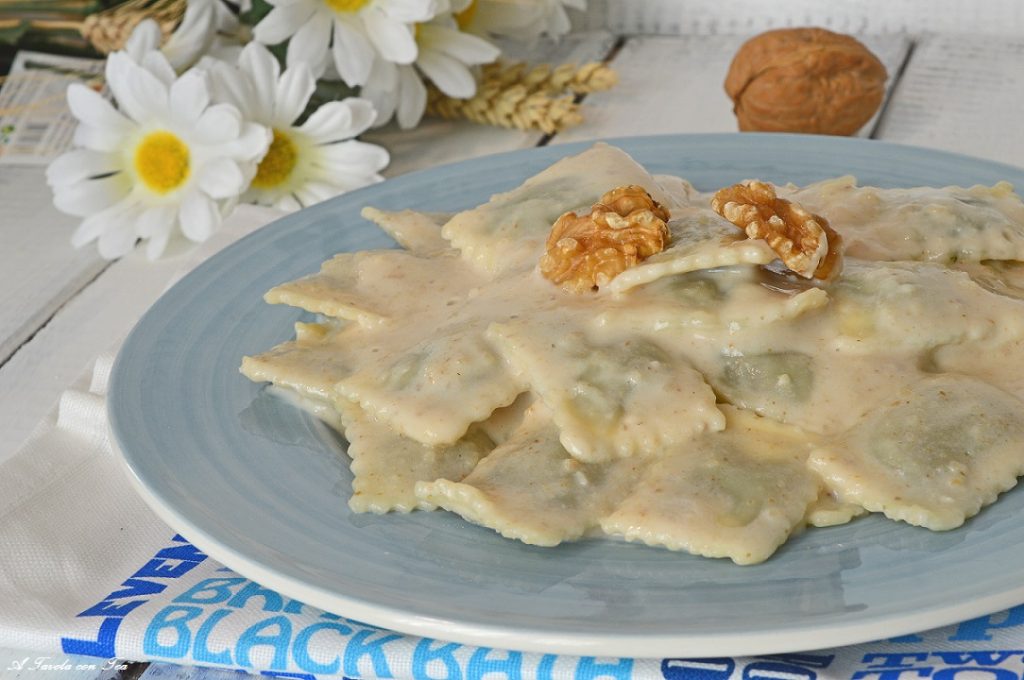
Often the simplest things are also the most delicious and that’s why today I decided to share the recipe for spinach and ricotta ravioli.
A lighter vegetarian alternative to classic meat ravioli. A dish that is delicate yet full of flavor. It may seem very complicated but in reality it only requires a bit of patience and a few rules to follow, and it’s definitely worth trying for the huge satisfaction of making filled pasta at home.
In Liguria, my region, they are a true specialty and are dressed either simply with butter and sage or, as we will see today, with the walnut sauce which, with its bold character, goes very well with the delicate filling.
It’s a dish I have always loved. It used to be Sunday lunch. I still remember how they melted in the mouth with a firm yet soft and delicate texture. My grandmother Lisetta used to make them for me; she was born and raised in Genoa, an excellent cook and an expert in all the secrets of Ligurian cuisine.
I must say that as an adult I rarely tasted ravioli as good as hers. Never would I have thought of attempting this preparation; nowadays who has time to make ravioli? It’s already something if I throw dried pasta into boiling water!
Then one day my mother accidentally found my grandmother’s notes, which among other recipes, mentioned her wonderful ravioli… the temptation was too strong. So I scheduled a day, bought the necessary ingredients and one Sunday morning I set to work following her instructions step by step.
To be honest, my grandmother’s will remain legendary; they were the best. Maybe because they were part of my childhood memories and I almost “mythologized” them, maybe because some people seem to have a magic wand in the kitchen and whatever they touch turns into a masterpiece. Even so, I must say that my ravioli were really good and I’m very satisfied with the results, so I decided to share my efforts with you.
Find a moment in your week to prepare them, it’s really worth it and they’re a great stress reliever to disconnect from the daily rush!
- Difficulty: Medium
- Cost: Inexpensive
- Preparation time: 1 Hour
- Cooking time: 3 Minutes
- Portions: 4 servings
- Cuisine: Italian
Ingredients
- 3 1/4 cups 00 flour (all-purpose flour)
- 4 whole eggs (about 3 oz (≈80 g) each)
- as needed re-milled semolina (semola rimacinata)
- 9 oz fresh spinach (about 8 cups fresh leaves (≈250 g))
- 1/2 cup cow's milk ricotta
- 1/2 cup Parmigiano Reggiano, grated (about 1.8 oz (≈50 g))
- as needed ground nutmeg
- as needed salt
Preparation
First of all, prepare the egg pasta dough that you will then fill with the spinach mixture. Follow all the instructions to make a perfect egg pasta sheet by clicking here The egg pasta: foolproof recipe for a perfect sheet
While the egg dough rests, prepare the filling. Wash the spinach and dry it with a cloth, then put it in a non-stick pan with a tablespoon of olive oil, cover with a lid and cook until softened (about 2 minutes). Remove from the heat, drain well and squeeze out the excess liquid, then set aside. In a bowl put the ricotta, the Parmigiano and a grating of nutmeg, season with salt and mix well with a spoon or whisk until well combined. Take the spinach, finely chop it in a food processor and then add it to the ricotta mixture, stirring to make it homogeneous. Set aside for filling the pasta.
Take the sheet that has now rested, divide it into two parts (keep the piece you’re not using wrapped in plastic so it doesn’t dry out), lightly flour it and begin to roll it out with the pasta machine starting from the widest setting and gradually moving to the second-to-last, narrower setting (it should be about 1 mm thick, ≈0.04 in).
Repeat the same for the remaining piece of dough. You can also roll it with a rolling pin, but since the sheet must be very thin, I don’t recommend it if you’re not particularly skilled.
Lay one sheet on a work surface lightly dusted with semolina and, using a teaspoon or a pastry bag, place small mounds of filling on the pasta spaced about 1 3/16 in (≈3 cm) apart.
At this point moisten the edges of the sheet with a little water, lay the second sheet over the first and press around the filling with your fingers to let out the air between one raviolo and another so they won’t open during cooking. Finally, use a pastry wheel to cut out your ravioli. You will obtain squares about 1 9/16 in per side (≈4 cm). Arrange them on a tray dusted with semolina so they do not stick to each other. Your ravioli are ready!!!
Bring salted water to a boil in a large pot, immerse the ravioli and cook until they float to the surface (about 3 minutes). Gently lift them out with a slotted spoon and dress with the walnut sauce (for the walnut sauce recipe click here WALNUT SAUCE) or more simply with butter and sage! Optionally sprinkle with grated Parmigiano. Enjoy!
Notes
Ravioli can be stored in the refrigerator for 2–3 days or in the freezer for up to 1 month. If you decide to freeze them, place them on a tray well spaced apart and when you want to use them cook them directly from frozen.
Tips for perfect ravioli:
1 – The dough should rest after being made to allow the gluten network to form.
2 – The sheet must be thin; if the sheets are too thick the result will be pasta with raw edges or an overcooked filling.
3 – The filling should be neither too wet nor too dry. To prevent it from being too wet it’s important to squeeze the greens well so they don’t release too much water, which is why it’s better to cook them in a pan rather than boiling them. If the filling is too dry add a little ricotta.
4 – To seal the edges well, brush the lower sheet’s edges with a wet brush before placing the top sheet.
5 – When closing the ravioli avoid leaving air inside because this will expand when heated by the boiling water and can burst the raviolo, causing the filling to spill out and water to enter.
6 – Cook them in water that is not boiling too vigorously, otherwise the water movement could cause the ravioli to open while cooking.
7 – Finally, once cooked do not pour them into a colander but lift them gently with a slotted spoon as you would do with gnocchi.
