
Traditional Moroccan Couscous: Recipe and Secrets of a Unique Dish
The Moroccan couscous, a dish that evokes exotic flavors and millennia-old traditions, is a culinary experience that wins the palate and warms the heart. This traditional recipe, with its harmony of spices, vegetables and meat, is a sensory journey to the heart of North Africa.
Couscous, originated in the Maghreb, is a symbol of conviviality and sharing, perfect for special occasions and family dinners. Its versatility makes it a beloved dish worldwide, with endless variations that reflect local traditions and tastes.
The original recipe calls for lamb, but you can customize your Moroccan couscous by choosing other meats such as chicken or beef, or opt for a vegetarian version rich in vegetables and legumes. In this guide, I will reveal the secrets to preparing an authentic couscous, with tips on ingredients, cooking techniques and creative variations. You will discover how to balance sweet and savory flavors, how to use spices to create an explosion of aromas, and how to adapt the recipe to satisfy every palate.
Whether you are a fan of ethnic cuisine or just curious, this recipe will allow you to bring to the table a dish rich in history and flavor, which will make you feel like you are in a true Moroccan riad. Get ready to experiment with flavors and textures, and to create an unforgettable couscous.
- Difficulty: Easy
- Cost: Medium
- Preparation time: 30 Minutes
- Cooking time: 2 Hours
- Portions: 8
- Cooking methods: Stovetop
- Cuisine: Italian
- Energy 662.89 (Kcal)
- Carbohydrates 86.80 (g) of which sugars 15.71 (g)
- Proteins 42.43 (g)
- Fat 18.78 (g) of which saturated 6.98 (g)of which unsaturated 9.30 (g)
- Fibers 6.52 (g)
- Sodium 511.91 (mg)
Indicative values for a portion of 250 g processed in an automated way starting from the nutritional information available on the CREA* and FoodData Central** databases. It is not food and / or nutritional advice.
* CREATES Food and Nutrition Research Center: https://www.crea.gov.it/alimenti-e-nutrizione https://www.alimentinutrizione.it ** U.S. Department of Agriculture, Agricultural Research Service. FoodData Central, 2019. https://fdc.nal.usda.gov
Traditional Moroccan Couscous Ingredients (for 4 people):
- 1.8 lbs lamb (shoulder or leg cut into large pieces, or substitute with chicken or beef)
- 3 cups raw couscous
- 2 onions (large, finely chopped)
- 3.5 cups butternut squash (butternut or delica, cut into cubes)
- 3 carrots (cut into thick rounds)
- 2/3 cup raisins (sultana)
- 1/3 cup almonds (peeled and toasted)
- 2 tbsp extra virgin olive oil
- 1 tsp ground ginger
- 1 tsp ground turmeric
- 1/2 tsp ground cinnamon
- 1/2 tsp saffron
- to taste salt
- to taste black pepper (ground)
- cups meat broth (or water — should cover the meat, about 3 to 4 1/4 cups)
- cilantro (fresh or parsley)
Tools
- Pot
- Bowl
- Kettle
- Couscoussier
How to prepare Couscous with vegetables and meat (lamb, beef or chicken)
This is the original Moroccan recipe for Vegetable Couscous with meat, which typically uses lamb but can easily be made with chicken or beef, or even as a vegetarian version without protein.
In a large pot (a tagine is ideal), heat the extra virgin olive oil. Add the chopped onions and sauté until translucent. Add the pieces of lamb and brown them on all sides to seal in the juices.
Add the spices to the pot: ginger, turmeric, cinnamon and saffron. Add salt and pepper. Mix well to flavor the meat.
Pour water or meat broth into the pot until it covers the lamb. Bring to a boil, then reduce the heat. Simmer for about 1 hour and 30 minutes, until the meat becomes tender.
Add the carrots and squash. Continue cooking for another 30 minutes, or until the vegetables are tender. 15 minutes before the end of cooking, add the raisins.
In a large bowl, pour the semolina couscous, add a pinch of salt and one tablespoon of extra virgin olive oil, and mix well with your hands to separate the grains. Pour boiling water (to speed up the process I use the Ariete Vintage KETTLE) over the couscous, in a volume equal to the couscous. Cover the bowl with a lid or a cloth and let rest for 5-10 minutes, or until the couscous has absorbed all the water.
Fluff the couscous with a fork, separating the grains. If you have a couscoussier, you can steam the couscous by placing it in the top part of the couscoussier and the broth with the lamb and vegetables in the bottom part.
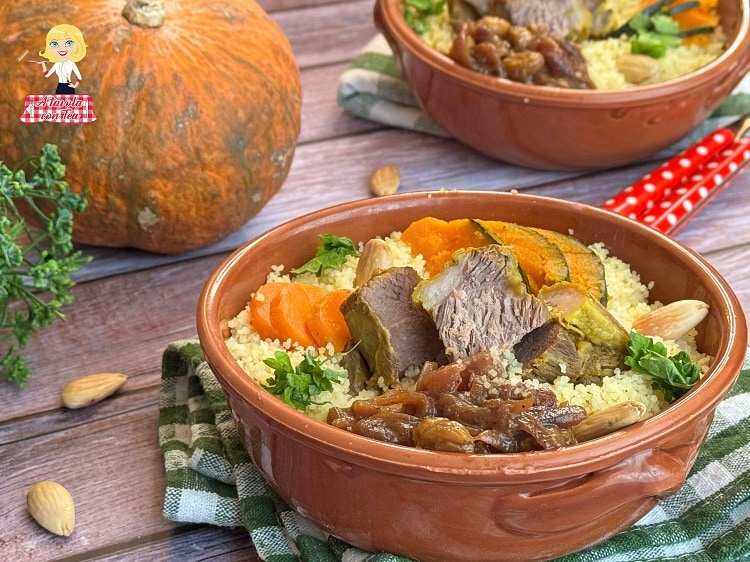
On a large, deep serving platter, spread the fluffed couscous. Create a well in the center and pour the lamb and vegetables with their broth into it. Garnish with toasted almonds and, if desired, parsley or fresh cilantro leaves. Serve hot.
Tips:
– For a more flavorful couscous, use homemade broth.
– Toast the almonds in a pan to enhance their flavor.
– Add a pinch of saffron for more intense color and aroma.
– For a stronger flavor, add ground cinnamon.
– Use butternut squash for this recipe, as it is the most suitable type.
– For a more robust flavor, you can use “ras el hanout”, a Moroccan spice blend.
– You can add other seasonal vegetables, such as zucchini, eggplant or peppers; some people add chickpeas.
– For a sweet-and-sour touch, add dried plums or apricots.
Storage Tips for COUSCOUS:
Refrigerator storage: Moroccan couscous keeps in the refrigerator for up to 2-3 days. Store the couscous and the sauce separately in airtight containers. Before serving, reheat the couscous and the sauce separately, adding a little broth or water if necessary.
Freezing: Cooked couscous can be frozen, but the texture may be slightly different after thawing. The lamb and vegetable sauce freezes well. Freeze couscous and sauce in individual portions in airtight containers. Thaw couscous and sauce in the refrigerator or in the microwave.
Additional tips: If you only have leftover couscous, you can use it to make salads or stuffings. If you only have leftover sauce, you can use it to dress other pasta or rice. It’s advisable to keep the cooking broth, as it can be used to reheat the couscous and for many other preparations.
Traditional Moroccan Couscous Variations:
Vegetarian couscous: Replace the lamb with chickpeas, lentils or mixed vegetables. Use vegetable broth instead of meat broth.
Fish couscous: Add fish such as cod, grouper or shrimp. Use fish broth and spices like saffron.
Chicken couscous: Replace the lamb with chicken, cut into pieces. Add olives and preserved lemon for a sweet-and-sour flavor.
Sweet couscous: Prepare couscous with milk, sugar and dried fruit. Add cinnamon and orange blossom water for a fragrant touch.
Spiced couscous: Add a spice mix called ras el hanout. Add harissa for a spicy kick.
SPICES: WHICH ONES TO USE
Spices are the soul of Moroccan couscous. Ginger gives a spicy, aromatic touch; turmeric provides color and an earthy flavor; cinnamon adds a sweet and enveloping note; and saffron gives an intense aroma and golden color.
COUSCOUS Cooking Techniques:
The tagine, with its conical shape, allows slow and even cooking, enhancing the flavors of the ingredients. The couscoussier, on the other hand, ensures steaming the couscous, making it fluffy and light.
PRESENTATION TIPS FOR COUSCOUS:
For a dramatic presentation, arrange the couscous on a large, deep serving dish, forming a mound. Arrange the vegetables and meat around the couscous, and garnish with toasted almonds and fresh cilantro.
NUTRITIONAL VALUES FOR COUSCOUS WITH MEAT AND VEGETABLES:
Moroccan couscous is a balanced dish, rich in carbohydrates, proteins, fiber and vitamins. Lamb provides protein and iron, vegetables supply vitamins and minerals, and raisins and almonds add fiber and antioxidants.
History and Origins of Couscous
Couscous is a symbolic dish of North African cuisine, with roots lost in time. Originating in the Maghreb, it spread throughout North Africa and became a fundamental element of local culinary culture.
In Morocco, couscous is a convivial dish, often served during celebrations and festivals. The version with lamb and vegetables is one of the most traditional, enriched with sweet and spiced flavors such as raisins and almonds.
FAQ (Questions and Answers)
How do you prepare couscous to make it fluffy and light?
The secret is to properly hydrate the couscous with boiling water, fluff it with a fork and, ideally, steam it in a couscoussier.
Which spices are used in Moroccan couscous?
The typical spices are ginger, turmeric, cinnamon and saffron, which give the dish its characteristic flavor.
Can I make Moroccan couscous in a vegetarian version?
Absolutely yes! You can replace the lamb with legumes such as chickpeas or lentils, and use vegetable broth instead of meat broth.
