
Trapanese Pesto: The original recipe, easy and quick
When you talk about pesto, your mind immediately goes to Liguria, its intensely fragrant basil and the unmistakable aroma that fills the kitchen.
But Italy is a kaleidoscope of flavors, and Sicily gives us an equally extraordinary variant, perhaps even richer and more enveloping: Trapanese pesto.
Born in one of the most fascinating towns in western Sicily, this condiment tells the story of cultural exchanges and sun-kissed ingredients.
Less known than its Ligurian cousin, Trapanese pesto has a unique character: rustic and deeply Mediterranean.
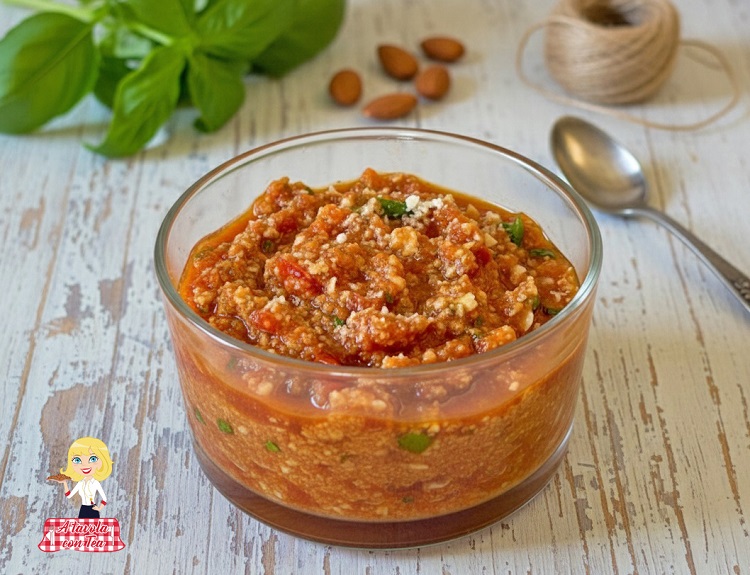
Its strength is not in a perfectly smooth texture but in a lively, grainy consistency where every ingredient is present.
Unlike Genoese pesto, here the true protagonist is the fresh tomato, which together with almonds, basil, garlic and pecorino creates a harmony of flavors that evokes the sea, the sun and tradition.
There is nothing complicated about its preparation—quite the opposite. With a few steps and the right ingredients, you’ll bring a piece of Sicily to the table, transforming a simple plate of pasta into an unforgettable sensory experience.
And believe me, once you try it, you won’t be able to do without it. It’s the perfect sauce for a summer dinner, a quick but flavorful lunch, or simply to surprise friends with an authentic and unexpected taste.
- Difficulty: Very easy
- Cost: Inexpensive
- Preparation time: 10 Minutes
- Portions: 4
- Cooking methods: No-cook
- Cuisine: Italian
Ingredients TRAPANESE PESTO
- 9 oz (about 1 1/3 cups) tomatoes (pizzutelli or ripe perini)
- 1.75 oz (about 1/3 cup) almonds
- 2 cups packed (about 1.8 oz) basil
- 1 tbsp Sicilian pecorino
- 1 clove red garlic (or regular garlic)
- to taste extra virgin olive oil
- 1 pinch black pepper
- to taste salt
Tools
- Kitchen scale
- Small saucepan
- Blender
Procedure TRAPANESE PESTO
For a smoother texture, blanch the tomatoes: wash them, make a small cross at the base and plunge them for 2 minutes into boiling water. Drain, peel and gently squeeze to remove seeds and excess liquid. Keep only the pulp. If you prefer a more rustic pesto, you can skip this step.
If you bought almonds with the skin on, put them in boiling water for 3 minutes. Drain and peel them easily by rubbing between thumb and forefinger. Grate the pecorino and clean the basil, but don’t wash it under running water to avoid damaging it: a damp cloth is enough. Finally, peel and slice the garlic.
This is the method that delivers the most authentic flavor. Start pounding the almonds in a marble mortar with a wooden pestle. Once they reach a grainy texture, add the tomatoes, then the garlic and finally the basil. Continue pounding with decisive blows, without scraping, until you obtain a homogeneous but rustic mixture.
If you don’t have a mortar, use a small food processor. Use the “pulse” function to avoid overheating the ingredients and ending up with a too-liquid consistency. Put the almonds in first, then add the other ingredients one by one as in the traditional method. Pulse intermittently, stopping often to check the texture. The goal is a grainy pesto, not a smooth sauce.
Once you have the desired consistency, add the grated pecorino, a drizzle of extra virgin olive oil, salt and pepper. Mix well and taste to adjust the flavors. The oil should bind the ingredients, not make the pesto watery.
Notes on Ingredients and Substitutions
The quality of the ingredients is fundamental for the success of the pesto.
Tomatoes: Use ripe, meaty tomatoes like pizzutelli or perini. Their sweetness and texture are ideal. If you can’t find them, you can use datterini or cherry tomatoes, but the flavor may be slightly less intense.
Almonds: Avola almonds are ideal for their rich flavor. If you’re in a hurry, use already-shelled almonds. If you have time, blanch them yourself: the flavor will be even fresher.
Garlic: Red garlic has a milder, less intrusive taste than common garlic, but if you can’t find it regular garlic is fine.
Pecorino: Sicilian pecorino is the authentic choice, with its savory taste that perfectly balances the sweetness of the tomato. If you can’t find it, you can use another aged pecorino, but the final flavor will change.
Storage
Trapanese pesto keeps in the refrigerator for 2-3 days. Put it in a clean glass jar and cover the surface with a thin layer of oil to prevent oxidation. You can also freeze it in ice cube trays or in small single-portion containers to have it on hand.
Alternatives and Variations
Vegan pesto: Replace the pecorino with 10 g of nutritional yeast flakes or with an extra handful of toasted cashews for a “cheesy” and creamy taste.
Adding ricotta: For a creamier and milder pesto, add 2 tablespoons of fresh sheep ricotta.
Spicy pesto: For a little kick, add a small fresh red chili or a pinch of chili powder during pounding.
Uses and Pairings
Trapanese pesto is traditionally paired with busiate, a typical Trapani pasta shape. But it’s also excellent with spaghetti, linguine or fusilli. It’s perfect as a topping for bruschetta, to flavor a rice salad or a tomato salad, or to accompany steamed white fish.
Origins and History of the Recipe
Trapanese pesto, or agghiata trapanisa, has ancient origins linked to the port of Trapani. It is said to have been born from the meeting between Genoese sailors, who brought with them the tradition of their garlic-and-basil pesto, and the typical ingredients of Sicily: tomatoes, almonds and pecorino. Trapanese pesto is therefore the result of this cultural fusion, a dish that tells of maritime routes, commercial exchanges and the richness of Sicilian culinary tradition.
FAQ (Questions & Answers)
1. Can I use sun-dried tomatoes?
No, the original recipe and its flavor depend on the use of fresh, ripe tomatoes. The acidity and sweetness of fresh tomato are essential to balance the taste of the garlic and almonds.
2. Why did my pesto turn dark?
Most likely your pesto oxidized due to contact with air. To prevent this, add a little lemon juice and always cover the surface with a layer of extra virgin olive oil before storing it in the fridge.
3. Can I use an immersion blender?
It is not recommended. An immersion blender tends to heat the ingredients and make the pesto too creamy and smooth, losing the rustic, grainy texture that distinguishes it. The ideal is a small food processor with the “pulse” function.
