
Veal Stew with Mushrooms: The Secret to Tender Meat and a Smooth Sauce
With the arrival of the cold months, the desire for a good comfort food that envelops with its warmth becomes irresistible. And it is precisely in these moments that veal stew with mushrooms becomes a protagonist.
This recipe is not complex, but the problem in this dish is twofold:
Dry Meat: The meat must be tender and melt in the mouth, not hard or stringy.
Lumpy Sauce: The flour used to coat the meat often creates lumps or causes the bottom to stick, making the sauce less smooth.
I’ll reveal the secrets for a perfect result, which you can achieve using any type of mushroom you have available, fresh or frozen:
Dry Coating: After coating the meat with flour, you must remove the excess flour with a sieve before browning. This is crucial to prevent lumps and achieve a smooth sauce.
Slow Cooking: The secret to tender meat is slow cooking for 1 1/2 – 2 hours, over very low heat with the pot covered. This breaks down the fibers and allows the collagen to dissolve, creating the thick and flavorful sauce that envelops the meat.
This is a rich and satisfying main course, ideal for family lunches or a special dinner.
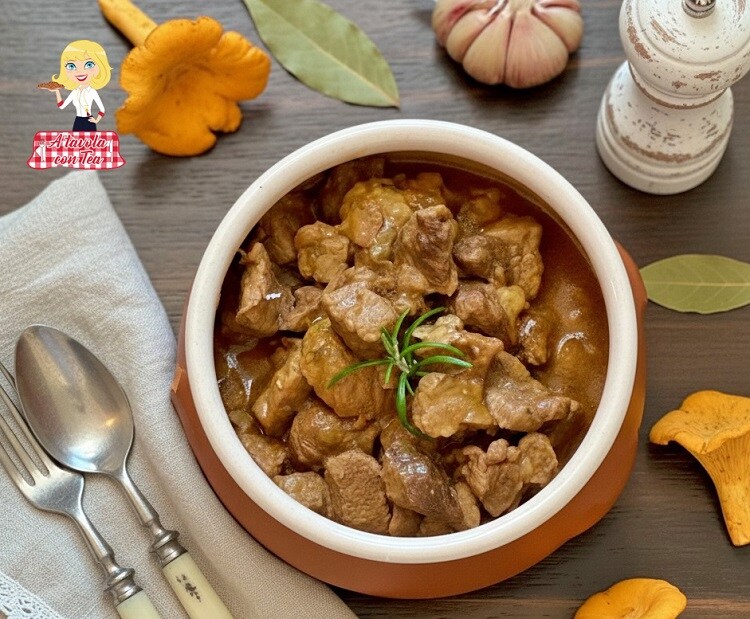
- Difficulty: Easy
- Cost: Medium
- Preparation time: 20 Minutes
- Portions: 4
- Cooking methods: Stovetop
- Cuisine: Italian
Ingredients for 4 People
- 1.75 lbs veal (neck, chuck, shoulder cut into 1.25-inch cubes)
- 6 tbsp butter
- 2 leaves bay
- 1 sprig rosemary
- garlic (1 or 2 cloves whole or slightly crushed)
- 10.5 oz mushrooms (chanterelles or other fresh or frozen mushrooms)
- 2.7 tbsp extra virgin olive oil
- 2 cups vegetable broth
- 2/3 cup dry white wine
- to taste all-purpose flour (For coating the meat)
- to taste salt
- 1 pinch black pepper
Tools
- Food scale
- Casserole
- Sieve
Procedure VEAL STEW WITH MUSHROOMS
In a large pot or a high-sided casserole, combine the extra virgin olive oil and 3 tablespoons of butter. Heat over medium flame. Add the garlic cloves, rosemary sprig, and bay leaves. Let them sauté gently for a couple of minutes, just enough time for the aromas to be released. Now add the mushrooms (already cleaned and cut if necessary) and sauté them over high heat for 3-4 minutes until they have lost their water and are slightly golden. Once ready, remove them from the pan and set them aside: we will add them later.
Cut the veal into cubes of about 1.25 inches. Pass them in flour, making sure it adheres well on each side. It is important to remove the excess flour with a sieve or colander to prevent lumps and achieve a smooth sauce. In the same pot where you cooked the mushrooms, add the remaining 3 tablespoons of butter. When the butter is hot, add the floured veal pieces. Brown them over high heat, turning them often, until they are well golden on all sides and all the juices released by the meat have been reabsorbed. This step is crucial to seal the flavors.
At this point, deglaze the stew with the white wine, letting the alcohol evaporate completely. Once evaporated, add the mushrooms that you had set aside and the hot vegetable broth. Adjust with salt and freshly ground black pepper to taste. Bring to a boil, then lower the flame to the minimum, cover the pot with a lid, and let the stew cook for about 1 1/2 – 2 hours. Remember to stir occasionally to prevent sticking at the bottom and ensure even cooking. The meat must be very tender.
When the meat is tender and the sauce is thick to the right point, turn off the flame. Taste and adjust with salt and pepper if necessary. Before serving, remove the rosemary sprig and bay leaves (and the garlic cloves if you left them whole). Serve your veal stew with mushrooms hot, perhaps accompanying it with your favorite side dish.
Notes on Ingredients and Possible Substitutions
Meat: For stew, cuts like neck, chuck, shoulder, or veal neck are perfect because they become very tender with slow cooking. You can also use beef if you prefer, keeping in mind that cooking times may be slightly longer.
Mushrooms: Chanterelles give a unique and slightly wild flavor. Alternatively, you can use porcini mushrooms (fresh or dried rehydrated) for a more intense taste, or a mix of button mushrooms and honey mushrooms for a more economical but still flavorful option.
Broth: Vegetable broth is the best choice. If you do not have it ready, you can use a good granular broth, but be careful with the salt.
Flour: All-purpose flour is used to create an outer crust on the meat that retains the juices and helps thicken the sauce. For a gluten-free version, you can use cornstarch or rice flour.
Storage
Mushroom stew is one of those dishes that, like good wine, improves the next day! You can store it in an airtight container in the fridge for 2-3 days. To reheat it, I recommend doing it over a very low flame in a casserole, adding a little broth if the sauce is too thick. It also freezes well: portioned in suitable containers, it can be kept for about 1-2 months.
Alternative and Creative Variants
Stew with Potatoes: If you want a unique dish, you can add diced potatoes (about 300-400 g) in the last hour of cooking. They will absorb the flavors of the sauce becoming delicious.
Aromatic with Thyme and Juniper Berries: For a more forest flavor, replace the rosemary and bay with a fresh thyme sprig and 4-5 slightly crushed juniper berries, to add together with the liquids.
With Cream (Extra dose): For a creamier and more enveloping version, at the end of cooking (after turning off the flame), you can add 50 ml of fresh cooking cream or sour cream, mixing well to combine.
Perfect Uses and Pairings
Chanterelle mushroom stew is a substantial main course that lends itself to various pairings:
Classic Sides: It is delicious with creamy mashed potatoes, a bed of steaming polenta, or boiled or baked potatoes.
Seasonal Vegetables: Accompany it with a simple green salad or steamed vegetables to balance the richness of the dish.
Wine: It pairs wonderfully with a medium-bodied red wine, such as a young Nebbiolo, a Barbera, or a Chianti Classico.
Origins and History of a Timeless Dish
Stew is an ancient dish, present in countless culinary cultures worldwide. It arises from the need to use less noble cuts of meat, making them tender and flavorful through a long and slow cooking process. The “mushroom” version is particularly widespread in the cuisines of Northern Italy and Central Europe, where the forests offer an abundance of wild mushrooms, enriching the dish with their unique aromas. It is a true tribute to “grandmother’s cooking,” which with few ingredients and a lot of patience knows how to create masterpieces of taste.
Extra Tips for a Chef’s Stew!
Quality of the meat: Do not be afraid to ask your butcher for a specific cut for stew; he will be able to advise you best to ensure tenderness.
Perfect Browning: Do not rush to brown the meat! This is the key step to seal the flavors and create that delicious crust that will make your stew irresistible. Do not overcrowd the pan; if necessary, brown in two or more batches.
Cooking times: The times are indicative. The true test is the tenderness of the meat: it has to melt in the mouth. If after 2 hours it is not yet at the right point, continue cooking over low heat until it is.
FAQ (Questions and Answers)
1. Can I use frozen mushrooms for this recipe?
Yes, you can use frozen chanterelles (or other mushrooms). It is not necessary to thaw them beforehand: add them directly to the pan from frozen and let them cook over high heat until they have released and reabsorbed their water.
2. How can I make the sauce thicker if it seems too liquid?
If at the end of cooking the sauce is too liquid, you can remove a ladle of broth, let it cool slightly and stir in a scant teaspoon of flour or cornstarch. Then add this mixture to the sauce and stir over low heat for a few minutes until it thickens.
3. Is it possible to prepare the stew in advance?
Absolutely yes! Stew is one of those dishes that gains flavor if prepared the day before. Once cooked and cooled, store it in the refrigerator. Reheat it slowly over low heat before serving, adding a little broth or water if necessary.
