
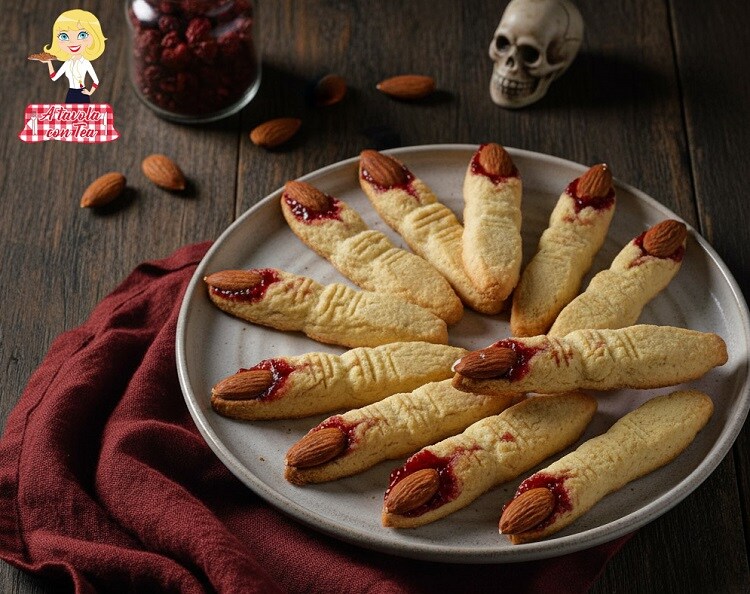
Witch’s Fingers Cookies: the terrifyingly perfect recipe for Halloween
If there is a dessert that embodies the spirit of Halloween, it’s them: the Witch’s Fingers!
These cookies are the spooky fun finger food that cannot be missing from your October 31st table.
The great thing is that beyond the macabre and creepy appearance hides a simple and delicious crumbly vanilla shortcrust pastry.
An ideal recipe for those who want to combine visual impact with a guaranteed result.
No weird ingredients are needed, just the classic shortcrust, enriched by a touch of vanilla for an enveloping scent. The real fun is in the modeling.
I’ll guide you step by step to create the bony effect and skin folds so that they look like real severed fingers.
The final touch, which makes the difference, is the bloody effect: the simplicity of raspberry or strawberry jam on the “cut” part is a genius trick that makes everything more realistic and delicious.
This sweet is perfect to prepare with children, who will have a blast modeling the fingers and scaring friends.
Don’t be fooled by their appearance: they’re so good they’ll disappear from the tray before you can say “trick or treat!”
- Difficulty: Easy
- Cost: Very cheap
- Rest time: 45 Minutes
- Preparation time: 20 Minutes
- Portions: 6/8
- Cooking methods: Oven
- Cuisine: Italian
Ingredients (Yields about 20 witch’s fingers)
- 2 1/4 cups all-purpose flour
- 1/2 cup butter
- 1/2 cup powdered sugar
- 1 egg (+ 1 yolk for brushing)
- 1 pod vanilla
- salt (a pinch)
- 20 almonds
- to taste raspberry jam (for the blood effect)
Tools
- Kitchen Scale
- Bowl
- Parchment Paper
- Baking Tray
- Knife
- Brush
WITCH’S FINGERS PROCEDURE
In a bowl (or a stand mixer with the paddle attachment), combine the cold butter cut into pieces and the flour. Add the seeds scraped from the vanilla pod and the salt. Quickly work with your fingertips, crumbling the dough until it resembles wet sand (sanding method). Add the whole egg and the powdered sugar. Continue to mix until the dough comes together.
Transfer the dough to a work surface, briefly knead it to compact and form a dough ball. Wrap it in plastic wrap and let it rest in the refrigerator for at least 30 minutes. This rest is essential for crumbliness.
Take small pieces of dough about 25–30 grams each to get about 20 sticks (the size is important for the final effect). Shape each piece into a stick and, to create bony knuckles, pinch the dough in two or three places to make it “bony”. With a blade or the back of a knife, make thin stripes in the folded area to simulate skin wrinkles.
Brush one of the stick’s ends with the egg white (kept aside). Apply a whole almond pressing lightly; it will be the nail. Finish the opposite edge to the almond with the blade to give it the appearance of a cut or severed finger. Arrange the cookies on a tray lined with parchment paper.
Brush all the fingers with the egg yolk (which you have saved), diluted if necessary with a drop of water or milk. Brush the severed part with a bit of raspberry jam for the “bloody” effect. Tip: Let the cookies rest in the refrigerator for another 15-30 minutes. This is not essential but helps to fix the shape before baking.
Bake in a static oven, already hot at 350°F, for about 20–30 minutes. The time varies depending on the thickness; the fingers must be golden and dry. Remove from the oven and let cool completely. Now you just need to scare everyone!
Notes on Ingredients and Substitutions
Butter: Cold butter is essential for the sanding method, which ensures maximum crumbliness. If you prefer soft (whipped) shortcrust, use butter at room temperature.
Egg (Weight): The precise dose is 55 g (one medium egg). To be sure, beat the egg and measure its weight: the perfect hydration of the shortcrust depends on this!
Jam: Raspberry Jam is the best for the bloody effect because it’s shiny, dark red, and dense. You can substitute it with Cherry Jam or red icing with food coloring.
Almonds: Whole peeled almonds create the most realistic nail. You can substitute them with sliced almonds for a thinner nail or whole cashews for a more “skeletal” effect.
Storage
Witch’s Fingers can be stored in a tin box or in an airtight container at room temperature for 7-10 days. They are moisture-resistant.
For maximum visual effect, add the raspberry jam (the “blood” effect) after baking. If you add it before, the jam will caramelize.
Creative Alternatives and Variants
Monstrous Cocoa Fingers: Replace 30 g of All-purpose Flour with 30 g of Unsweetened Cocoa Powder sifted. You will get dark fingers, perfect for a “zombie” effect.
Autumn Spiced Fingers: Add 1 teaspoon of Cinnamon and 1/2 teaspoon of Ground Ginger to the dough for a warm scent and a more complex flavor.
Colored Nails: For a “fashion” witch touch, use a few drops of green or purple food coloring to dye part of the shortcrust and make colored icing nails (powdered sugar + water + coloring) instead of almonds.
Usage and Pairings
These cookies are the absolute stars of the Halloween buffet:
Scenic Presentation: Display them on a tray covered with cotton wool (simulating a spider web) or directly in a bowl full of “dirt” (crumbled chocolate cookies) for an even more macabre effect.
Beverage Pairings: Perfect with red non-alcoholic punch (to stay on the “blood” theme), with thick hot chocolate for the little ones, or with a glass of spiced Mulled Wine for adults.
Origins and History of the Recipe
Witch’s Fingers cookies are a relatively modern phenomenon, but the concept of using sweets to represent the macabre is linked to the Celtic tradition of Samhain (the ancestor of Halloween) and the theme of playful fear. They don’t have a centuries-old tradition like Carnival sweets, but they were born from American creativity in the late 1990s and early 2000s, quickly going viral thanks to themed recipe books and, later, social media. They are a perfect example of how food styling can turn a simple shortcrust into a global thematic icon.
FAQ (Frequently Asked Questions)
1. The shortcrust sticks and deforms, what do I do?
The dough is too warm. If it sticks, it means the butter is melting. Put the shaped dough in the freezer for 10 minutes before baking. Another trick is to lightly flour your hands during modeling.
2. The almonds detach during baking, why?
This happens if the almond was not attached well or if the shortcrust hasn’t rested enough. Ensure you press the nail well and use egg white as glue. Resting in the fridge before baking (Step 5) helps to fix them.
3. If I don’t have powdered sugar, can I use granulated sugar?
It is not recommended. Powdered sugar makes the shortcrust much more crumbly and melt-in-the-mouth (because it blends better with the butter). Using granulated sugar will make the shortcrust more compact and less delicate. If you must, grind the granulated sugar to make it as fine as possible.
