Step-by-step tutorial on how to deamidate rice to reduce its glycemic impact.
Before starting, a question I often receive:
Should deamidation be done for all types of rice?
In cases of hyperglycemia, prediabetes and diabetes it is always recommended.
It helps reduce the amount of starch available for rapid absorption with an attenuated glycemic impact.
Some rice varieties, even if cooked for a long time, tend to remain hard and tenacious in the center: deamidation reduces cooking times and improves texture.
The rice and risotto recipes on the blog include and describe the deamidation process.
You might be interested in:
- Difficulty: Easy
- Cost: Budget-friendly
- Rest time: 2 Hours
- Preparation time: 10 Minutes
- Cuisine: Italian
Ingredients
- rice (low glycemic index)
Soak in cold water for about 2 hours – for basmati rice 30 minutes is enough.
Suggested tools
- Mixing bowl
- Strainer
Preparation
Using a fine-mesh sieve:
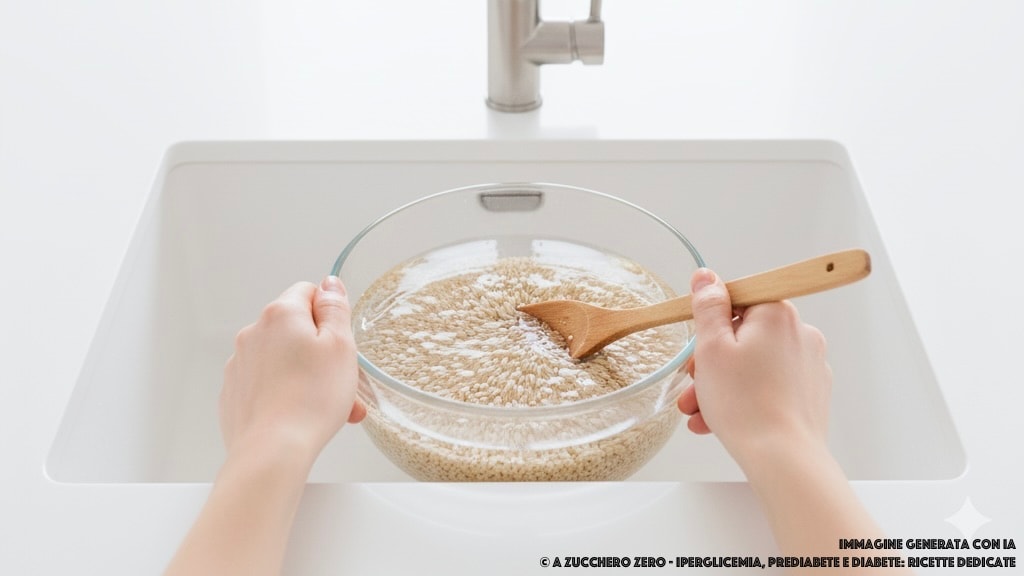
1. rinse the rice under running water, rubbing the grains between your hands until the water runs clear and transparent;
2. soak it in cold water for about 2 hours – for basmati rice 30 minutes is enough – stirring occasionally and changing the water at least a couple of times;
3. finally, rinse again and drain thoroughly before cooking.Source: Dr. Anna Chiara Ragone, nutritionist biologist.
If you taste a grain you’ll get the sensation of eating par-cooked rice.

Remember that deamidation reduces cooking times; taste the rice a few minutes before the time indicated on the package.
Risotto
1) deamidate the rice;
2) toast it or, more correctly, warm it: it’s already hydrated, so it won’t heat like raw rice — this is normal;
3) deglaze with white wine, add the broth [the rice is already hydrated and will not absorb much] – or the sauce – ladle by ladle, stirring until absorbed as in a traditional risotto.Alternatively
1) deamidate the rice;
2) cook the rice in lightly salted water;
3) prepare the sauce – in a pot or in a pan;
4) combine the deamidated, cooked rice with the sauce and mix well or sauté in a pan, depending on the recipe.In any case, remember to check your blood glucose response!
The creaminess of a risotto depends on the starch present in the rice and on the final finishing (mantecatura).
So, to obtain a creamy texture it is necessary to “compensate” for the lack of starch [desired and due to deamidation] by intervening in the final finishing.
The final finishing of the risotto is done by adding a fatty element [butter or oil, preferably cold] and stirring vigorously with the heat off.In cases of hyperglycemia, prediabetes and diabetes butter is usually not recommended, but if your meal plan allows it you will find the indication below.
Finishing risotto without butter
To create the creamy sauce add at the end of cooking a cold ingredient of your choice from:
– extra virgin olive oil added raw [for a creamier result, use frozen cubes of extra virgin olive oil];
– 1–2 tablespoons of light spreadable fresh cheese, for example cottage cheese, ricotta, cream cheese (Philadelphia);
– 1–2 tablespoons of grated cheese or nutritional yeast flakes [vegan];
– 1–2 tablespoons of 100% nut butter [for example peanut or almond butter] or 1 tablespoon of tahini [sesame seed paste];
– vegetable creams and purees [browse the blog recipes];
– 1–2 tablespoons of legume puree [for example blended cannellini beans];
The temperature contrast between the boiling broth with which the risotto is soaked and the cold ingredient results in better creaminess.If, instead, your meal plan includes butter, at the end of cooking you can add:
– 1 teaspoon or a small pat of cold butter [even better if slightly frozen].After finishing, let the risotto rest covered for 2–3 minutes.
This step helps the flavors blend and further improves the texture.This way, even without the necessary starch, you can obtain a creamy, cohesive risotto that is light and pleasant to eat.
Storage, tips and variations
Storage
You can store cooked rice in the refrigerator in a closed container for 1–2 days.
Do not leave par-cooked or cooked rice at room temperature for more than 1–2 hours [to prevent growth of the bacterium Bacillus cereus, which can cause food poisoning].
Tips and variations
Start the meal with a generous portion of raw or cooked vegetables and pair the rice with fiber, lean proteins and healthy fats to slow carbohydrate absorption.
Browse the rice and risotto recipes on the blog.