Low-glycemic, high-fiber turmeric bread
I used the Molino Spadoni low glycemic mix blended with type 2 and wholemeal flours.
No sponsorship.
This content is not the result of a collaboration with the brand.
The dough for turmeric bread is a versatile base to prepare different kinds of bread.
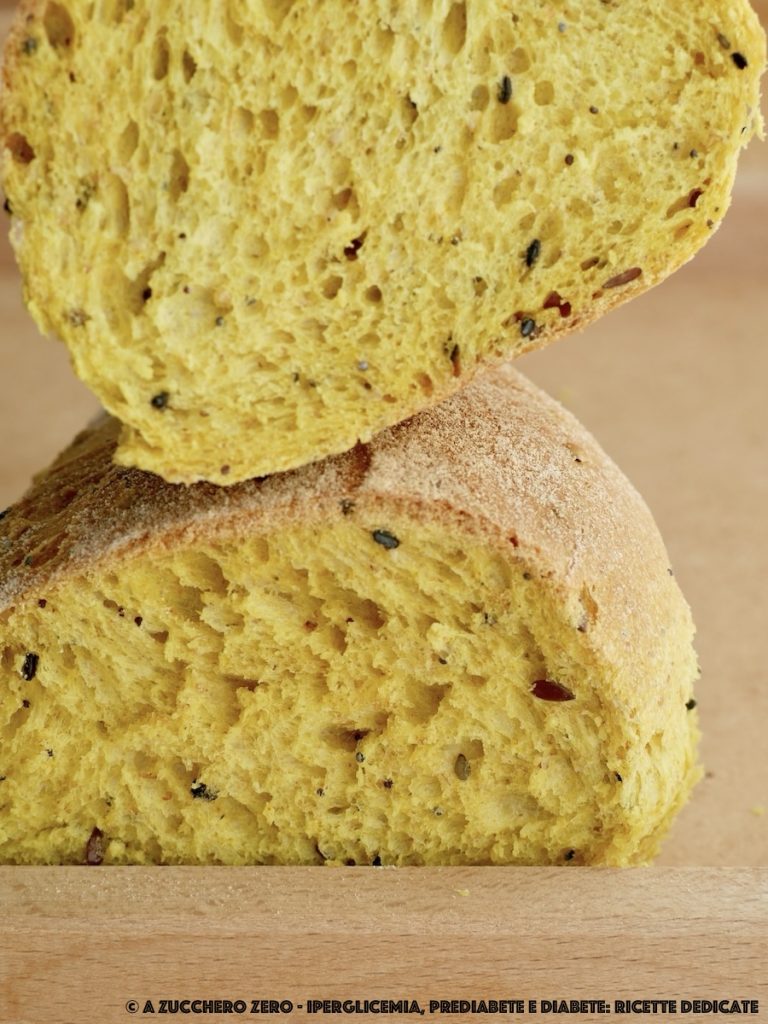
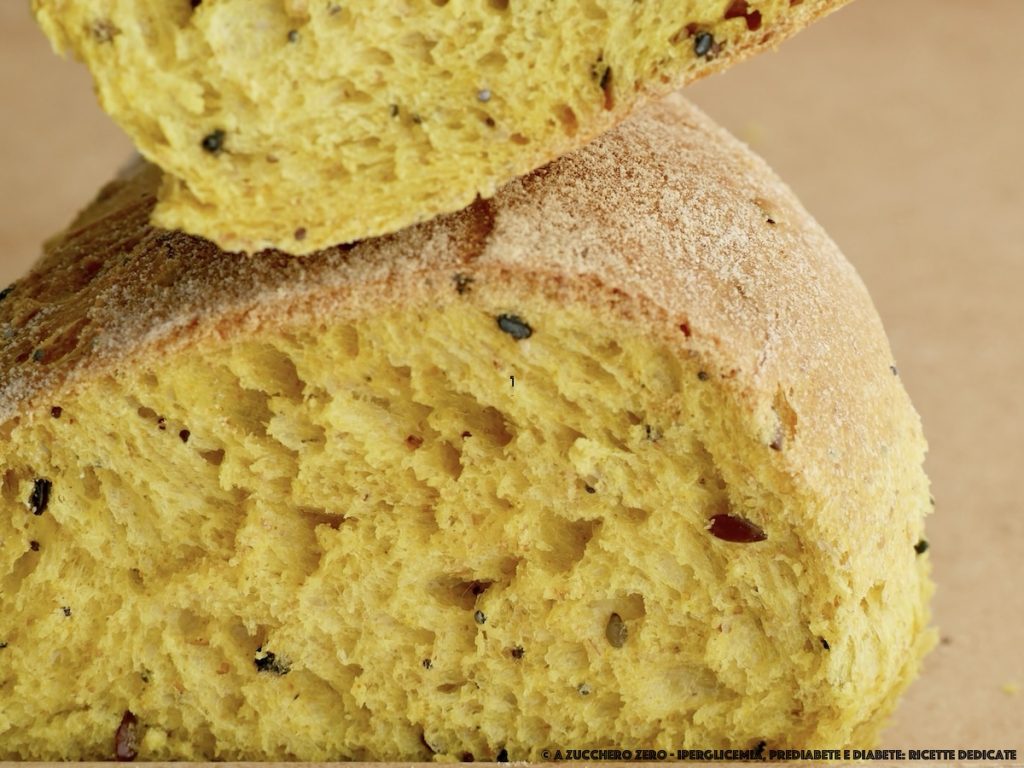
I made turmeric bread with mixed seeds.
Crispy crust, soft interior almost like a brioche.
Turmeric gives a delicate aroma while keeping a neutral taste.
Suitable for both savory and sweet uses.
Turmeric bread using the poolish method | recipe with a bread machine
Below you will find the procedure both with a bread machine and without one.
- Difficulty: Facile
- Cooking methods: Macchina del pane, Forno elettrico
- Cuisine: Italiana
Ingredienti
- 1 1/4 cups water
- 1/4 tsp dry yeast (Mastro Fornaio PANEANGELI)
- 2 1/2 cups low glycemic index flour (Molino Spadoni mix)
- 3 1/3 tbsp water
- 1 2/3 cups type 2 flour (Molino Spadoni)
- 3/4 + 1 tbsp cups wholemeal flour (Molino Spadoni)
- 1 tbsp turmeric powder
- 2 tsp extra virgin olive oil
- 1 tsp salt
- to taste mixed seeds (about 2–3 tbsp seed mix for bread: flax, poppy, white sesame (20–30 g))
- to taste flour (or semolina)
As an alternative to 1 g of dry yeast you can use:
– 3 g fresh brewer’s yeast;
– 4 g dried sourdough starter.
Suggested tools
- Bread machine Imetec Zero Glu or another model
- Measuring cup graduated glass
- Kitchen scale digital
- Measuring spoon scale spoon scale
- Measuring spoons measuring spoons set
- Spatula silicone
- Pastry cutters / scrapers
- Workboard / cutting board kneading board
Preparazione
This recipe can be reproduced with any model of bread machine, stand mixer or dough mixer because the actions and durations of the different phases are detailed; compare programs before starting the recipe.
Prepare the ingredients for the poolish:
– 1 1/4 cups (300 ml) of room temperature water;
– about 1/4 tsp dry yeast;
– 2 1/2 cups (300 g) of low glycemic mix.From the 300 ml (1 1/4 cups) of water, warm a small portion: about 50 ml (approx. 3 1/3 tbsp), it should be lukewarm, not hot.
Pour it into a small bowl, add and dissolve the yeast.
* From experience I found it’s not necessary to add sugar to activate it.POOLISH WITH A BREAD MACHINE
Place the ingredients for the first dough – poolish into the loaf container:
– water;
– water with dissolved yeast;
– low glycemic mix.
Select program 13 [bread with little yeast, poolish method] and press START.
The machine will knead for 8 minutes.
Use a silicone spatula to bring down any flour stuck to the container walls.
When the kneading phase ends, press STOP for a few seconds and turn the machine OFF.The poolish must mature for 12 hours — set an alarm!
POOLISH WITHOUT A BREAD MACHINE
If you don’t have a bread machine, you can use a stand mixer, a dough mixer or, more simply, an immersion blender.
Knead for 8 minutes, cover and let it mature.After 12 hours the poolish is mature and appears doubled and full of bubbles.
The appearance varies depending on the flour used.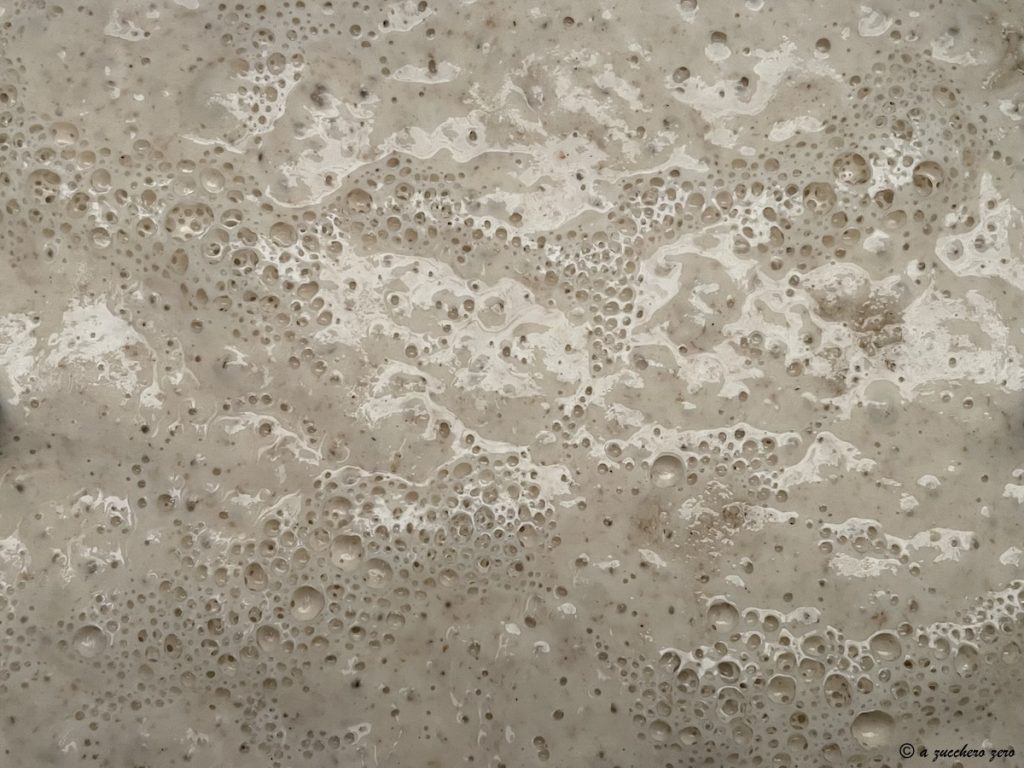
Prepare the ingredients for the second dough:
– about 3 1/3 tbsp (50 ml) of water;
– 1 2/3 cups (200 g) type 2 wheat flour;
– about 3/4 cup + 1 tbsp (100 g) wholemeal wheat flour;
– 1 tablespoon turmeric;
also:
– 2 tsp extra virgin olive oil;
– 1 tsp salt [adjust according to your taste or dietary needs, you can also omit it];
optional:
– about 2–3 tbsp mixed seeds for bread [seed mix for bread: 25% flax, 25% poppy, 25% white sesame, 25% black sesame].SECOND DOUGH WITH A BREAD MACHINE
Select program 18 [knead and rise] which includes:
– a kneading phase lasting 27 minutes;
– three proving phases each lasting 40 minutes, total 2 hours;
for an overall duration of 2 hours and 27 minutes.Pour onto the poolish:
– the water;
– the flours mixed together and the sifted turmeric;
and press START.Wait a couple of minutes for the dough to start coming together and add:
– the oil.Wait a couple of minutes for the dough to incorporate it and add:
– the salt.Use a silicone spatula to bring down any flour remaining on the container walls.
At the 4 BEEPS add the seeds.
During the proving phases do not open the lid to avoid temperature fluctuations; the machine will beep between phases.
When the program finishes the machine will emit several beeps — remove the loaf container.
The dough should be elastic and well-kneaded.SECOND DOUGH WITHOUT A BREAD MACHINE
If you don’t have a bread machine, you can use a stand mixer or a dough mixer for the kneading phase and a switched-off oven or blankets for the proving phase, extending times until the dough doubles.Knead for 27 minutes, cover and leave to rise until doubled.
Spread a thin, even layer of semolina on the work surface.
Turn the loaf container over to remove the dough.
Remember to separate the kneading paddles and carefully remove any dough residue from the container.Turn the dough.
Do not handle it excessively:
– spread a thin, even layer of semolina on the dough;
– using dough cutters divide the dough into portions.I divided my turmeric bread dough in half.
first half the dough
I divided one half of the dough into two loaves to bake in the bread machine using the dedicated ciabatta molds.second half the dough
I divided the other half into three small loaves to bake in the oven on a baking sheet.If you want a rustic result, sift a thin, even layer of flour over the surface with a fine-mesh sieve.
Baking in the bread machine
I used ciabatta molds.
I greased the ciabatta molds.
I placed the dough pieces into the ciabatta molds with the scored side up.Place the accessories on their proper support and insert it into the machine.
Select program 20 [proofing and baking for ciabattas and rolls] which includes:
– a proving phase of 50 minutes;
– a baking phase of 30 minutes adjustable by -10 or +10 minutes.
Check doneness 5–10 minutes before the program ends.
If necessary, rotate the molds for even baking.The program 20 is suitable when the baking phase is single-stage.
For a second bake in the bread machine with the same program:
– turn the machine off for at least an hour and wait for it to cool.Alternatively, select program 19 [bake] and proceed without waiting:
– adjustable duration from 10 to 60 minutes.
Set it to 30 minutes.
Check doneness 5–10 minutes before the program ends.
If necessary, rotate the molds for even baking.Baking in a conventional oven
Line a baking sheet with parchment paper, transfer the loaves with the scored side up.
Proof in a switched-off oven for about an hour.Follow the instructions — program, temperature and times — indicated in your appliance manual.
Preheat the oven.
I baked in a conventional/static oven at 356°F (180°C) for 25 minutes, lower rack position.
* times and temperatures may vary depending on the oven and loaf size.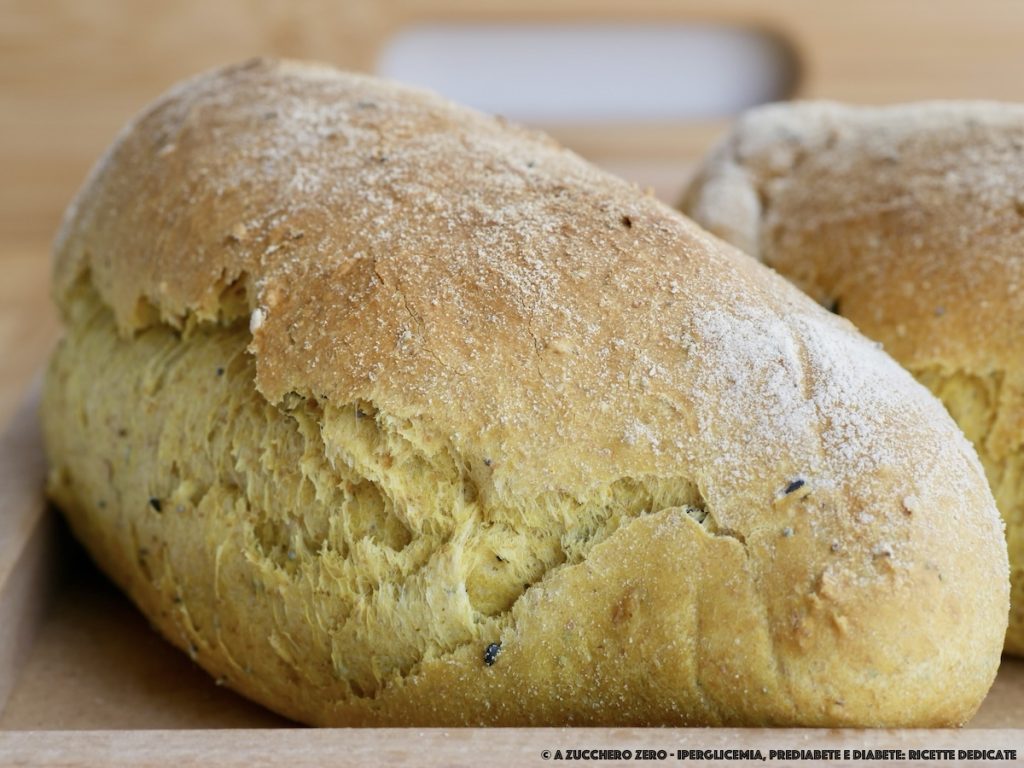
Experiment with savory leavened goods
– sandwich loaf, rustic loaf, rolls, baguette, ciabatta, bâtard;
– pizza and focaccia;
– breadsticks and taralli;
– gastronomic panettone;
– stuffed bread or loaf cake;
– filled savory pastries: croissants, muffins, Danubio.The same dough can become a base for light sweet leavened goods such as:
– brioche-style buns, croissants, sweet rolls;
– pandoro- or panettone-like breads;
– pan brioche, sweet loaves.Browse the blog section dedicated to Recipes with the Bread Machine.
Storage, tips and variations
Wait until it is warm or cold before slicing so the crumb does not compress.
I store the bread on a rack placed over an empty support so air can circulate underneath: this way the bread breathes and the crust stays dry.
It keeps well for 2–3 days at room temperature.
If it hardens, simply warm it slightly in the oven or in a pan to restore its crispness.
FAQ (Questions & Answers)
What is the low glycemic mix?
The Molino Spadoni low glycemic mix: made from type 1 flour and resistant starch, rich in fiber and protein, is a practical ally in cases of hyperglycemia, prediabetes and type 2 diabetes.
What is resistant starch?
During digestion, digestible starch is broken down into simple sugars causing glycemic spikes.
Resistant starch is not digested and reaches the colon intact where it behaves like fiber and therefore does not cause glycemic spikes.
It is not a chemical additive but a type of starch that behaves like fiber, helping to reduce the post-meal glycemic response and helping to keep blood sugar more stable.
Can children consume it?
Yes, it can be consumed by children, but it is advisable to consult the pediatrician.Where can I find the low glycemic mix?
In well-stocked supermarkets, in some pharmacies and on the manufacturer’s official website:
– low glycemic mix;
– low glycemic mix 5 kg.Can I substitute the flours?
In this case it doesn’t make much sense because the dough is intended for those following a specific dietary regimen and a high-fiber diet.
From experience it is possible to substitute and vary flours, bearing in mind that they have different characteristics.
Wholemeal flours absorb varying amounts of water, tend to rise less and doughs are less elastic; for a softer result I recommend mixing them with semi-whole flours such as type 2 or type 1 flour.
Of course, by changing flours the impact on blood sugar may be different.