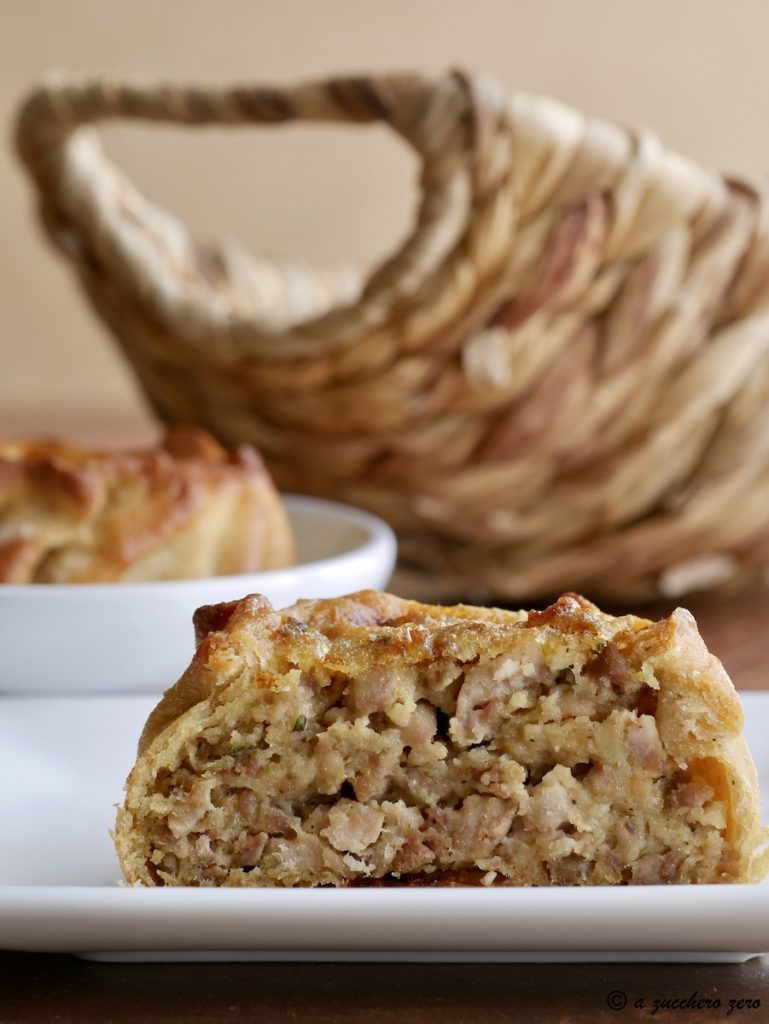
Today we make the pastieri di carne, a typical recipe from Modican rosticceria and the Easter tradition: it is customary to prepare them on Holy Saturday.
The Modican pasturieddi are small baskets of semolina dough filled with ground meat.
The recipe comes from my mother, who is from Modica, adapted to our table: I’ll tell you how to prepare the traditional Modican meat pastieri with a lighter, more digestible version while retaining the authentic taste.
Dough for Ragusane scacce
My pastieri are made with the same dough used for Ragusane scacce, without lard.
The traditional dough for Ragusane scacce is based on re-milled durum wheat semolina.
You can also make it with whole durum wheat semolina stone-milled.
With or without yeast.
Light, digestible meat filling
Made with selected ground meat, a mixture of beef and pork, lean first cuts – if you want an even leaner filling you can use ground white meat such as chicken or turkey, preferably breast – with no milk and only one egg.
You may be interested in:
- Difficulty: Medium
- Cost: Economical
- Preparation time: 20 Minutes
- Cooking time: 20 Minutes
- Portions: 4 Servings
- Cooking methods: Stovetop, Electric oven
- Cuisine: Italian regional
- Region: Sicily
Ingredients
You can prepare your dough with or without yeast.
- 1.5 cups re-milled durum wheat semolina (or wholemeal)
- 2/3 cup water (slightly sparkling)
- 1/2 tsp extra virgin olive oil
- 1/2 tsp salt
- 1 pinch baking soda
- 1.5 cups re-milled durum wheat semolina (or wholemeal)
- 2/3 cup water (slightly sparkling)
- 1/3 tsp active dry yeast (Mastro Fornaio PANEANGELI)
- 1/2 tsp extra virgin olive oil
- 1/2 tsp salt
- 10.6 oz mixed ground meat (beef and pork, lean first cuts (about 2/3 lb))
- 1 pinch salt
- 1 pinch mixed peppercorns (with grinder)
- 1 egg
- 4 tbsp breadcrumbs (or whole-grain breadcrumbs)
- 4 tbsp grated cheese (cacio cavallo, grana or parmesan)
- to taste chopped parsley
- 1 egg
- 1 pinch salt
- 1 pinch mixed peppercorns (with grinder)
The sparkling water helps make the dough lighter and softer.
You can of course use still water if you prefer.
As an alternative to 1 g of dry yeast you can use:
– 3 g fresh brewer’s yeast;
– 4 g dried sourdough starter.
Suggested tools
I recommend using a stand mixer, although it is possible to knead the dough by hand.
- Kitchen scale digital
- Stand mixer with hook
- Bowl for proofing with lid
- Cutting board dough board
- 1 Frying pan
- Rolling pin
- Baking tray 9.84 x 11.42 in
- Parchment paper
Preparation
You can prepare your dough for Ragusane scacce without yeast to shorten preparation times.
In the bowl of the stand mixer pour:
– the semolina or wholemeal semolina;
– a pinch of baking soda;
– the salt;
– the oil;
and start the mixer at speed 1.
Continue working at speed 2 for about 10 minutes:
– adding the water little by little.
The dough should come away from the sides of the bowl and be smooth, elastic and not sticky.
Transfer the dough to a work surface and knead briefly by hand to form a ball.
Sprinkle the bottom of a bowl with a little semolina and place the ball inside.
Seal the bowl with a lid or wrap it with plastic wrap.
Let the dough rest at room temperature for about one hour.
After this time, your dough without yeast will be ready to use.Heat the water: it should be lukewarm, not hot.
Pour the lukewarm water into a measuring jug, add and dissolve the yeast.
In the mixer bowl pour:
– the semolina or wholemeal semolina;
– the oil;
and start the mixer at speed 1.
Continue working at speed 2 for about 10 minutes:
– adding little by little all the water in which you dissolved the yeast;
– adding the salt halfway through kneading so it does not come into direct contact with the yeast.
The dough must come away from the sides of the bowl and be smooth, elastic and not sticky.
Transfer the dough to a work surface and knead briefly by hand to form a ball.
Sprinkle the bottom of a bowl with a little semolina and place the ball inside.
Seal the bowl with a lid or wrap it with plastic wrap.
Store it in a cool, dark place.
[see photo 01]About 4 hours after mixing [see photo 02]
Turn the dough out onto a work surface lightly dusted with a little semolina.
Knead it a few minutes by hand and reshape it into a ball.
Place it again in the bowl, seal it and return it to the same place.About 24 hours after mixing [see photo 03]
* after 24 hours the dough should be doubled or nearly doubled.
Many factors affect the rise such as flour, yeast and environmental conditions.
You can use it earlier, but the long fermentation makes the dough more digestible.Traditionally, in Modican pastieri the meat is added raw and seasoned before baking in the oven.
Alternatively, you can add the meat after a quick browning in a pan.Heat a pan.
Add the ground meat to the pan, stir and break it up with a silicone spatula.
Brown quickly.
Add a pinch of salt and grind the pepper.
Transfer the meat, raw or browned [if browned, wait until it is warm], into a bowl.
Add:
– one egg;
– 4 tablespoons of breadcrumbs or whole-grain breadcrumbs;
– 4 tablespoons of grated cheese;
– chopped parsley;
and mix the ingredients well.Your dough for Ragusane scacce, traditional or whole, is ready to be used in the preparation of the pastieri.
Once the filling is ready:
– turn the dough out onto a work surface lightly dusted with a little semolina;
– work it a few minutes by hand to restore elasticity and reshape it into a ball.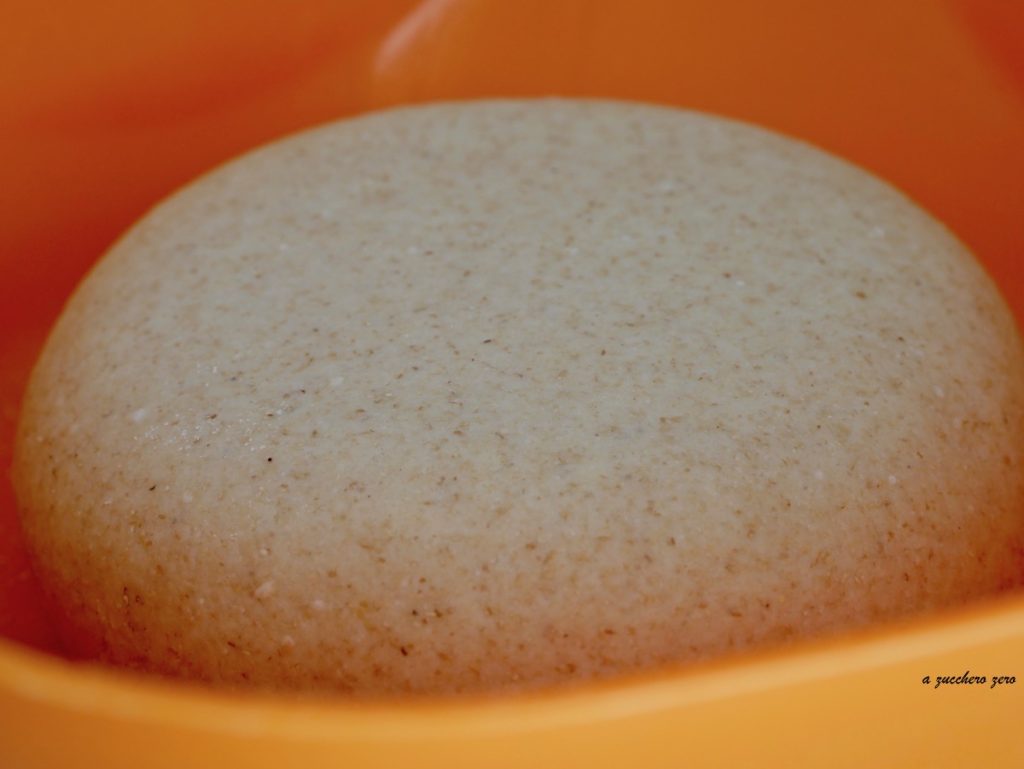
You can proceed with rolling out and filling the pastieri.
Line a baking tray with parchment paper.
Roll out the dough with a rolling pin, helping yourself with a little semolina, until you reach a thickness of about 0.08–0.12 in (2–3 mm).
If the dough tends to contract, let it rest for 5 minutes and then continue rolling.
It is a sequence of: flour, roll, flour, roll, rotate and so on.
Cut out dough disks using a round cutter, plates, bowls or lids with a diameter of about 3–4 in (8–10 cm).Spread the meat filling in the center of the dough discs.
Lift the edge of the disc and fold it, pinching with your fingers to form the typical small open basket in the center.
Watch the short video on how to make the rim for Modican meat pastieri here.Break an egg into a bowl.
Add a pinch of salt and grind the pepper.
Beat everything with a fork.
Brush the center and edges of the pastieri with the beaten egg.
Arrange the pastieri on the baking tray.I set the oven as follows:
– temperature 356°F (180°C);
– fan (convection) mode;
or static oven at 374°F (190°C).
Preheat well.
Bake for about 20 minutes until golden and check for doneness.
* times and temperatures may vary depending on the oven.Your light and digestible Modican meat pastieri are ready.
Excellent hot or cold, but I recommend waiting until they are warm.
Enjoy your meal!The meat pastieri can become a complete dish; add your portion of vegetables to compose a balanced meal or one-dish meal that helps keep blood sugar stable.
Storage, tips and variations
Storage
When preparing Ragusane scacce, multiple fillings are usually planned so you can bring several types and flavors to the table, therefore dough rarely remains.
If you have leftover dough:
– you can use it to make delicious flatbreads or whole-grain flatbreads;
– you can freeze it by wrapping the ball in plastic wrap.
The evening before use transfer it to the refrigerator to thaw then leave it a couple of hours at room temperature before rolling it out.
Pastieri are also great the next day!
Pastieri keep:
– at room temperature for 1 day;
– in the refrigerator for 2-3 days;
– in the freezer for 2-3 months.
Warm them briefly in the oven to restore crispness.
Tips and variations
If you want an even leaner filling you can use ground white meat such as chicken or turkey breast.
There are many variations, ranging from the use of lamb offal to the addition of rice [not recommended in case of hyperglycemia].
Gluten-free alternative
For a gluten-free dough for Ragusane scacce you can use gluten-free bread flour.
The sheet will of course be less elastic.
FAQ – Questions and Answers
Dough for Ragusane scacce | semolina
The traditional dough for Ragusane scacce is prepared with re-milled durum wheat semolina.
Semolina generally has a favorable glycemic response.
Wholemeal semolina – richer in fiber – remains the recommended choice for those seeking a lower glycemic index dough.
Excellent ancient wheat semolinas: Maiorca, Perciasacchi, Russello, Senatore Cappelli, Tumminia.
To learn more on the topic click the following link: semolina and flours glycemic index.Can I use other flours?
Remember that the dough must always be smooth, elastic and firm.
Using other flours you may not obtain the characteristic result of the Ragusana scaccia.