Today we prepare a quick and light vegetable broth:
– quick vegetable broth
requires just 10 minutes of cooking;
– light vegetable broth without carrots and without potatoes
without carrots [cooking raises the glycemic index] and without potatoes [which contain a large amount of starch], using the seasonal vegetables you have in your pantry.
Let’s see how to prepare it!
- Difficulty: Easy
- Cost: Affordable
- Preparation time: 10 Minutes
- Cooking time: 10 Minutes
- Portions: 2 Servings
- Cooking methods: Boiling
- Cuisine: Italian
Ingredients
- 1 2/3 cups water
- 1 onion (or shallot)
- to taste celery (stems and leaves)
- 1 pinch salt
- Swiss chard (red, stems and leaves)
- leek
Suggested Tools
- Knife
- Cutting board
- 1 Casserole with lid preferably glass
- Ice cube tray
Preparation
Guidelines for hyperglycemia | prediabetes and diabetes
without carrots and without potatoes, no fats.
For my vegetable broth I use onion or shallot, celery and other seasonal vegetables and greens I have in the pantry.
It is also a recycling recipe very useful in the kitchen because it allows you to use outer parts, less tender or not perfectly fresh vegetables and greens, for example: outer leaves and stems, slightly wilted leafy lettuce, outer leaves, stems and fronds of fennel, parsley stems.About the carrot
Cooking changes the glycemic index of the carrot: raw food IG 30, cooked food IG 85.
You can add it for flavor and avoid eating it.Thoroughly clean and wash the vegetables:
– onion or shallot;
– celery stems and leaves;
seasonal vegetables you have in the pantry, I use:
– Swiss chard or red chard stems and leaves;
– leek.Chard
Remove damaged outer leaves and the tough fibrous lower part of the stalk.
Thoroughly clean and wash leaves and stems, removing all traces of soil.You can add the vegetables cut into large pieces or chopped according to taste and needs.
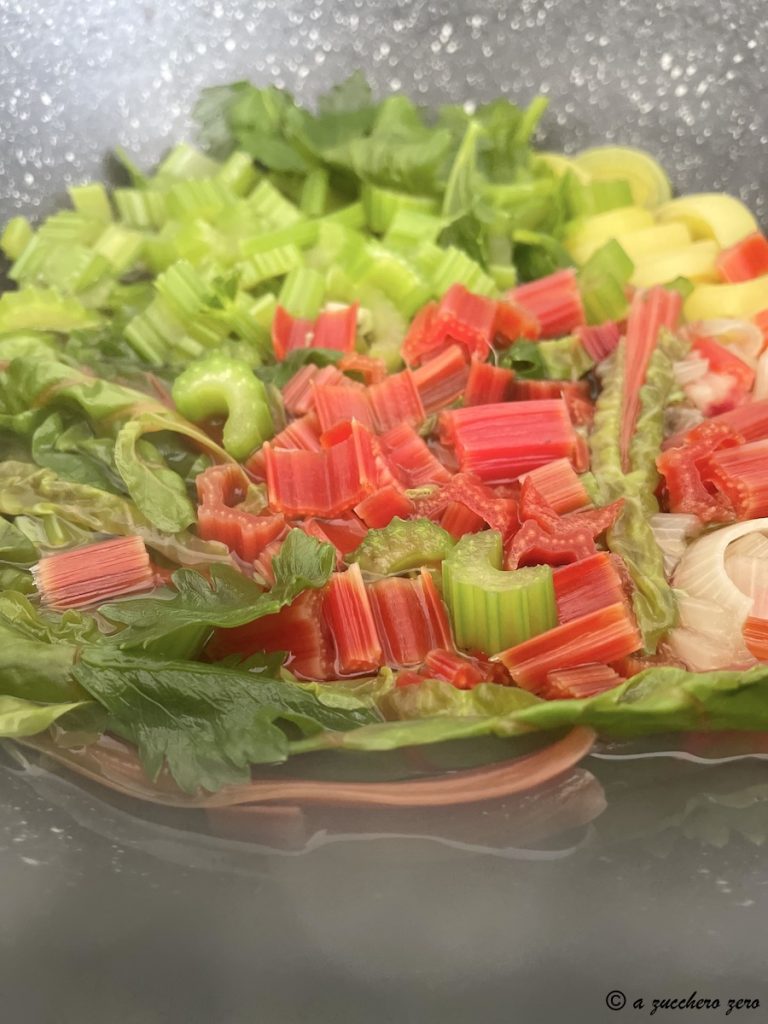
In a saucepan, pour 1 2/3 cups of water and add:
– onion;
– celery;
– Swiss chard or red chard;
– leek;
and a pinch of salt.Cover with a lid (preferably glass), bring to a boil and cook for 10 minutes.
Your quick and light vegetable broth is ready.
It is a clear, fat-free broth; filtering is not necessary.Use it with the vegetables, whole or puréed, or without.
For brothy first courses, to avoid glycemic spikes, it is advisable to cook the pasta separately, then rinse it and add it to the brothy sauce prepared separately; this way the starch released by the pasta into the cooking water is removed.
Cook the pasta separately from the broth.
Drain and rinse it well under running water to remove the released starch.
Combine it with the hot broth prepared separately.This reduces the glycemic load of the dish and makes it more manageable and lighter, without giving up the comfort of pasta in broth.
Pasta in vegetable broth is a first course – a source of carbohydrates – easy to balance by adding a protein source and vegetables to compose a balanced meal or single-dish that helps keep blood sugar stable.
Homemade vegetable broth is a natural, healthy and versatile basic ingredient for cooking and flavoring.
It is perfect as a base for many vegetable, legume but also meat and fish recipes:
– sauces, dressings and condiments;
– soups, pasta or risottos;
– couscous, fregola or paella;
– appetizers, first and second courses;
– stews and soups.
Storage, Tips and Variations
For a slightly colored and more flavorful version add tomato sauce to taste: tomato sauce.
Store the vegetable broth:
– in the fridge up to 2 days;
– in the freezer up to 3 months;
in jars and containers with lids or in ice cube trays.
If you don’t consume the boiled vegetables, set them aside and purée them to prepare a vegetable bouillon cube or vegetable sauce.
FAQ (Questions and Answers)
Hyperglycemia and diabetes, which broth?
The vegetable broth or vegetable stock is fat-free and therefore ideal for those following a low-calorie diet and in cases of hyperglycemia, prediabetes and type 2 diabetes.
What other vegetables can I use?
You can use any seasonal vegetables you have in the pantry, avoiding carrots and potatoes.
For example besides onion or shallot, celery, chards and leeks you can also use broccoli and cauliflower, cabbages and savoy cabbages, chicories, fennel, mushrooms, pumpkin.