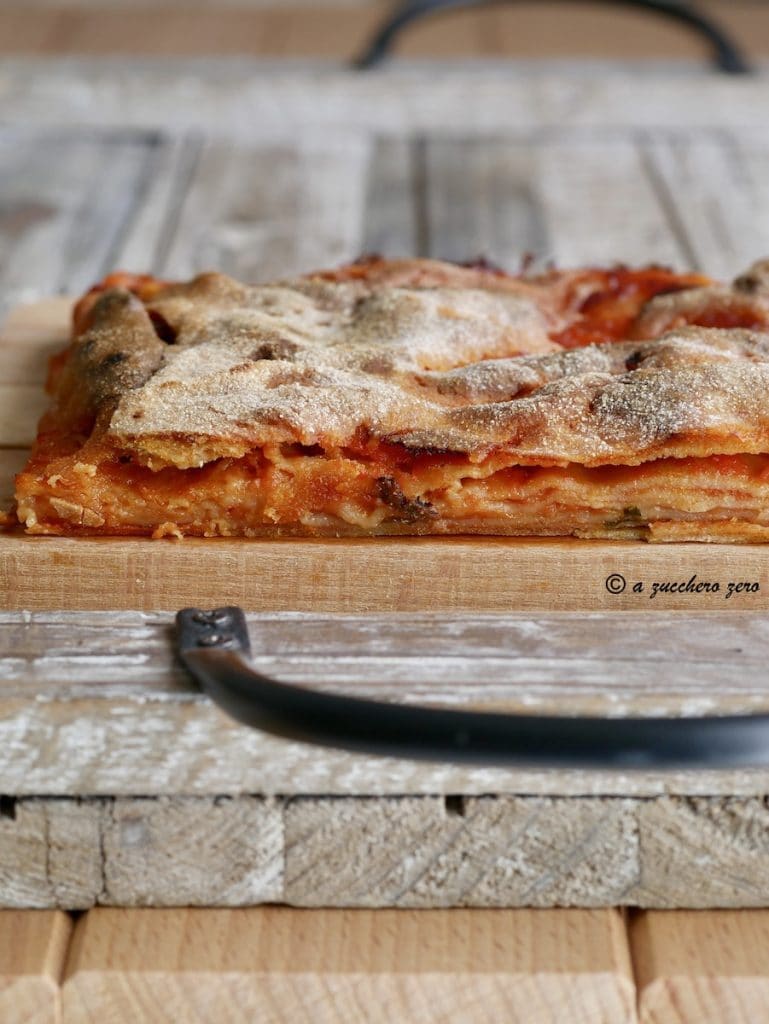
Today we are preparing the ragusane scacce with tomato and cheese.
The ragusane scaccia is a dish from the gastronomic tradition of the province of Ragusa, in Sicily.
The ragusane scaccia with tomato and cheese is the most well-known and appreciated version of the traditional Ragusa preparation.
The dough is rolled out very thinly with a rolling pin, filled, and then rolled or folded over itself.
It is filled with tomato sauce and Ragusa cheese.
Simple yet delightful, it is the undisputed queen of scacce.
The traditional ragusane scacce dough is made with re-milled durum wheat semolina.
Semolina generally has a good glycemic response.
The whole wheat semolina – richer in fiber – is the recommended choice for those who want a low glycemic index dough.
Excellent are the ancient grain semolinas: Maiorca, Perciasacchi, Russello, Senatore Cappelli, Tumminia.
For more details, you can click on this link: semolina and flours glycemic index.
With or without yeast.
I recommend using a mixer, although it can be kneaded by hand.
The ragusane scaccia requires a bit of skill, but don’t be discouraged: scacce don’t need to be perfect to be good!
- Difficulty: Medium
- Cost: Cheap
- Preparation time: 20 Minutes
- Cooking methods: Electric oven
- Cuisine: Regional Italian
- Region: Sicily
Ingredients
The whole wheat dough is slightly more delicate to handle and roll out.
– if you are a beginner;
– if you knead by hand;
I recommend using re-milled durum wheat semolina.
- 4 cups re-milled durum wheat semolina (or whole wheat)
- 1 1/4 cups water (lightly sparkling)
- 1 g dry brewer's yeast (Mastro Fornaio PANEANGELI)
- 1 tsp extra virgin olive oil
- 1 tsp salt
- as needed semolina (for rolling the dough)
- tomato sauce (homemade)
- 1 pinch mixed peppercorns (with grinder)
- caciocavallo cheese (aged grated or in chunks)
- caciocavallo cheese (semi-aged in chunks)
- basil
As an alternative to one gram of dry brewer’s yeast, you can use:
– 3 g of fresh brewer’s yeast;
– 4 g of dried sourdough.
You can prepare your ragusane scacce dough without yeast and shorten the preparation times:
– do not add yeast;
– add a pinch of baking soda.
Suggested Tools
I recommend using a mixer, although it can be kneaded by hand.
- Knife
- Cutting Board
- Food Scale digital
- Mixer and hook attachment
- Bowl for rising with lid
- Cutting Board pastry board
- Rolling Pin
- Baking Tray 10×11.5 inches
- Parchment Paper
Preparation
The ragusane scaccia with tomato and cheese is filled with tomato sauce and Ragusa cheese.
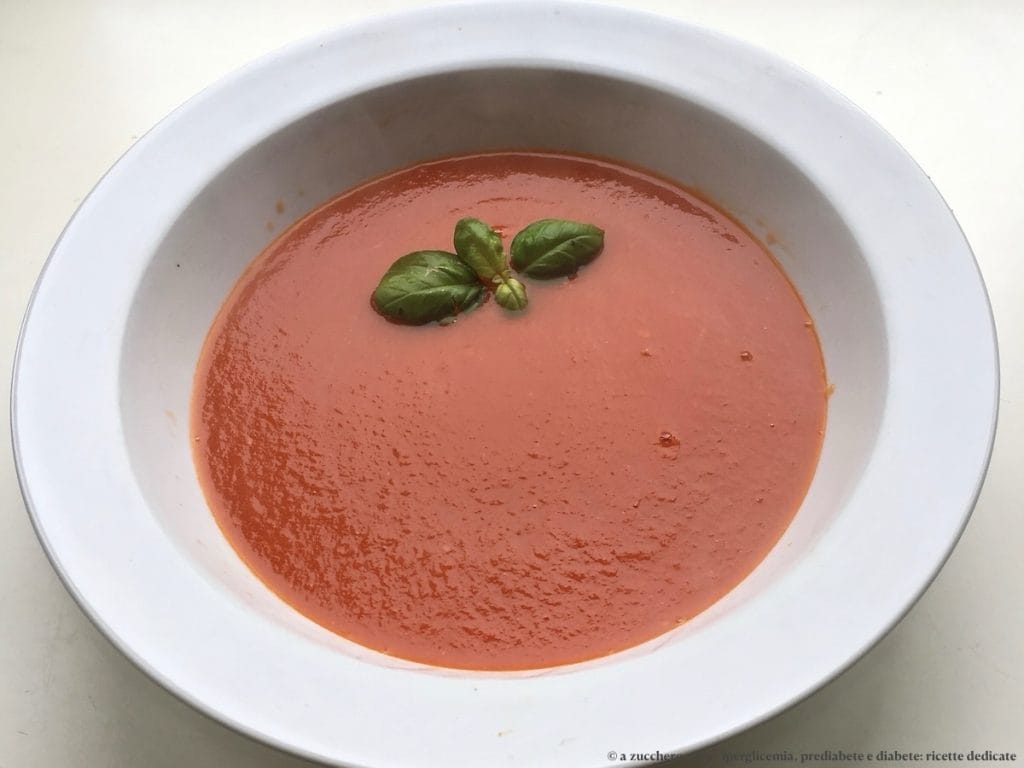
Tomato Sauce
Prepare plenty of tomato sauce.
For the detailed step-by-step procedure, you can read the full recipe by clicking on the following link: homemade tomato sauce without sugar or oil in cooking.Alternatively, use a tomato puree.
Canned tomatoes, purees, and ready-made sauces often contain added sugars and other ingredients that can contribute to increased blood sugar, always read the label.Season with a pinch of pepper.
Ragusa caciocavallo cheese
You’ll need:
– aged caciocavallo grated or in chunks;
– semi-aged caciocavallo in chunks.If you’re using aged caciocavallo grated, add it to the tomato sauce.
Basil
Select and wash the basil leaves.
Let them drain in a colander.
Pat gently with kitchen paper to remove excess water.For the scacce dough without yeast, follow the instructions in the next section: scacce dough with yeast but
– do not add yeast;
– add a pinch of baking soda.Knead and let the dough rest at room temperature for about an hour.
After this time, your yeast-free dough will be ready to use.
Heat the water – it should be warm, not hot – and dissolve the yeast in the warm water.
Pour the semolina or whole wheat semolina and the oil into the mixer’s bowl and start the mixer at speed 1.
Continue working at speed 2 for about 10 minutes:
– adding the water in which you dissolved the yeast little by little;
– adding the salt halfway through, to avoid direct contact with the yeast;
until you obtain an elastic and firm dough.Transfer the dough onto a work surface and knead it briefly by hand to form a loaf.
Dust the bottom of a bowl with some semolina and place the loaf inside.
Seal the bowl with a lid or by wrapping it with cling film.
Store it in a cool, dark place.4 hours after kneading
Turn the dough onto a work surface lightly dusted with some semolina.
Knead it by hand for a few minutes and give it the loaf shape again.
Put it back in the bowl, seal it, and store it in the same place.24 hours after kneading
* after 24 hours, the dough should be doubled or almost;
many factors, such as flour, yeast, and ambient conditions, affect rising.Turn the risen dough onto a work surface lightly dusted with some semolina.
Knead it by hand for a few minutes to regain elasticity.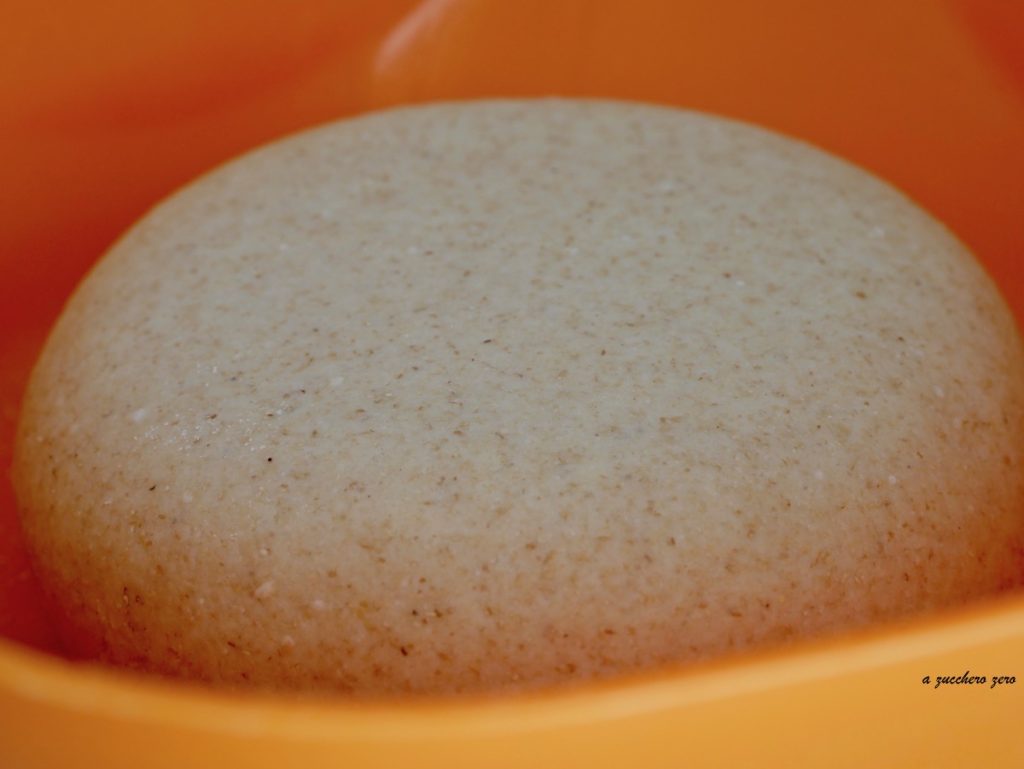
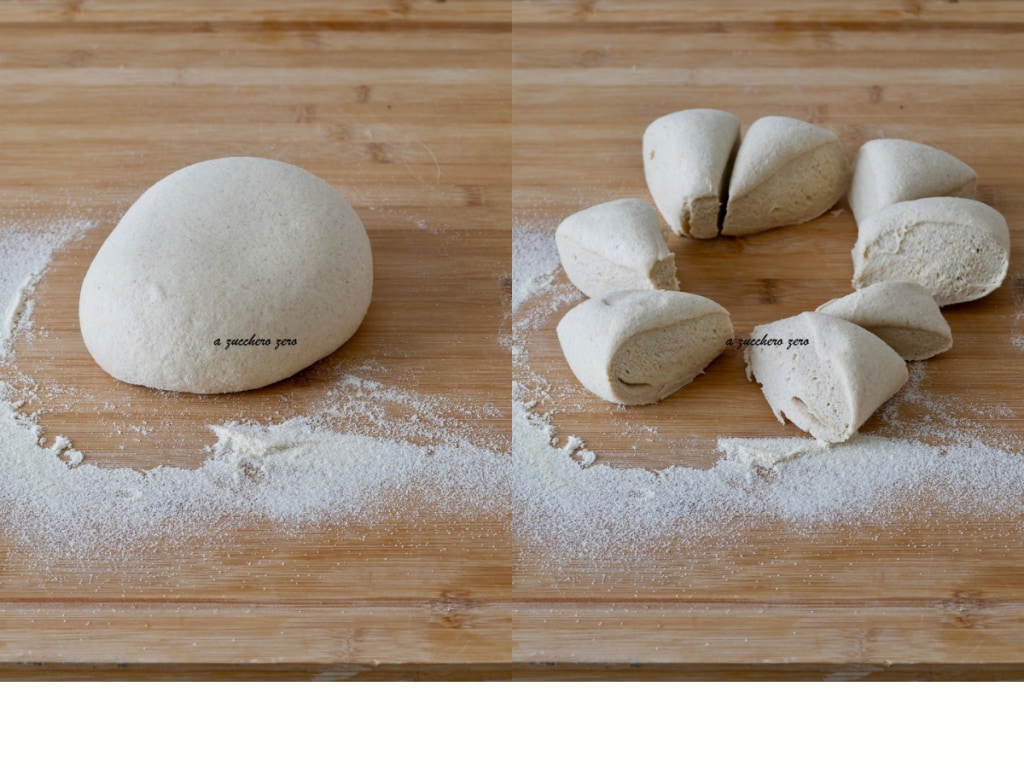
Divide the dough into loaves, from 4 to 8 depending on the size you want for your scacce.
Line a baking tray with a sheet of parchment paper where you will place the scacce.
Roll out each loaf with a rolling pin, using some semolina, until you obtain a dough sheet of a round or rectangular shape as thin as possible.
The whole wheat dough is more delicate to handle compared to the classic one.
It is an alternation of dust, roll, dust, roll, rotate, and so on.
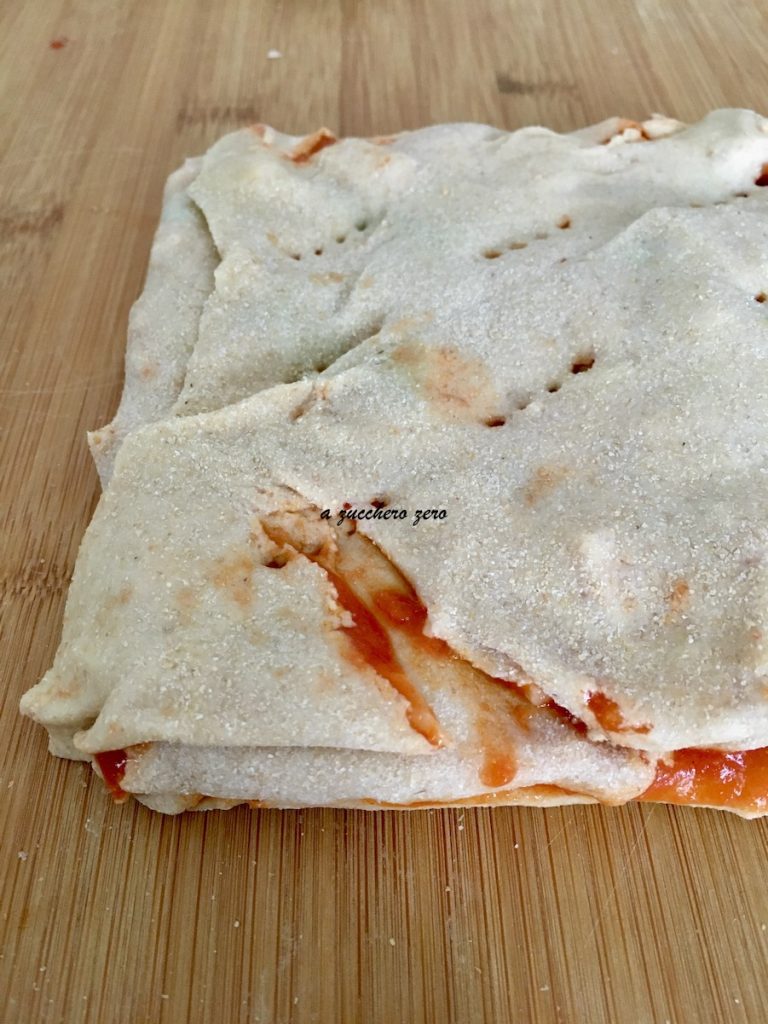
It requires skill, not perfection, and don’t worry if the dough sheet has some tears.Generously distribute tomato sauce and basil and the cheese chunks, leaving the edges free.
Fold the two sides of the dough sheet over towards the center.Distribute more tomato sauce and basil and cheese chunks.
Fold from the top towards the center.
Fold one more time to close the scaccia.Prick the scaccia with a fork in several places.
[step-by-step images valid for any type of filling].
Place it on the baking tray.
If you have difficulty rolling out the dough, you can use a pasta machine – Nonna Papera – to obtain thin and uniform strips to be filled and rolled up to make small scacce:
– divide the dough into smaller loaves;
– flatten the loaf with your hands;
– pass the loaf at 1;
– fold the sheet and pass the folded sheet at 1;
– finally, pass the sheet at 6.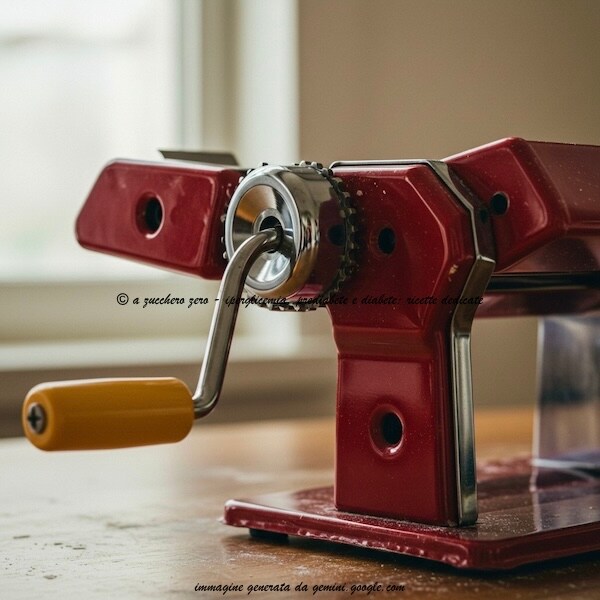
Set the oven as follows:
– maximum temperature [428°F];
– fan mode.Preheat well.
Bake for 20 minutes and check for doneness.
* times and temperatures may vary depending on the oven and the size of the scacce.
In my mother’s larger, more powerful oven, 20 minutes are enough; in mine, it takes 30.If some cheese should leak out, don’t worry, they will be even more delicious.
Your ragusane scacce with tomato and cheese are ready.
Great both hot and cold, but I recommend waiting until they are warm.
Enjoy your meal!
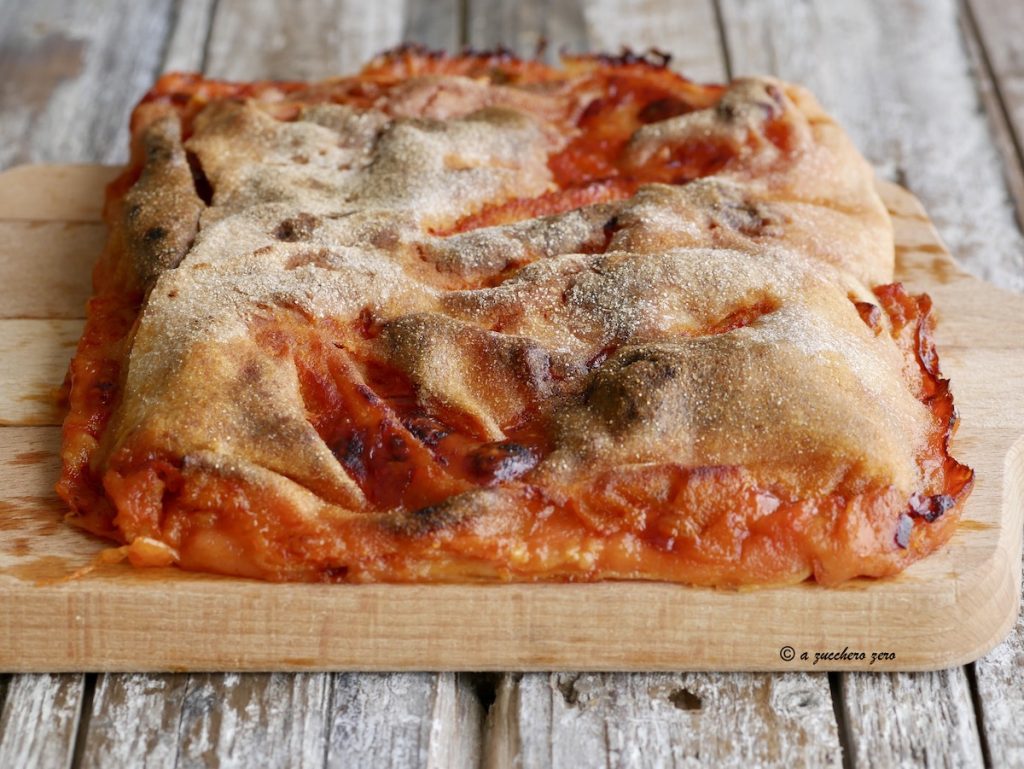
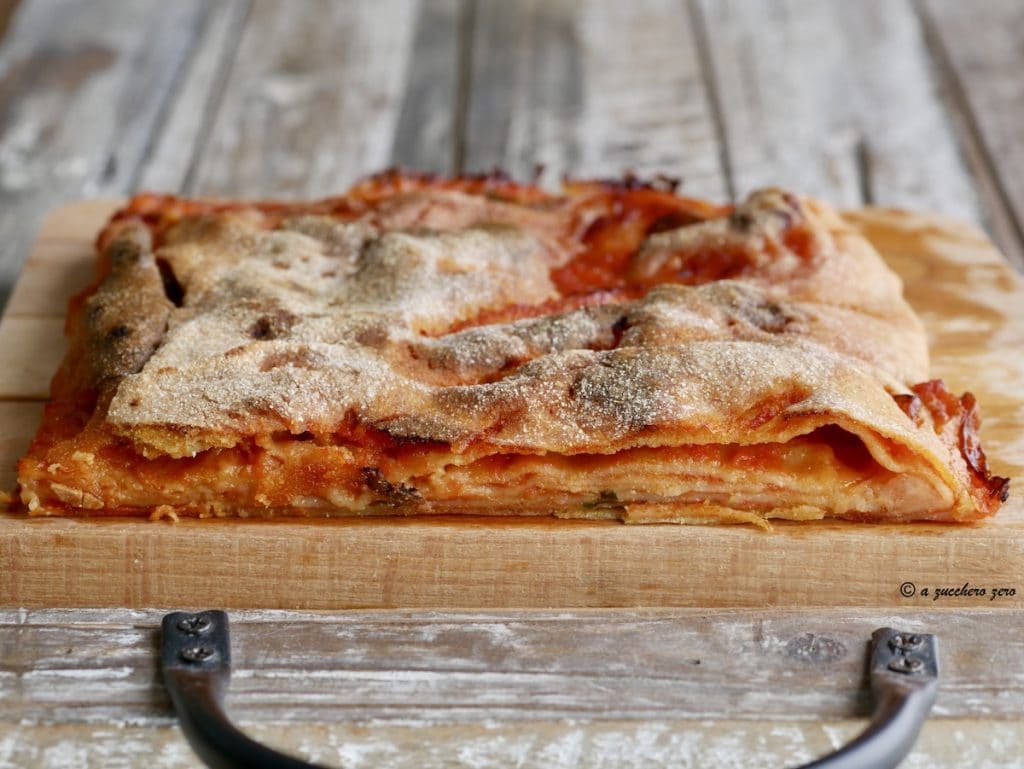
The ragusane scaccia with tomato and cheese is similar to a margherita pizza but usually has a more favorable glycemic impact.
Add your portion of vegetables to compose a balanced meal or one-dish meal that helps keep blood sugar stable.You can consult the complete collection by clicking on this link: ragusane scaccia: dough, types, flavors.
Storage, Tips, and Variations
Gluten-Free Alternative
For a gluten-free ragusane scacce dough, you can use gluten-free bread flour.
The dough will obviously be less elastic.
For a milder taste, replace Ragusa caciocavallo with Ragusa provola.
If you’re from another region and can’t find Ragusa cheese, you can use another stringy cheese.
You can add to the filling onion or eggplant traditionally fried, optionally grilled.
The filling can be adapted to different dietary needs:
– lactose-free;
– vegan;
– vegetarian.
If you have leftover dough:
– you can use it to make delicious flatbreads or whole wheat flatbreads;
– you can freeze it by wrapping the loaf in food wrap; the night before use, transfer it to the refrigerator to thaw, then leave it at room temperature for a couple of hours before rolling it out.
If they are left over, they are also great the next day!
Scacce can be stored:
– at room temperature for 1 day;
– in the refrigerator for 2-3 days;
– in the freezer for 2-3 months.
Reheat briefly in the oven to restore crispness.
FAQ (Questions and Answers)
Can I use other flours?
Remember that the dough must always be elastic and firm.
You may not achieve the characteristic result of ragusane scaccia.Why use sparkling water in the dough?
Sparkling water helps make the dough lighter and softer.
You can also comfortably use still water.