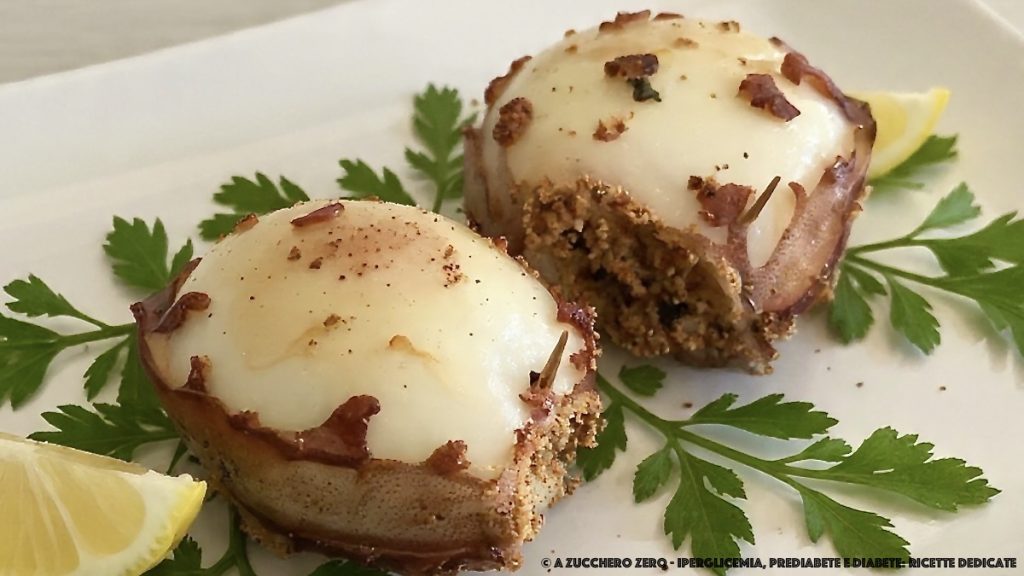
Sicilian-style stuffed cuttlefish are a recipe from the maritime tradition.
I live in a small seaside village, in the places of Inspector Montalbano.
When in season, my father never fails to bring us fresh cuttlefish purchased directly from the local fishermen of the town [Marina di Ragusa] or from nearby towns [Donnalucata or Scoglitti].
In fishing villages, stuffed cuttlefish represented the “Sunday” dish or dishes for special occasions.
The filling, simple but tasty, was born as a way to reuse ingredients: stale bread and cuttlefish tentacles seasoned with whatever was available – cheese, aromatic herbs, sometimes capers or pine nuts.
Remember to account for the stuffing in the total carbohydrate count of your meal.
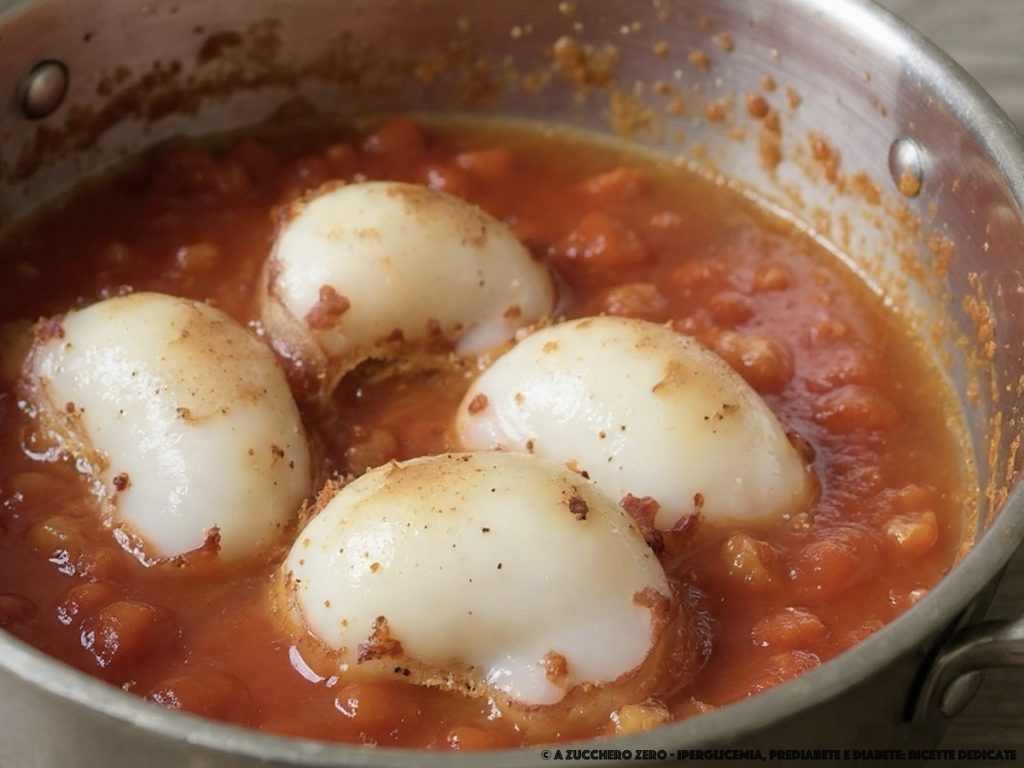
You can cook them in the oven or in tomato sauce.
You might be interested in:
- Difficulty: Easy
- Cost: Medium
- Preparation time: 20 Minutes
- Cooking time: 20 Minutes
- Portions: 2 People
- Cooking methods: Electric oven, Stovetop
- Cuisine: Italian
Ingredients
If you find the cleaning steps too complicated, ask your trusted fishmonger to clean the cuttlefish at the time of purchase.
- cuttlefish (2 medium-sized)
- 1 pinch garlic powder
- 1 small glass white wine (about 2 fl oz (60 ml))
- as needed breadcrumbs (or wholemeal breadcrumbs)
- as needed grated cheese (grated: grana or Parmesan)
- 1 pinch salt
- 1 pinch mixed peppercorns (for grinding)
- as needed chopped parsley
- as needed capers in salt (optional)
- as needed pine nuts (optional)
- 1 drizzle extra virgin olive oil
- 1 pinch garlic powder
- as needed onion
- 4 sprigs parsley
- 1 small glass white wine (about 2 fl oz (60 ml))
- as needed tomato sauce (homemade)
- 1 pinch salt
- 1 pinch mixed peppercorns (for grinding)
Suggested tools
- Knife
- Cutting board
- Frying pan nonstick
- Baking sheet 9.84×11.42 in
- Parchment paper
- 1 Pan
Preparation
Cuttlefish ink is not used in this preparation.
You can save it and keep it for another recipe.
For a detailed step-by-step procedure you can read the tutorial by clicking on the following link: freezing cuttlefish ink in tomato sauce | without crystals or granules.
On YouTube you’ll find a very clear video about cleaning cuttlefish in which the recovery of the ink sac is described in detail.
Rinse the cuttlefish under running water and pat dry with kitchen paper.
Remove the eyes and the beak and extract the pen (gladius).
Rinse again.
Proceed to remove the viscera.
After extracting the pen, part of the mantle [cuttlefish sac] remains open:
– cut the skin that covered the pen to open the internal cavity that contains the viscera;
– gently remove the viscera, if necessary help yourself with a small knife: eggs, milt and the ink sac in one block, then separately livers and gills.
The eggs and milt of cuttlefish are a real delicacy.
The livers are also edible.
The gills should be discarded.
Locate the ink sac and separate it gently intact so as not to spill its contents.
The walls are very thin and break easily so keep a small glass or bowl at hand in case you need to recover its contents urgently.
After removing the viscera, check that there are no residues inside the mantle.
Skin the cuttlefish: note that the skin is edible so this is not a necessary operation:
– peel the skin by pulling it along the mantle from one side and then the other.
Thoroughly wash the sac, inside and out, and the tentacles under running water.
Pat dry with kitchen paper.The cuttlefish is clean and ready to be stuffed.
Rinse the cuttlefish under running water.
Pat dry with kitchen paper.
Cut the cuttlefish tentacles into small pieces.In a small pan heat a sprinkle of garlic powder.
Deglaze with a small glass of white wine (about 2 fl oz).
Add the tentacles and quickly brown over high heat.Let cool.
In a bowl, add:
– breadcrumbs or wholemeal breadcrumbs;
– grated cheese;
in approximately equal amounts, according to the size of the cuttlefish;
– salt;
– pepper;
– chopped parsley;
and mix.
You can flavor the stuffing with a handful of chopped capers and a handful of pine nuts.
Add the tentacle pieces, drizzle with a little extra virgin olive oil and combine the ingredients.
If the mixture is too dry add one tablespoon of water.With the help of a tablespoon or teaspoon, fill the cuttlefish leaving about 0.4 in (1 cm) from the edge of the sac and close with a toothpick.
Line a baking sheet with a sheet of parchment paper.
Arrange the stuffed cuttlefish.
Preheat the oven.
Bake in a fan-assisted oven at 356°F (180°C) for about 20 minutes.
Turn the cuttlefish halfway through cooking to brown them evenly.Plate.
Grind a little more pepper and drizzle with a little extra virgin olive oil raw.Your Sicilian-style stuffed cuttlefish are ready.
Enjoy your meal!
Serve whole if small and sliced if large.
In a pan heat a sprinkle of garlic powder, the chopped onion and a few parsley stems.
Deglaze with a small glass of white wine (about 2 fl oz).
Place the cuttlefish in the pan and brown for one minute per side, turning gently.
Cover with tomato sauce and enough water to rinse out the sauce container.
Add a pinch of salt and grind pepper.
Let cook covered, preferably with a glass lid, over low heat for about 20 minutes, turning the cuttlefish occasionally, depending on their size, until they are cooked and the sauce has reduced.Plate.
Your stuffed cuttlefish in tomato sauce are ready.
Enjoy your meal!
Stuffed cuttlefish are theoretically a main course.
Do not forget to take into account the breading when calculating the total carbohydrates of your meal.
Balance the meal by completing with preferably whole grain carbohydrates [bread, pasta or rice] and vegetables so as to compose a balanced meal or one-plate dish that helps keep blood sugar stable.In honor of the traditions of the fishing village, stuffed cuttlefish are among the dishes on St. Joseph’s table.
They are presented decorated with sprigs of parsley and lemon slices.
Storage, tips and variations
Storage
Cooked stuffed cuttlefish are stored in the refrigerator in an airtight container for a maximum of a couple of days.
You can reheat them in the oven or in a nonstick pan.
Tips and variations
Instead of cuttlefish you can use squid or calamari.
You can use gluten-free breadcrumbs for a gluten-free version.
You can omit the cheese but you will need to increase the amount of breadcrumbs and the stuffing may be drier.
Alternatively, you can add an egg to make the filling softer and more cohesive.
For a more fragrant coating you can add grated lemon zest.
FAQ – Questions and Answers
Mollusks and cholesterol
In our dietary scheme, squid and calamari, octopus and cuttlefish are among the foods indicated as “to be consumed occasionally.”
Although they are lean mollusks, they are a source of cholesterol and intake should be limited.
Nutritional guidelines recommend a dietary cholesterol intake of less than 300 mg per day, a limit that can drop to 200 mg per day in the presence of hypercholesterolemia and hyperglycemia.
Therefore, mollusks do not directly affect blood sugar but in cases of high blood sugar, prediabetes and diabetes they should be consumed in moderation.