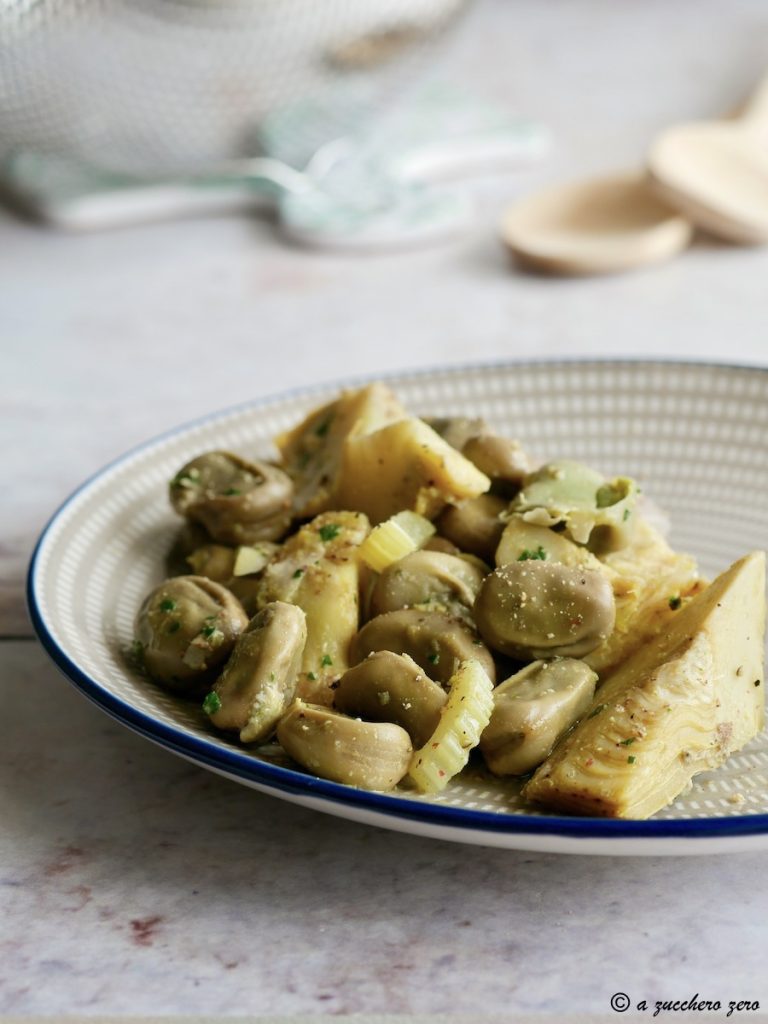
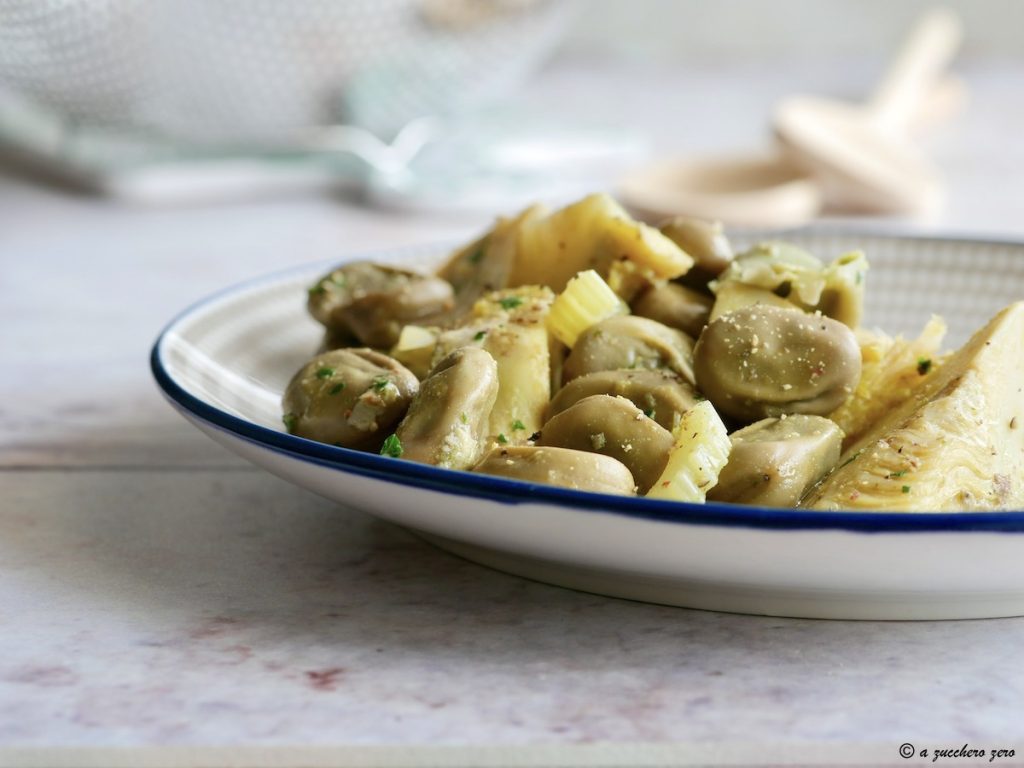
The vignarola with artichokes and fava beans is a humble, genuine and simple dish, typical of peasant tradition.
The term “vignarola” comes from “vignarolo”: greengrocer.
It used to be prepared after returning from the vineyards using the legumes and vegetables grown and harvested among the vine rows.
It marked the transition from winter [last artichokes of the season] to spring [first fava beans and peas].
Mine is a vegan version, without guanciale.
You might be interested in:
- Difficulty: Easy
- Cost: Inexpensive
- Preparation time: 20 Minutes
- Cooking time: 40 Minutes
- Portions: 2 People
- Cooking methods: Stovetop
- Cuisine: Italian
Ingredients
Fresh fava beans: weight varies from raw to cooked.
From 1 kilogram of fresh fava beans (weight with pods) I obtained about 350 g shelled (about 12.3 oz).
- fava beans (fresh) (2 servings, weight according to dietary plan)
- 1/2 onion (blended or grated, or whole)
- 1 pinch garlic powder
- 3 tbsp + 1 tsp water (+ enough to cover the fava beans)
- 1 pinch salt
- 1 pinch mixed peppercorns (for grinder)
- 1 vegetable bouillon cube (homemade vegetable)
- 1 sprig parsley
- 4 artichokes (or 9 oz (250 g) frozen artichoke pieces)
- as needed lemon juice
- as needed water
- 1 pinch salt
- 1 small glass (about 1.7 fl oz / 50 ml) white wine
- 1 shallot (sliced or whole)
- as needed celery (1-2 stalks)
- as needed lemon juice
- 6 tbsp + 2 tsp water
- 1 vegetable bouillon cube (homemade vegetable)
- 1 pinch salt
- 1 pinch mixed peppercorns (for grinder)
- as needed chopped parsley
- 1 drizzle extra virgin olive oil (for finishing)
The cooking time for fresh fava beans varies depending on:
– the size and freshness of the beans;
– the desired consistency [soupy or drier].
Suggested tools
- Gloves disposable
- Cutting board
- 1 Pan with lid preferably glass
Preparation
For my vignarola I cooked the fava beans and the artichokes separately.
If you want to save time, you can cook the fava beans and artichokes together: scroll through the recipe to read the alternative method.
Extract the fava beans from their pods and rinse them under running water.
“Pizzica” the fava beans by removing the little stem and leaving them slightly exposed at the top.
If you’re not used to doing it with your fingers like grandmothers do, help yourself with a knife and cut away a tiny piece of the bean.Peel and wash the onion.
Blend or finely grate the onion or leave it whole if you prefer to remove it after cooking.
In a pan briefly warm a sprinkle of garlic powder and the onion.
Add 3 tbsp + 1 tsp of water and let it stew for a few seconds.
Add the fava beans and stir to flavor.
Add more water to cover them about 3/8 in above their level.
Add a pinch of salt and a pinch of pepper, a vegetable bouillon cube and the parsley.
Bring to a boil.
Continue cooking on low heat.
The cooking time of fresh fava beans varies depending on:
– the size and freshness of the beans;
– the desired consistency [soupy or drier].
Let them cook for 20 to 60 minutes, taking care to:
– check the consistency;
– add more water if necessary;
– stir to prevent the broth from drying out and the beans sticking to the bottom of the pan.
Adjust salt to taste.Put on a pair of disposable gloves to avoid your hands and nails darkening.
Clean the artichokes:
– trim and remove the stem;
– discard the tougher outer leaves;
– cut each artichoke to about one third of its length [starting from the top] removing the tip [the toughest part of the leaves];
– halve the artichoke;
– remove the “barbetta” (the fuzzy choke) from the inside of the heart with the help of a knife;
– cut the heart into slices or wedges;
– immediately drizzle the artichokes with lemon juice to prevent them from darkening.Blanch the artichokes:
– in a small saucepan bring salted water to a boil;
– add the cleaned and cut artichokes;
– add the white wine;
– let cook over low heat for about 10 minutes until tender [a fork slides easily into the heart];
– drain the artichokes;
– transfer them to a bowl and drizzle again with lemon juice to avoid discoloration.Peel and wash the shallot, slice it or leave it whole.
Clean and wash the celery, separate leaves and chop the stalks into pieces.In a pan add:
– the blanched artichokes;
– a pinch of salt;
– lemon juice;
– 6 tbsp + 2 tsp of water;
and cook covered [lid preferably glass] for 5 minutes.
Add the shallot and celery and continue cooking for another 5 minutes.
With the heat off add a vegetable bouillon cube and the stewed fava beans and stir; the more you stir the more the beans will break down.
Adjust salt and freshly grind the pepper.Bring the artichokes and fava beans back to a simmer.
With the heat off add the chopped parsley.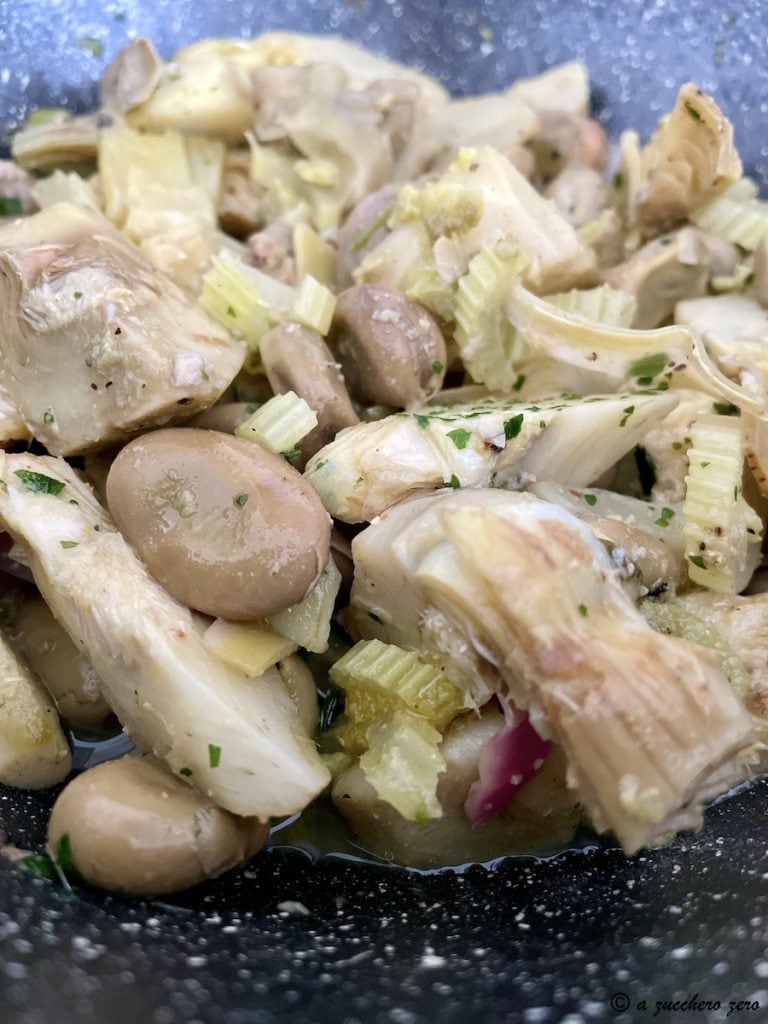
Plate up.
Grind a little more pepper and drizzle with a stream of extra virgin olive oil just before serving.Your vignarola with artichokes and fava beans is ready.
Enjoy your meal!
Clean the fava beans.
Clean the artichokes and cut them into wedges.
Clean the shallot and the celery.In a pan briefly heat a sprinkle of garlic powder and the shallot.
Add 3 tbsp + 1 tsp of water and let it stew for a few seconds.
Add the raw fava beans and stir to flavor.
Add more water to cover them about 3/8 in above their level.
Add:
– a pinch of salt;
– a pinch of pepper;
– a vegetable bouillon cube.
Bring to a boil.
Continue cooking on low heat.
Let cook for 20 to 40 minutes, taking care to:
– check the consistency;
– add more water if necessary;
– stir to prevent the broth from drying out and the beans sticking to the bottom of the pan.
Add the raw artichokes and the celery and continue cooking for another 10-20 minutes.
Adjust salt.
The vignarola is ready when the fava beans are soft and the artichokes tender.
With the heat off add the chopped parsley.Plate up.
Grind a little more pepper and drizzle with a stream of extra virgin olive oil just before serving.
Storage, tips and variations
Storage
The vignarola with artichokes and fava beans keeps in the refrigerator for 1-2 days in an airtight container.
Reheat in a pan adding a splash of water.
Tips and variations
Prepare the vignarola with artichokes, fava beans and peas for a more traditional version.
Squeeze the juice of 1/4 lemon directly into the pan and add the squeezed wedge as well: this helps keep the fava beans and artichokes greener and brighter, preventing them from darkening.
FAQ – Questions and Answers
Why remove the “barbetta” from artichokes?
The “barbetta”, the fuzzy inner choke of the artichoke heart, is unpleasant and not chewable.
Why do artichokes darken?
Artichokes darken shortly after being cut due to oxidation.
To prevent oxidation after cutting, immediately drizzle them with lemon juice or immerse them in a bowl of cold water with lemon juice.Can I use frozen artichokes?
Yes.
Frozen artichokes are already cleaned and cut.
You can blanch them directly without thawing.
Follow the instructions on the package.FAVA BEANS AND DIABETES
Glycemic index of fava beans: GI 40.
The glycemic index of fava beans is higher compared to other legumes and it increases with cooking.
– Can I eat fava beans? This is a question you should ask your diabetologist.
– Can people with diabetes eat fava beans? Follow your dietary plan; ours includes them.
Usually, in cases of hyperglycemia, prediabetes and diabetes cooked fava beans can be consumed without exceeding portion sizes.Can I use frozen fava beans?
Yes.
Add them directly to the cooking without thawing.Tips on pairing legumes
In short:
– legumes + cereals [preferably wholegrain bread, pasta or rice] = a correct pairing;
– legumes + proteins = a correct pairing.
To explore further read the article by clicking the following link: pairing legumes in the diet.