
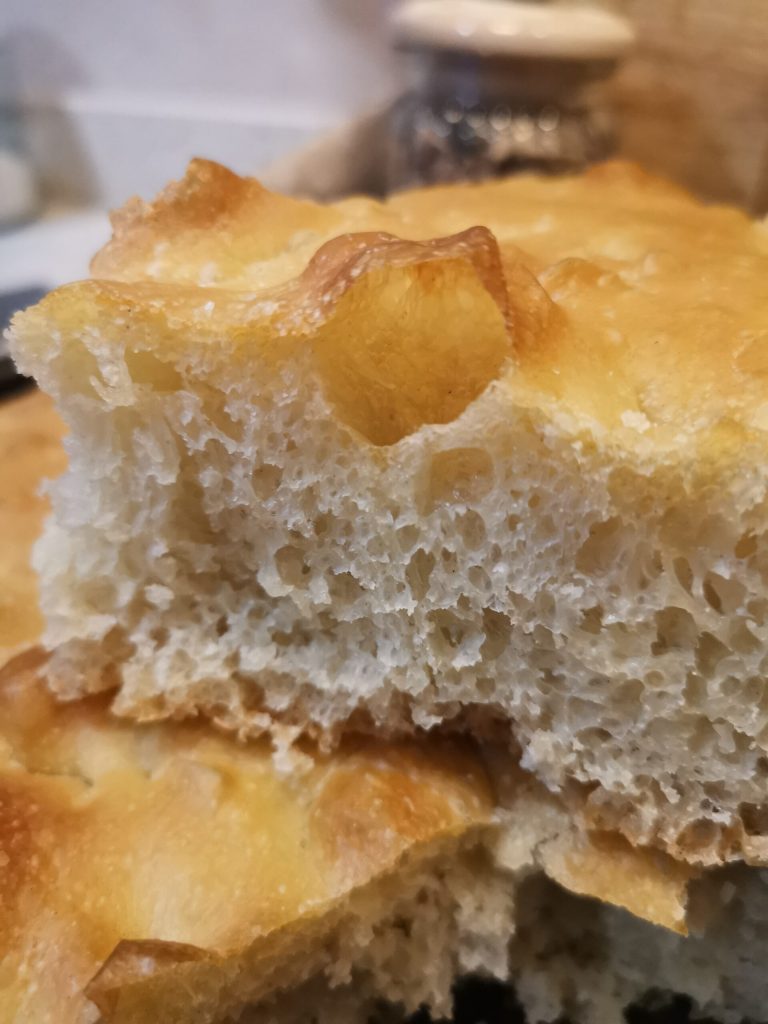
Tall, soft focaccia with little yeast is an easy leavened bread to make at home, perfect to enjoy both in the classic version and stuffed. Thanks to the small amount of yeast and the long resting hours for the dough, you will get a soft, tall focaccia with a well-developed crumb.
This homemade tall, soft focaccia is also ideal served instead of bread or sliced and filled with cold cuts, cheeses or vegetables. An easy recipe that once tried you’ll make again and again.
Thanks to the long fermentation and the small amount of yeast, this tall, soft focaccia turns out light, fluffy and very digestible.
If you love homemade leavened breads I also recommend trying these recipes:
- Difficulty: Easy
- Cost: Very economical
- Rest time: 7 Hours
- Preparation time: 20 Minutes
- Portions: 8
- Cooking methods: Oven
- Cuisine: Italian
- Seasonality: All seasons
Ingredients
Here are the ingredients to make this very simple tall, soft focaccia
- water (400 g (about 1 2/3 cups or 13.5 fl oz), slightly lukewarm)
- fresh brewer's yeast (about 5 g (approx. 1 2/3 tsp))
- extra virgin olive oil (50 g (about 3 1/2 tbsp) + 20 g (about 1 1/3 tbsp) for brushing the surface)
- 2 teaspoons sugar
- flour (600 g (about 5 cups))
- fine salt (10 g (about 1 2/3 tsp))
Tools
I prepared the tall, soft focaccia with a stand mixer but if you don’t have one, you can easily make the dough by hand.
I love kneading, but when I’m in a hurry I use the mixer.
Below is the list of tools I used to make the recipe.
For some of them you’ll also find a clickable Amazon icon, so you can buy them directly if you want.
- 1 Stand mixer
- 1 Baking pan round 11 in (28 cm)
- 1 Teaspoon
Steps
As I mentioned in the introduction, this time I used the stand mixer, but the method is the same if you decide to knead by hand.
Pour the lukewarm water into a bowl and dissolve in it the yeast, the sugar and the oil.At this point start adding the flour little by little and when you’ve incorporated about 500 grams (about 4 cups), add the salt, which should always be added toward the end of mixing.
This way the salt won’t interfere with the yeast and the sugar, which are already beginning to activate the dough’s fermentation.
Once all the flour is incorporated, the focaccia dough will be quite hydrated. If you knead by hand, don’t worry if it still sticks slightly to your fingers: it’s normal to obtain a tall, soft focaccia.
Dust your hands with a little flour and, if you didn’t use the mixer bowl but worked the dough on a wooden work surface, transfer it to a bowl to rest for at least 6 hours, covering the container with plastic wrap.
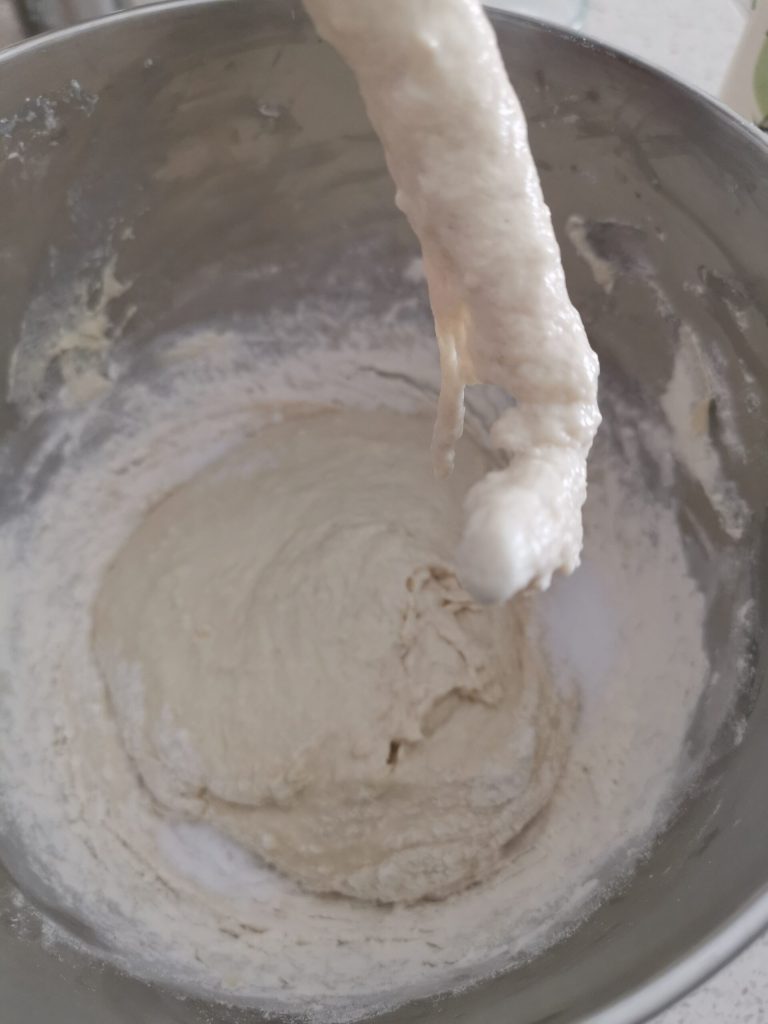
After the fermentation period, the dough will have doubled in volume and will be full of small bubbles.
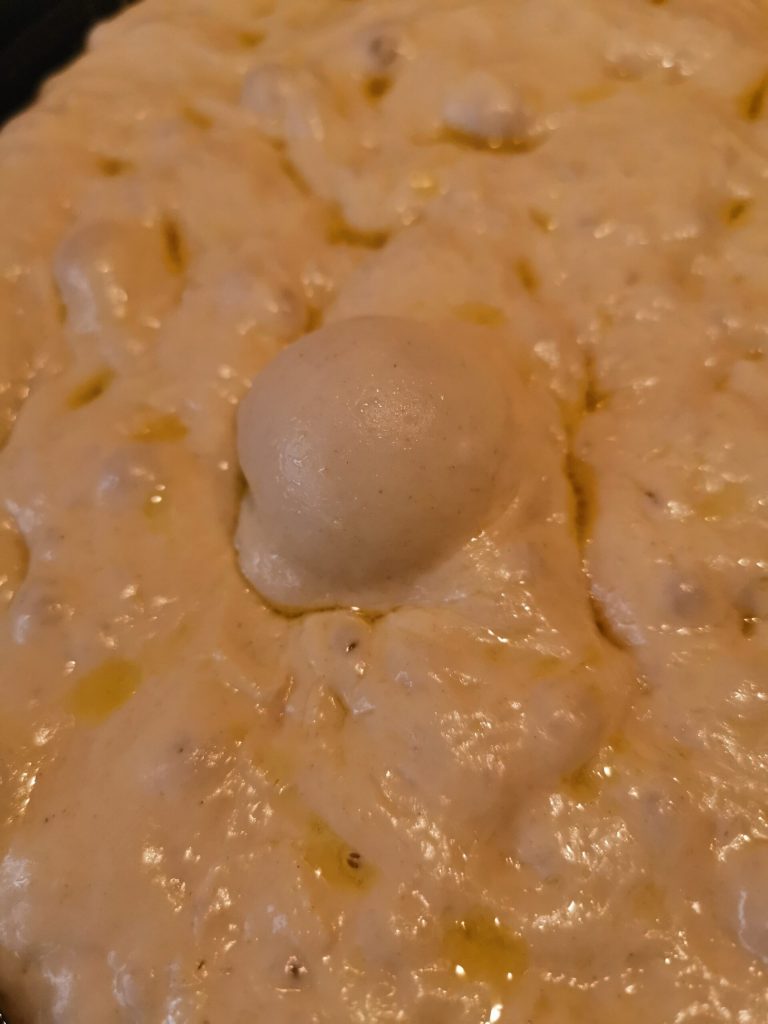
Lightly oil your hands and take the dough from the bowl to transfer it to the pan, which you have previously oiled well.
Once the dough is stretched out, press your fingers into it to recreate the classic focaccia dimples and brush the surface with the emulsion made with 20 g of extra virgin olive oil (about 1 1/3 tbsp), about two finger-widths of water and a pinch of salt.
I use fine salt and in a small amount. According to the traditional recipe coarse salt would be used, but even though I’m from Genoa and love focaccia, I don’t like to feel the grains of salt on the surface.
Let the focaccia rest for about one more hour in the pan before baking. My pan measures 13 3/4 in (35 cm) in diameter: I mention this because if you use a smaller pan the focaccia will be even taller and the baking time may be slightly longer.
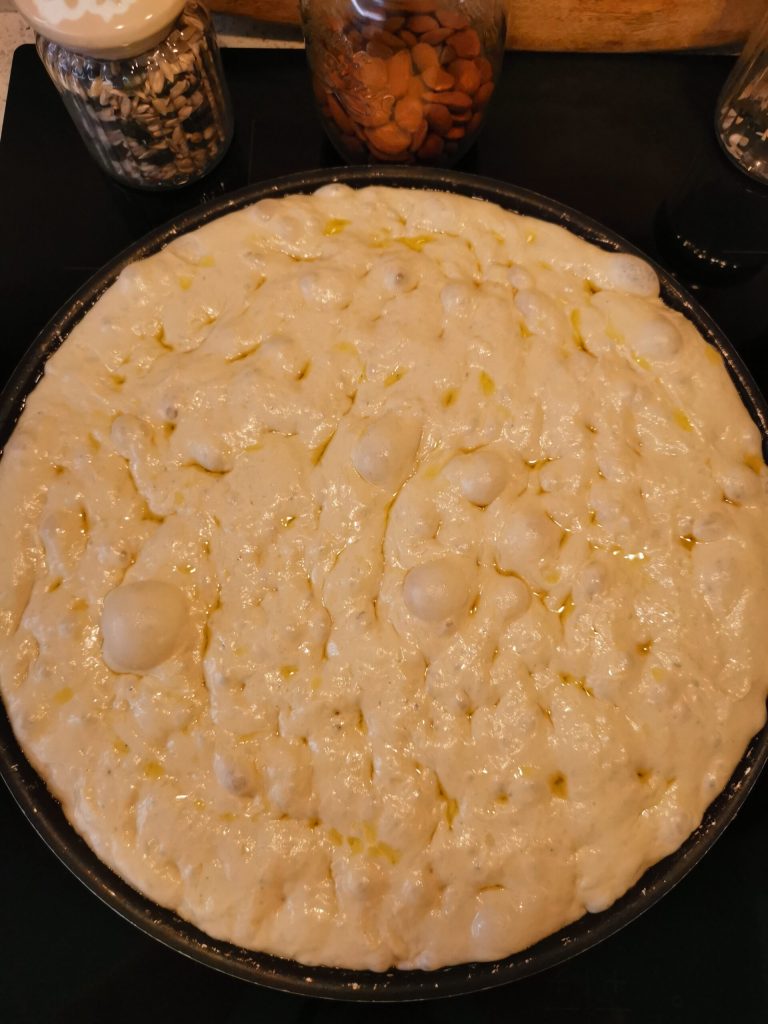
After the final resting time, proceed to bake and put the focaccia in the oven.
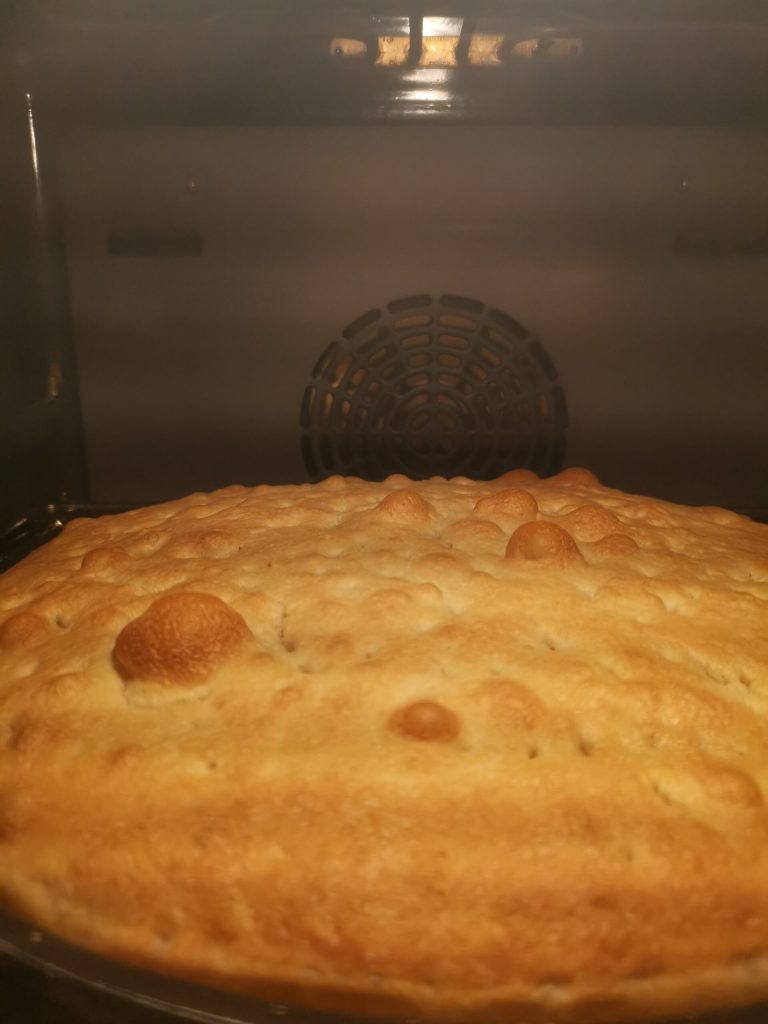
Bake in a conventional oven at 356°F for about 40–45 minutes. Before turning off the oven, perform the toothpick test: insert it into the center of the focaccia to check that the interior is perfectly cooked.
Remove from the oven and let it cool for a few minutes, then dive into this tall, soft focaccia with an incredible fluffiness.
How to store tall, soft focaccia and tips to keep it soft
The tall, soft focaccia keeps perfectly for about two days if stored in a paper bread bag or wrapped in a clean kitchen towel. This way it retains its aroma and does not become soggy.
If you want to make it fragrant again like just out of the oven, simply warm it in the oven for a few minutes at 356°F: the crust will become slightly crisp again and the inside will remain soft.
If you want to make it fragrant again like just out of the oven, simply warm it in the oven for a few minutes at 356°F: the crust will become slightly crisp again and the inside will remain soft.
FAQ (Questions & Answers)
Why does the focaccia become tall and soft even with little yeast?
The focaccia can become tall and fluffy even using a small amount of yeast if the fermentation times are respected.
A dough with a long fermentation, from 7 to 9 hours, allows the gluten to develop well and to create a structure rich in alveoli.
This way the focaccia is light, well aerated and very digestible, even using a reduced amount of yeast.
What is focaccia called in Genoa and how is it really eaten
The Genoese focaccia (or as we Ligurians call it FUGASSA) is a typical specialty of Ligurian cuisine, about one centimeter high, golden in color with well-defined alveoli; it is distinguished because before the final proof it is brushed with an emulsion made of extra virgin olive oil, water and coarse salt. I always use fine salt.
It can be eaten for breakfast, as a mid-morning “breakfast breaker” or as an aperitif-appetizer-evening snack.
It is traditionally accompanied by a small glass of white wine (or gianchetto (pronounced in the Ligurian way)).
In Liguria it is also a fairly common habit to dip focaccia in cappuccino or milk for breakfast. Don’t be shocked — it’s delicious 😉
