
To make the best use of my homemade artichoke powder (you remember it, right?) I couldn’t help but start with gomasio, and here it is: my fresh artichoke gomasio, that is… freshly prepared. 😊
The artichoke powder can be used in the kitchen in various ways, for example, it can be added as is to doughs, risottos, fillings, sauces, omelets… and if you have any other ideas or suggestions, write to me, I’m open to proposals!
My primary goal, one of the two reasons why I started on this self-production of artichoke powder (the other is reducing waste, not wanting to throw away a mountain of artichoke leaves every time I cook them), is to use it for flavoring, just like with celery salt.
 As you know, I’m always on the lookout for new flavorings to use instead of salt, to improve and, when possible, innovate my daily low-sodium cuisine (which I hope is yours too).
Then, yes let’s say it, if the artichoke powder had a more vibrant and cheerful color it would be better 😄 I would also use it as a food coloring (and I would have so many ideas!), but for now, the test I did adding it to an omelet… delicious in flavor, but it turned out a dull ash gray (which honestly wasn’t very photogenic). 😅
But we’ll talk about color experiments on other occasions, today let’s go with artichoke gomasio.
Very simple, as simple as preparing celery salt gomasio: just add the artichoke powder to ‘regular’ gomasio, that is gomasio made with sesame and salt, or simply use the powder instead of the salt. Although the salt in gomasio is minimal (especially if used in a minimal percentage, like 1:20), among those who need to follow a low-sodium diet, there are also those who cannot add even that twentieth of salt, and here these natural substitutions with vegetable powders or aromatic herbs come to our aid.
For now, you can rely on my two tutorials (namely, artichoke and celery powders) but if you intend to try producing other ‘vegetable salts’ the procedures are the same: drying the vegetable, blending, and sifting.
The vegetables to prefer are those with a more intense flavor – try also with all the cruciferous, particularly broccoli – unfortunately for me, all kinds of cabbage are banned in my house due to family members’ intolerances, but I plan to try with fennel, and also with aromatic herbs (but we will talk about that again).
Well, I’m ready to show you how to make artichoke gomasio in a few quick steps. Are you ready? 🙂
〰 〰 〰
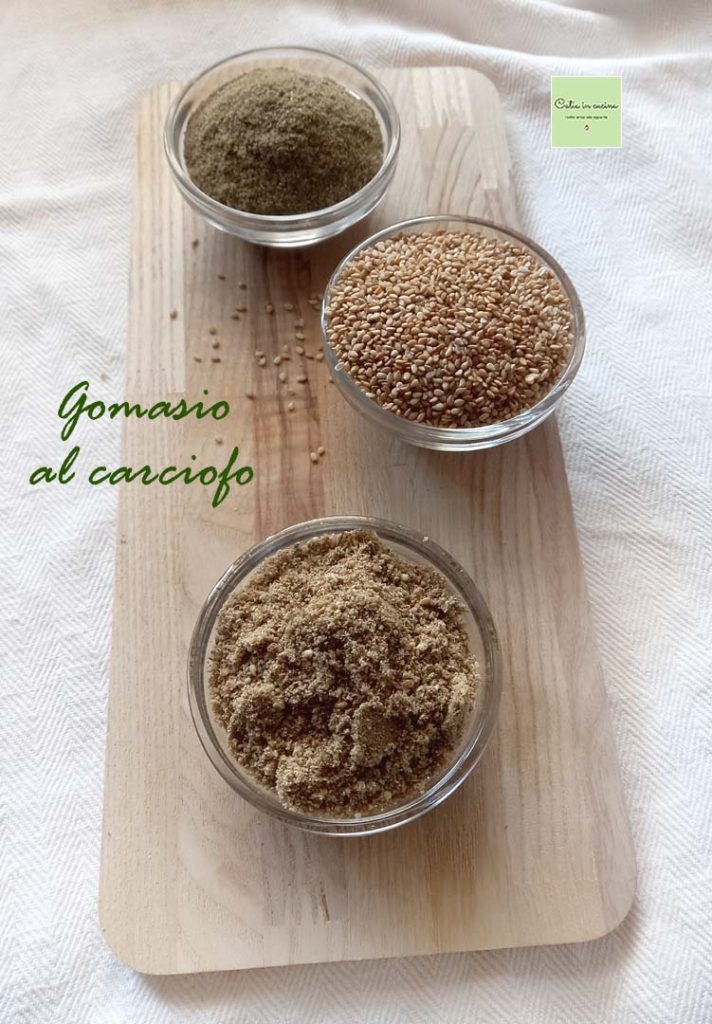
- Difficulty: Easy
- Cost: Affordable
- Preparation time: 3 Minutes
- Portions: 1 small bowl
- Cooking methods: Stovetop
- Cuisine: Healthy
- Seasonality: All Seasons
Ingredients
- 6 teaspoons gomasio
- 3 teaspoons artichoke powder
Tools
- Pan
- Grinder
How to Prepare Artichoke Gomasio
Prepare the gomasio (in a salt-sesame ratio of 1:20) as explained in the basic gomasio recipe.
Or simply toast the sesame (without salt) in a small pan.
When the sesame just starts to brown, immediately turn off the heat and add the artichoke powder.
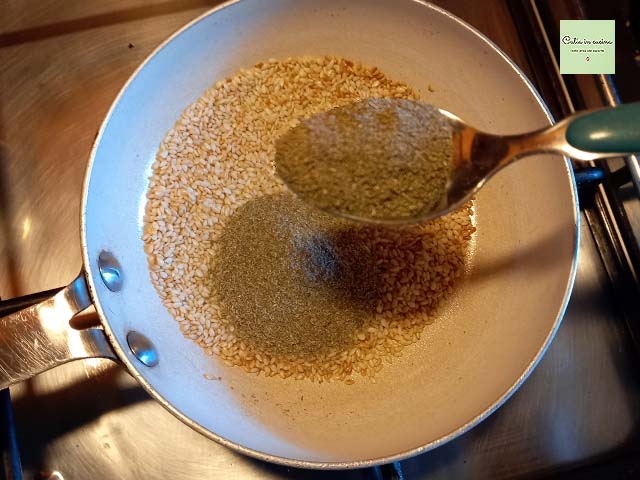
Mix quickly.
The artichoke powder, in contact with the hot pan and sesame, will immediately release a wonderful artichoke aroma.
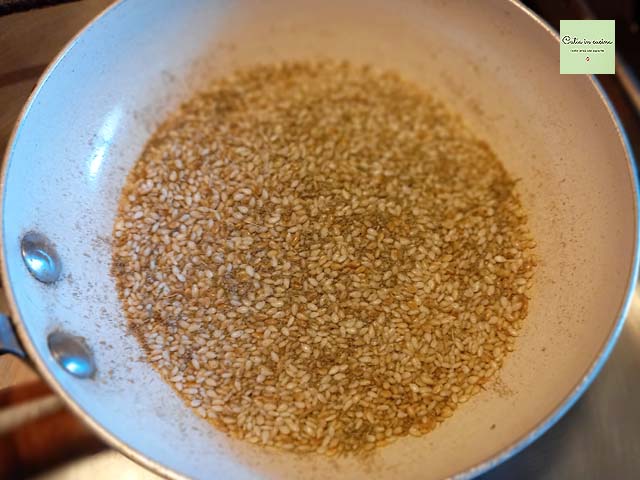
Transfer everything to a plate to cool, otherwise the sesame in the hot pan continues to toast and could become bitter.
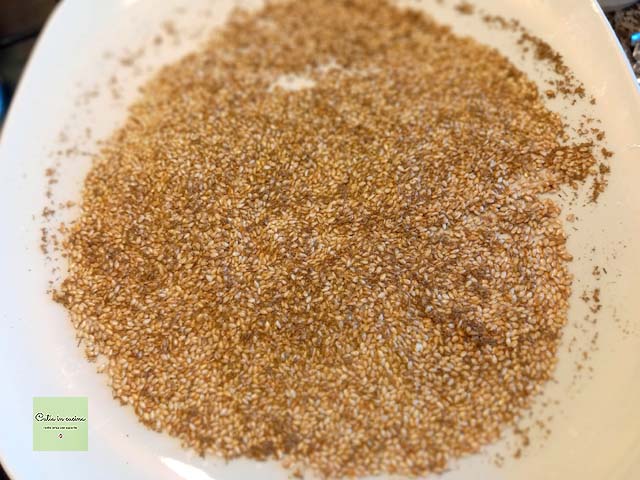
Then grind it.
👉 So far, for gomasio and celery salt gomasio, I have always used my small chopper, which, although not particularly effective in grinding sesame, has always satisfied me. Also because, in reality, according to the rule, gomasio should not be ground completely but only 80% (and, again according to the rule, it should be pounded in a mortar, it’s fair to say, although I prefer to grind it).
Lately, I’ve started using the coffee grinder to grind all sorts of things, and I must say that it works perfectly with gomasio, ready in a few seconds.
Here’s how it looks after a few seconds of the grinder’s operation:
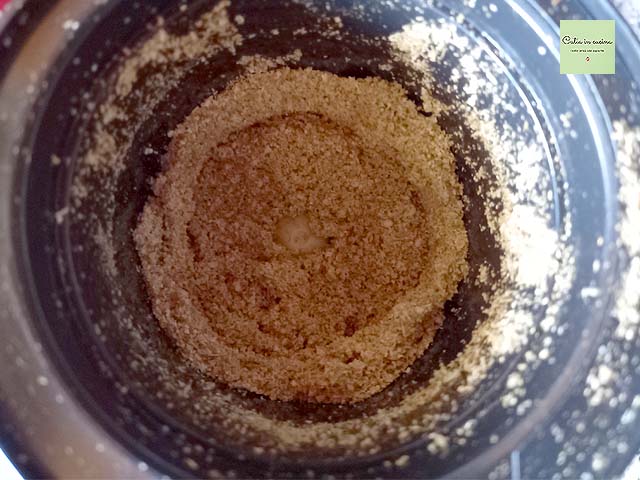
Done. The artichoke gomasio is ready!
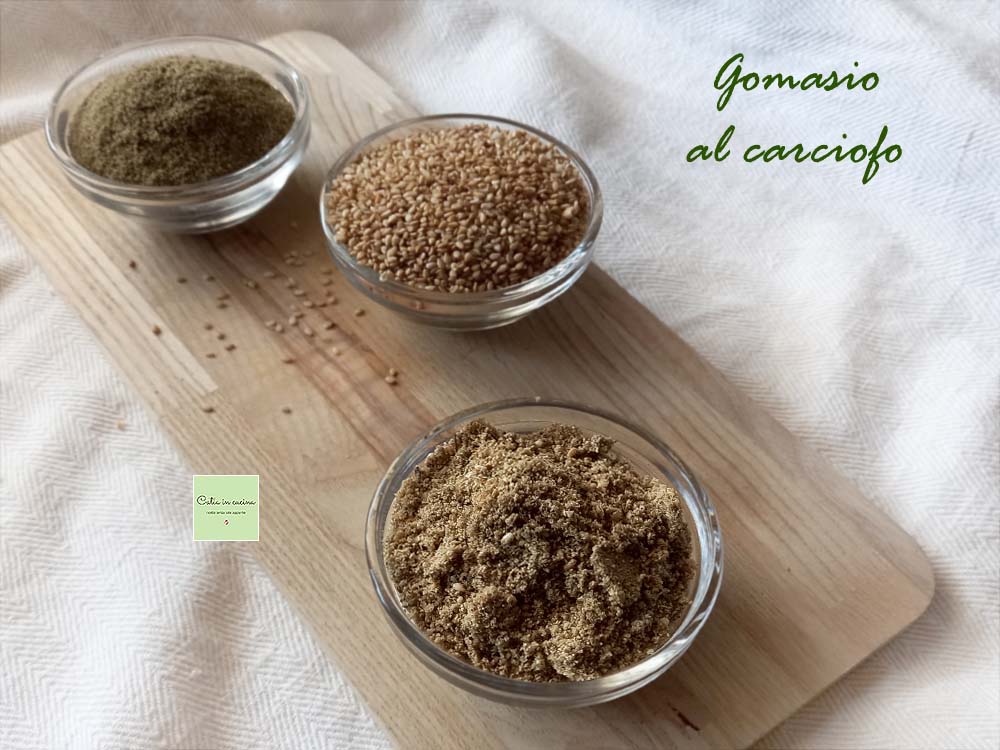
☝ The gomasio-artichoke ratio can be varied as desired, also because it may depend on the intended use of this seasoning. For now, I am trying this 2:1 ratio (2 teaspoons of gomasio for 1 of artichoke powder) as indicated in the ingredients, and I will tell you in a future recipe how I used it. 😉
See you soon!
Salt-Free Tips
If you’re interested in reducing or eliminating salt, always remember to:
▫ Decrease salt gradually, the palate needs to get used gradually and should not notice the progressive reduction.
▫ Use spices. Chili, pepper, curry, nutmeg, cinnamon, cloves, cumin…
▫ Use aromatic herbs. Basil, parsley, oregano, thyme, sage, marjoram, rosemary, mint…
▫ Use seeds. Sesame, pine nuts, almonds, walnuts…
▫ Use spicy vegetables or fruit. Garlic, onion, lemon, orange…
▫ Use my salt-free vegetable granules
▫ Prefer fresh foods.
▫ Avoid cooking in water, prefer methods that do not disperse flavors (grilling, en papillote, steaming, microwave)
▫ Avoid bringing the salt shaker to the table!
▫ Occasionally break the rules. It’s good for your mood and helps you persevere.
If you don’t want or can’t give up salt:
▫ You can still try my recipes, salting according to your habits.
Follow Me!
In my new WhatsApp channel and on Instagram.
As always, you can find me on my Facebook page, on my Pinterest boards, in my two groups: Catia’s Group, in the kitchen and beyond and Just what I was looking for! and if you like… sign up for my Newsletter.
As always, you can find me on my Facebook page, on my Pinterest boards, in my two groups: Catia’s Group, in the kitchen and beyond and Just what I was looking for! and if you like… sign up for my Newsletter.
