
The bazzana is an old-time country recipe, a simple dish typical of a bygone era, but one I was fortunate enough to experience.
I have vivid memories of the countryside, that rural world which today seems like another time, and yet it still existed (or rather, coexisted) during my childhood.
I have indelible memories of my grandfather Giovanni who would till the entire field by hand, of the wine bottle planted in the ground, of me and my grandmother Francesca sitting and admiring the chicks, of the “priest” used to warm the beds, the inevitable fireplace, and my grandfather sitting in front of it, always saying that the crackling fire was much more of a companion than the television. I remember the wonder of watching those little fluff balls of newborn rabbits, watching my grandmother preparing the chicken for soup and discovering how many little eggs of varying sizes it had inside, something that seemed magical to me.
I also remember less idyllic things, like the chamber pot under the bed because there was no bathroom, the “bathroom” (if you could call it that) in the field, the bothersome normalcy of flies, the “flit,” the bad smells…
No, not everything was rosy. But the memories I carry with me are all beautiful, the child I was saw only positives in that world. The farming life back then was undoubtedly hard, exhausting, and often unfair. But it had the merit of authenticity and a connection with nature that we have now lost.
Strangely, I do not recall ever eating the bazèna – the original dialect name – at my grandmothers’ houses, neither one. The bazzana I know was always only cooked by my mother.
Including the recipe I share today, specifically cooked by her while I merely photographed it (and then ate it too 😊😜).
I’ll take a short detour: doing some online research, among the recipes published I saw it often called bazzana of fava beans. Instinctively, that of fava beans gives me a sense of redundancy, the term bazzana, and even more the dialectal bazèna, already implies the meaning of of fava beans (at least here in our part of Romagna bordering the Marche). I know this is the case, it is one of those things I know even though I don’t know why. Is it the same for you?
So, the bazzana. When, why, and how is it cooked?
My mother always demurs and says “no, but I don’t know how to make it well, I do it by eye, I don’t know the recipe” 😃 Ahah! That “I don’t know the recipe” is wonderful.
But that’s how it is.
Old recipes, those cooked by mothers and grandmothers, weren’t recipes, they existed in themselves.
So this one I’m sharing is not “the bazzana recipe,” but “the bazzana recipe that mother cooked today,” following her experience and memories of how her mother, my grandmother Maria (born in 1903), used to cook it when wasting food was a sin, and unthinkable, when the purpose of cooking was to prepare dinner with what was available, to cook those fava beans that were too large, too tough, or too old. Or simply “limp,” that is, wilted because they had been picked a few days earlier.
Because fava beans are so good “eaten from the plant” (quote) but by the next day, they aren’t anymore, so it’s better to cook them.
Before the bazzana: I leave you links to other recipes from my tradition that are present here on the blog, all recipes to which I am enormously attached: 👇
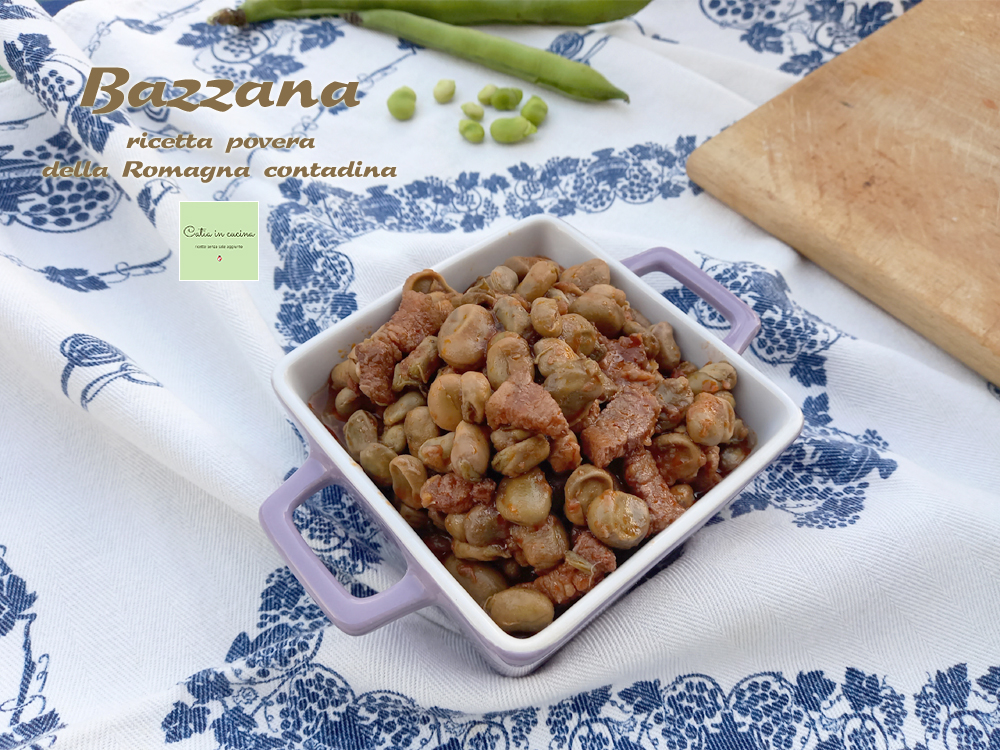
- Difficulty: Easy
- Cost: Very cheap
- Preparation time: 5 Minutes
- Portions: 2
- Cooking methods: Stovetop
- Cuisine: Regional Italian
- Region: Emilia-Romagna
- Seasonality: Spring, Summer
Ingredients
- 400 g fava beans (shelled)
- 50 g fresh bacon
- 30 g onion (half small onion)
- 3 tablespoons tomato sauce (about 50 g)
- 1 glass water (200-250 g)
- 1 tablespoon extra virgin olive oil
- 2 leaves bay (optional)
- salt and pepper (to taste)
Tools
- Frying Pan
Preparation
Shell the fava beans, briefly rinse the seeds in water and drain.
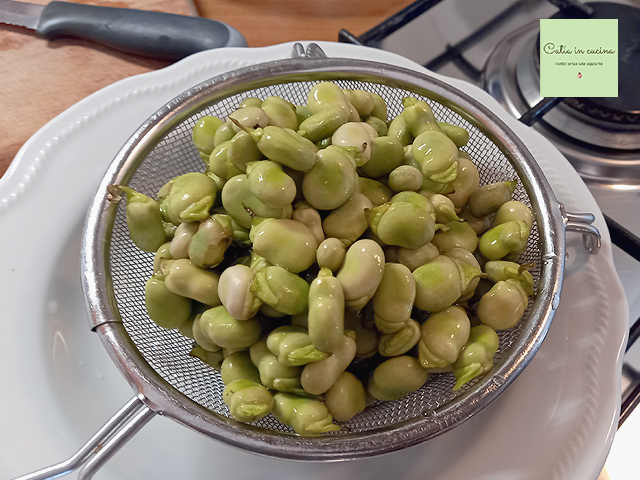
Chop the onion and cut the bacon into small pieces.
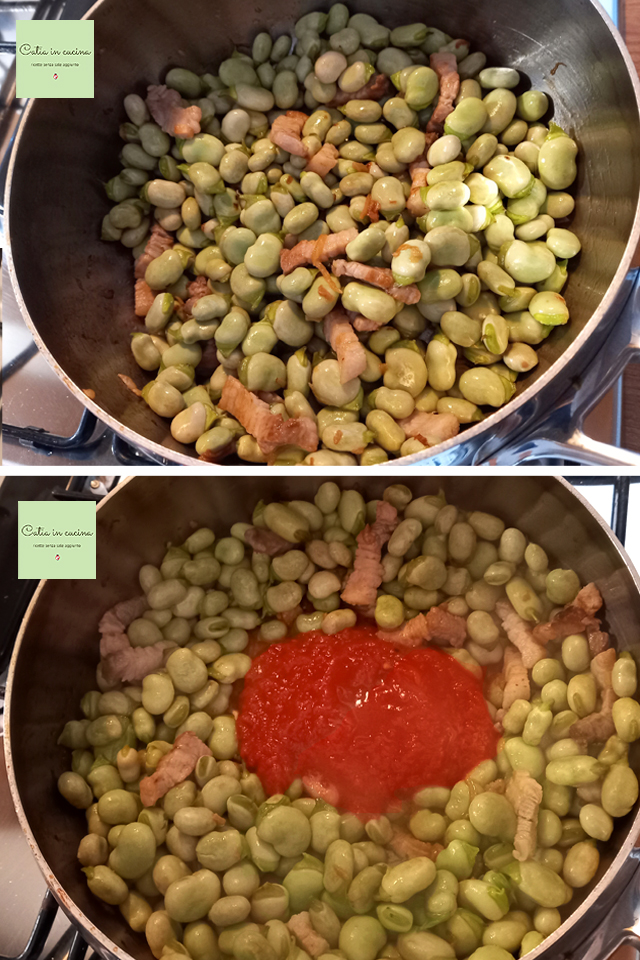
In a saucepan, sauté the onion in a tablespoon of oil until it becomes transparent, add the bacon and brown it (but do not let it char).
Add the fava beans and let them flavor for a few minutes, then add the tomato sauce.
Tip: don’t throw away the pods! (if you are sure of their organic origin), and use them to cook this excellent pods velouté 😉
Stir, add a glass of water (or enough to cover everything), close the lid, and let it cook on low heat for 40-45 minutes.
The cooking time may vary, depending mainly on the size of the seeds, if they are very large it might even take an hour.
Check from time to time that the water has not dried out and replenish if necessary.
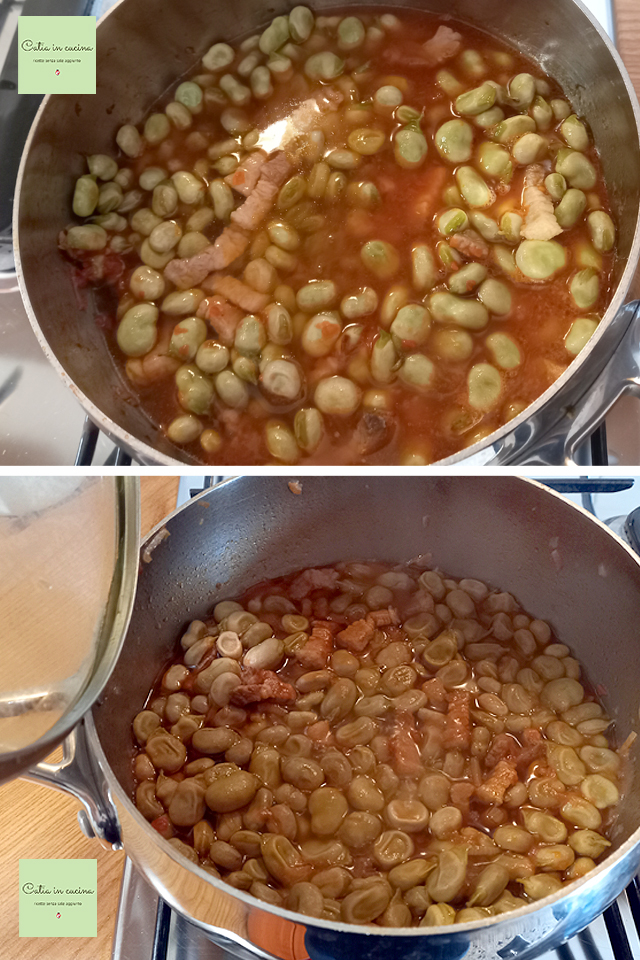
If you want a thicker sauce, you can use more tomato sauce (in case you want to eventually turn the bazzana into a pasta sauce). Or you can make it even more brothy to turn it into a soup.
But in the classic bazzana version as a side dish/second course, my mom assures that the sauce made this way…
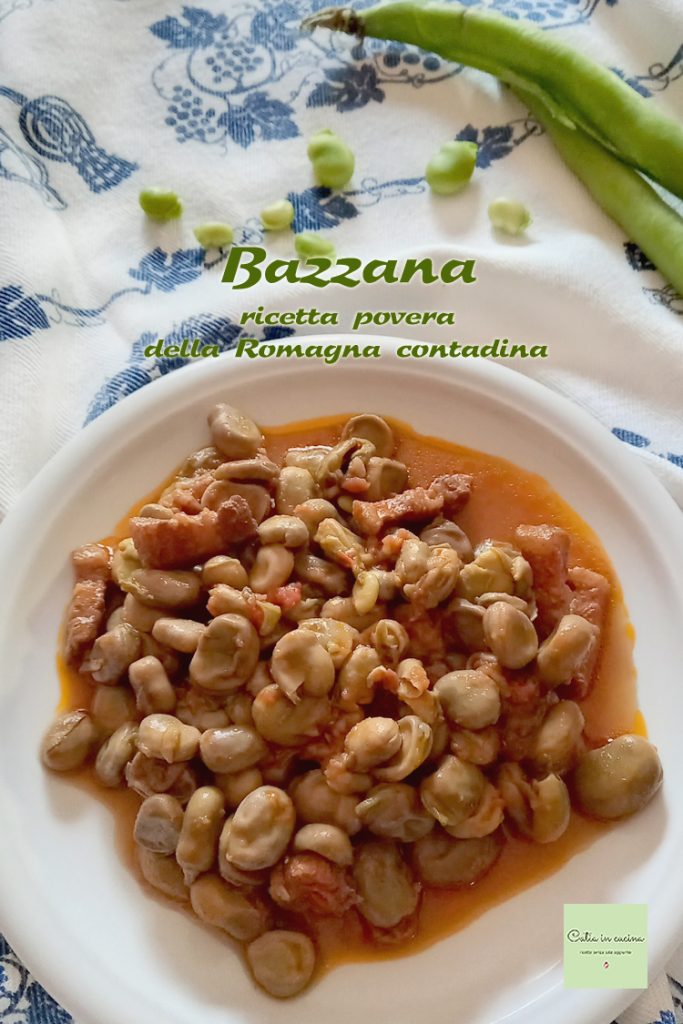
…is just how it should be.
And dipping bread into that sauce, there’s nothing more to say… it’s a must! 😀
Tips and suggestions
Bay leaves: you need them. But if you don’t have them, then nothing. I suggested to mom to replace it with rosemary but she didn’t approve. Better nothing than just anything, basically.
Bacon: by pure chance we had a piece of homemade bacon in the fridge. Great! It was needed! Because as mom says: “pork is a must”.
Pork must never be missing in any respectable Romagna country recipe. In fact, I suspect that instead of oil, a bit of lard was used to sauté the onion, as I know for sure that country cooking used lard regularly, and widely, both in pasta sauces and in the cooking of second courses (if anyone knows better than I do, tell me if this suspicion is founded).
In the absence of bacon, a crumbled sausage can be used, or a piece of prosciutto (“it was made with what was available at home”).
Here, I’ll show you a photo from a few years ago, of a bazzana where we used a piece of prosciutto heel cut into pieces (and bay leaves):
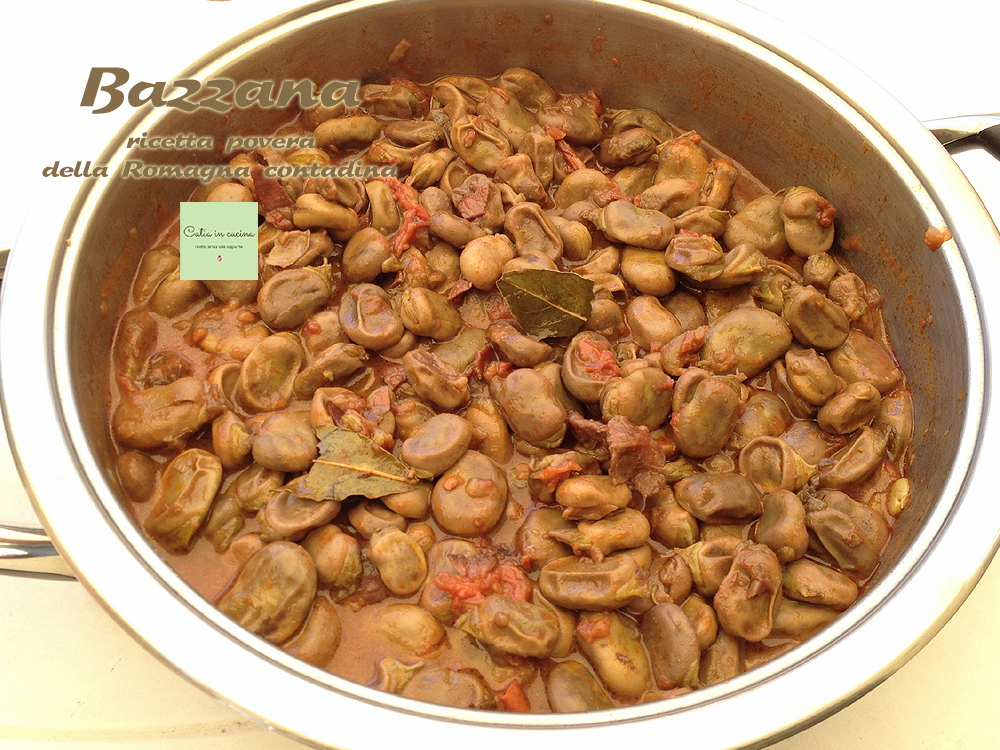
Bazzana has a flavor all its own. Cooked fava beans have a different taste, at least to me, than they do when raw. At the first spoonful, you perceive the bitterness, and an aftertaste I can’t explain but which fully conveys the meaning of country cooking. It’s a dish that should not be just tasted, it should be eaten. And it should be eaten all. With bread, or why not with a nice garlic bruschetta made with homemade bread. And I assure you, with every spoonful, it becomes more and more delicious.
Have I convinced you? 😀
Enjoy your meal!
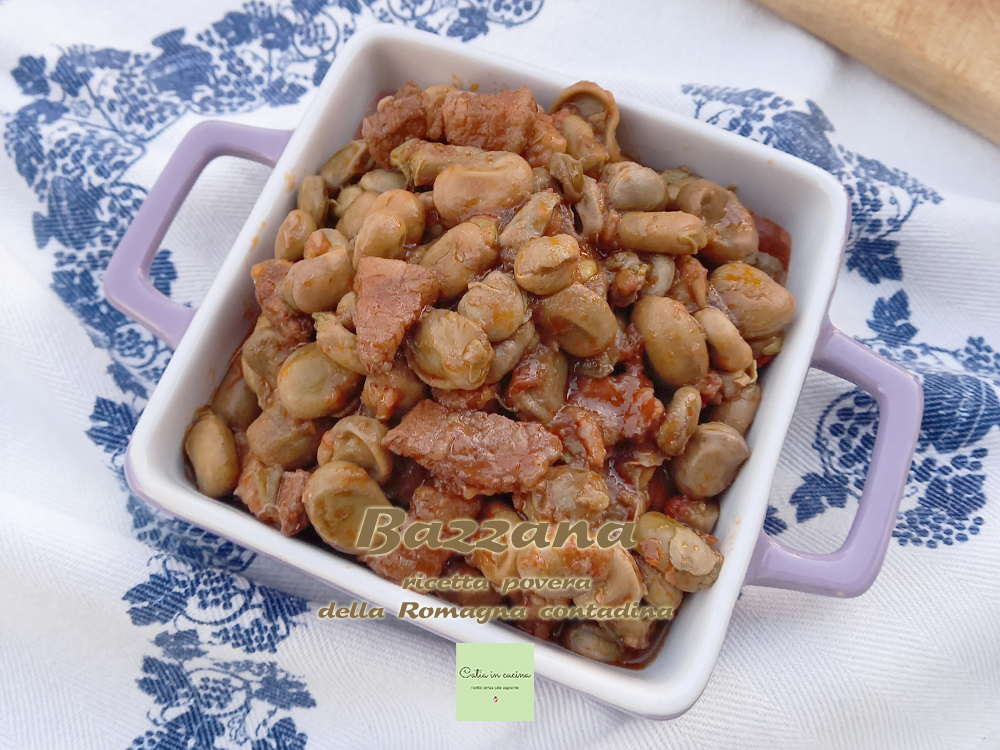
In conclusion, before saying goodbye and inviting you to the next recipe, I tackle the thorny (😄) subject of without salt. If you’re here because you’re following me, you already know the purpose of this blog, which is to promote low-sodium cooking.
Today I made an exception, I indicated, very rarely, salt in the ingredient list, and I also spare you the without salt advice with which, as you know, I always conclude my recipes. Reason: today’s is a traditional recipe, I did my best to bring it here as faithfully as possible. And low-sodium cooking was certainly not, I bet, typical of our grandparents’ and great-grandparents’ era. At the time, things were salted (everything, not just the bazèna) without too many doubts, indeed, the more flavorful, the better. Hypertension, cardiovascular diseases, renal issues, dementia prevention… were not known, were not priorities in life back then.
 Today we are aware of our health and our diet, and we all know that the sodium we need is exactly half of what – unfortunately – is habitually used by everyone. I urge you to take it into account. And to reduce it. (Even when cooking a traditional recipe 😉).
Enjoy!
Follow me!
On my new WhatsApp channel and on Instagram, on Facebook page and Pinterest, in my two groups: Catia’s group, in the kitchen and beyond and Just what I was looking for! and if you feel like it… subscribe to my Newsletter.
