
After more than nine years of blogging, after two bechamel recipes both cooked in the microwave, and after mentioning bechamel several times in various recipes, I believe it’s finally time to write the recipe for classic bechamel.
Or rather: the classic bechamel as I make it, in my kitchen, with my hands and my cookware, with no claim to call it traditional, true, or original.
A necessary clarification, always made when I write about traditional recipes, indispensable in this current era in which there are people who feel entitled to hurl insults at anyone who ‘dares’ not to have the same feeling (let’s put it that way, because saying I don’t like it or I prefer to make the recipe differently apparently isn’t allowed) about certain traditional recipes. Apparently some believe that daring to personalize a recipe to one’s own taste is sufficient reason to launch insults.
This current mix between, on one hand, an unstoppable globalization of recipes where everyone replicates dishes from around the world, and on the other hand, a maniacal attachment to traditional recipes (but only to one’s own traditions, never those of others, because other people’s traditional recipes apparently count less), I frankly struggle to understand this short circuit. It wasn’t long ago that recipes weren’t a reason for spite and confrontation but were simply food. Cooking used to be a simple part of daily life, not a competition.
Recently I received insults for daring to write in an online conversation that I don’t like carbonara and that (at home, and never intending to publish my version) I personalize it to suit my taste. A stranger felt obliged to intervene with gratuitous insults directed at me and, not content, at all my fellow countrymen. What disturbed me most was noticing that there are people (really??) who use regional recipes as a banner of superiority, as if we didn’t live in a single Italy but still in Grand Duchies, Two Sicilies and the Papal State. Are we really like that?
Traditional recipes are a heritage, and there are registered recipes and specifications that protect them. But cooking, like everything else, evolves. Nothing remains static (oops, except for some unthinking opinions…). Mixtures are natural and inevitable, in cooking as in every other field. Have you ever thought about how language evolves? Without digging back to Latin and Vulgar Latin, just pick up a book from a few decades ago and you’ll see obvious differences with the current way of writing and speaking. Maybe in the future the language of my grandparents will disappear entirely, that dialect they had as their only language, which my parents still speak daily alongside Italian, that dialect I can barely speak like I barely speak English, and that my children do not speak at all while they know English perfectly. In the same way I think that in a few generations it will be normal to cook things we now reject, or that we may not even know yet. Maybe my beloved traditional piadina made with lard, once essential and now coexisting with the oil version, will no longer be a priority because perhaps lard will no longer be bought by anyone (possible? impossible? who can say?). And perhaps carbonara (or pizzoccheri or vincisgrassi) will no longer be identical to the version for which someone now allows themselves to hurl insults (possible? impossible? who can say?).
It may seem I’m digressing from the bechamel you expected, but no, because this parallel between food and language brought back a memory.
We — my grandmother, my mother when I was a child, and I as a child — used to call bechamel balsamella. Yes, just like Artusi called it. Did you too? And if so, when did you stop calling it balsamella? I don’t know, maybe in the late ’70s. My mother no longer uses that outdated term either, but no one ever told us to change it, no one told us we had to call it bechamel; it was an unconscious update.
And if one day it happens that, consciously or not, some recipe gets modified, deep down… what problem could it really be? Is it really a serious issue to debate, or insult, about how one must make carbonara (not in a restaurant, but at home, where one hopes you can do what you want) now, amid the sea of enormous problems we are struggling with in this era? Do we really have to read venomous comments every day toward someone who dared to add, say, cocoa to pastiera, or cook ragù for less than eight thousand hours, or similar things? Where does all this meanness, rudeness and, also, arrogance come from? Please!
Now I’ll write to you about my bechamel. Of course, if you’d like to read it. Otherwise, like everything else, the web is surely full of bechamels of every kind and style (and thank goodness it is!). 🙆♀️🤗
〰〰〰
- Difficulty: Easy
- Cost: Very affordable
- Preparation time: 5 Minutes
- Cooking methods: Stovetop
- Cuisine: Italian
- Seasonality: All seasons
Ingredients
- 2 cups milk
- 2 tbsp butter
- 3.5 tbsp flour
- nutmeg
- pepper
Tools
- Saucepan
- Spoon
Steps
Melt the butter in a saucepan and add the flour.
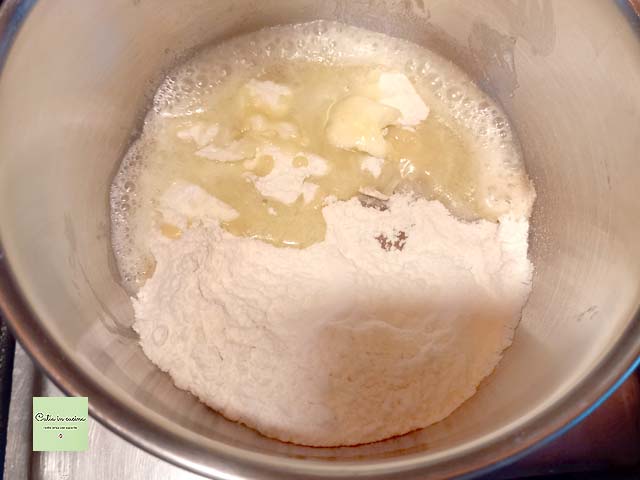
Combine the flour and butter and cook for a couple of minutes, stirring with a spoon or whisk.
Add the milk little by little, always stirring.
Keep stirring until the milk reaches a boil.
Continue cooking for a couple of minutes, or as needed.
Flavor with a generous grating of nutmeg and, if you like, with freshly ground pepper.
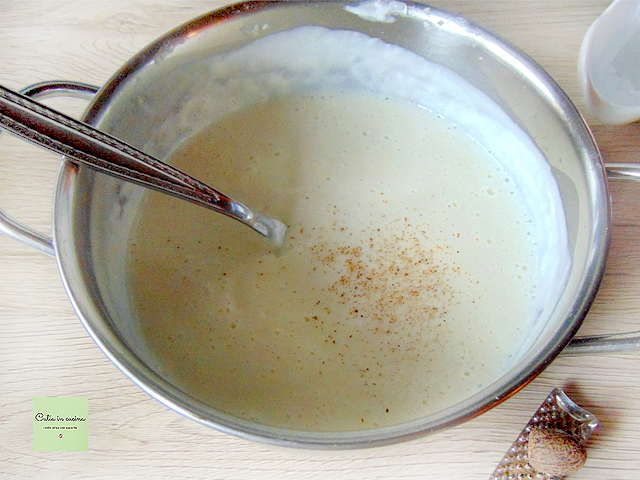
☝ The standard recipe everyone knows calls for 100 g (about 3.5 oz) of flour and 100 g (about 3.5 oz, roughly 7 tablespoons) of butter for 1 liter (about 4.25 cups) of milk. Often I make a half-liter batch (the one in this recipe) and use less butter and flour because I prefer a lighter bechamel that isn’t too thick, also considering it firms up as it cools. Depending on needs (personal preference or the requirements of the recipe where the bechamel will be used) it is possible to vary the amount of butter and flour, but always keeping the proportion unchanged, that is, the same weight of butter as flour.
👉 Using the same amount of butter and flour should help prevent lumps from forming, but if some lumps do form, simply blend the bechamel with an immersion blender.
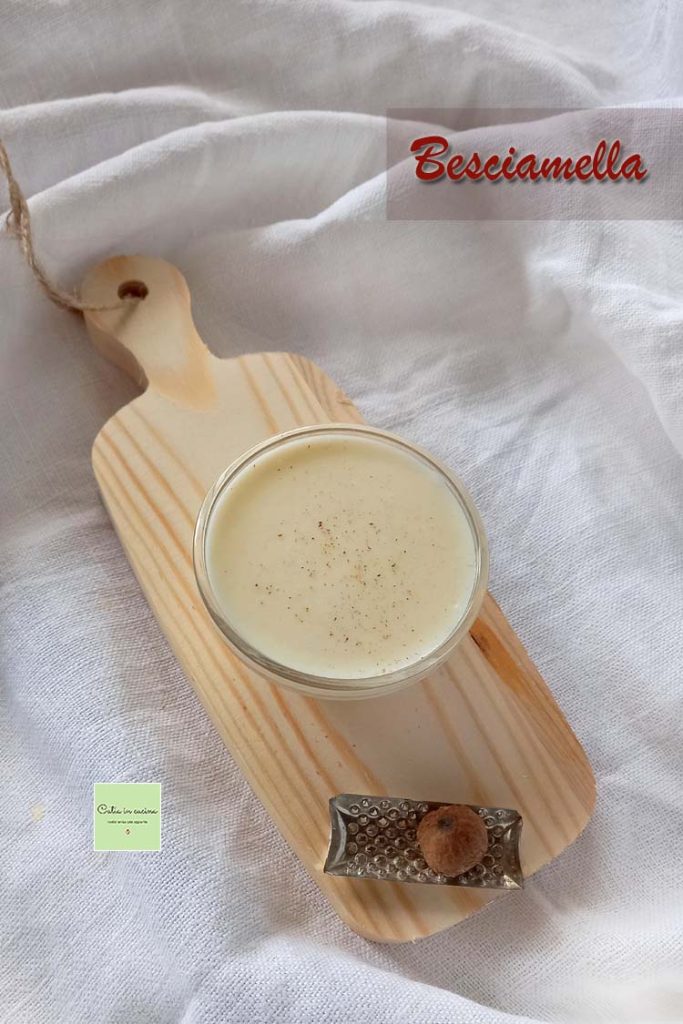
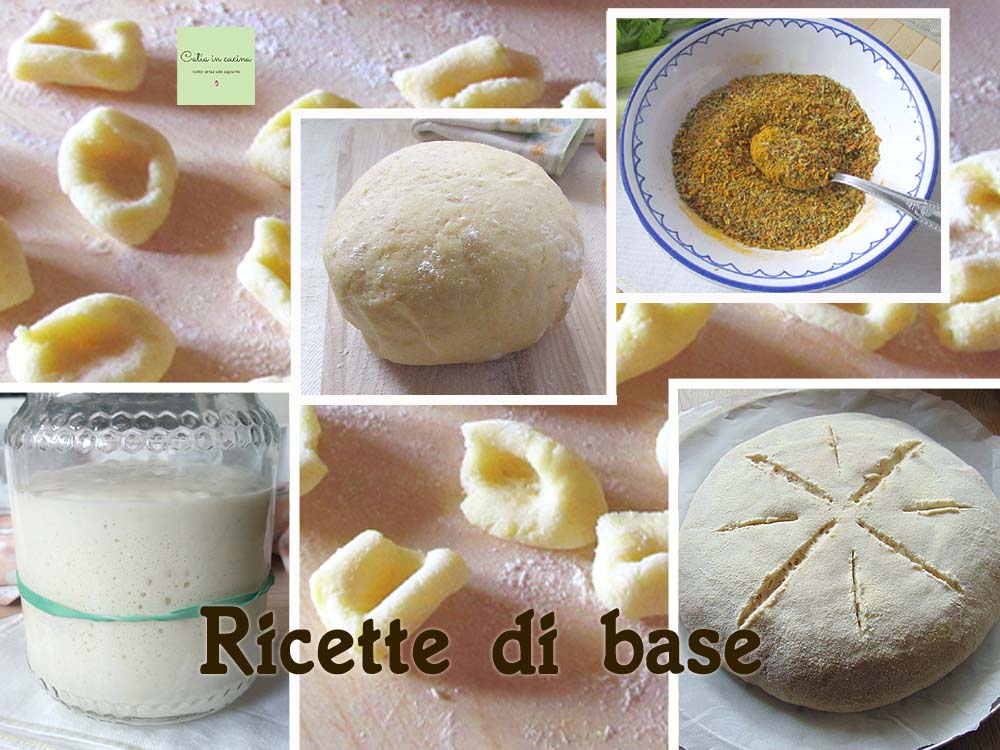
This recipe will enrich the collection of my basic recipes, which I invite you to consult because it’s full of useful ideas (useful to me, of course 😜). Click here! or on the photo below 👇👇
Salt-free tips
 I remind you that I cook without adding salt. 😉 If you want to learn more read this article and join my group!
If you’re interested in reducing or eliminating salt, always remember:
▫ Reduce salt gradually; the palate needs to get used to the change slowly.
▫ Use spices: chili, pepper, curry, nutmeg, cinnamon, cloves, cumin…
▫ Use aromatic herbs: basil, parsley, oregano, thyme, sage, marjoram, rosemary, mint…
▫ Use seeds: sesame, pine nuts, almonds, walnuts…
▫ Use pungent vegetables or fruits: garlic, onion, lemon, orange…
▫ Use my salt-free vegetable granular and the gomasio.
▫ Prefer fresh foods.
▫ Avoid boiling in water; prefer cooking methods that don’t disperse flavors (griddle, foil, steam, microwave).
▫ Avoid putting the saltshaker on the table!
▫ Allow yourself an occasional indulgence. It good for the mood and helps you persist.
If you don’t want or can’t give up salt:
▫ You can still try my recipes and season them according to your habits.
Follow me!
On my WhatsApp channel and on Instagram, on my Facebook page, on Pinterest and in my two groups: Il gruppo di Catia, in cucina e oltre and Proprio quello che stavo cercando! — and if you like… subscribe to my Newsletter.
On my WhatsApp channel and on Instagram, on my Facebook page, on Pinterest and in my two groups: Il gruppo di Catia, in cucina e oltre and Proprio quello che stavo cercando! — and if you like… subscribe to my Newsletter.
