
I present to you a new leavened dough: the beer dough.
A dough that I will immediately include in two different collections:
– in the collection of basic recipes, as it is a base dough suitable for various recipes, from bread (also stuffed) to pizzas, and focaccias,
– and also in the collection of anti-waste and recycling recipes, because it is leavened with excess (of licoli) (which I always use, never throw away the excess) and is kneaded with leftover beer.
Sometimes it happens that we don’t drink all the beer, especially when we buy slightly larger bottles. Does it happen to you?
Most of the time I start kneading right after dinner, specifically to use the leftover beer from the just-finished dinner, so the dough rises overnight and for the next day’s lunch, I have the bread ready.
But if I can’t, or I’m tired, or I feel like sitting on the couch (yes, it happens! 😊) I close the bottle tightly and put it in the fridge and then use it in the following days, maybe topping it up with leftover from another bottle, as it works just as well when used for kneading. What can I say, I don’t have the heart to pour the leftover beer down the sink anymore? Years ago I did, but since I learned to use it in doughs, I don’t do it anymore, it’s the right thing to do!
Here it is, for me, this beer dough is beautiful. And it’s exactly what I used to make the next recipe.
PS: Naturally, if you never end up with leftover beer (not that I don’t understand you 😊) you can also use freshly and specially opened beer. Then, yes, you’ll still have leftover beer… that someone will have to drink! Same cycle, but in reverse. 😄
- Difficulty: Medium
- Cost: Economical
- Rest time: 10 Hours
- Preparation time: 10 Minutes
- Cooking methods: No Cooking
- Cuisine: Italian
- Seasonality: All Seasons
Ingredients
- 2 cups cups all-purpose flour (manitoba)
- 2 cups cups whole wheat flour
- 1 1/8 cups cups beer
- 5 oz oz liquid sourdough starter (excess)
- 1 1/2 tbsp tbsp oil
Tools
- Stand Mixer Russel Hobbs
Procedure
The procedure is very simple, and similar to other doughs like for example this dough with licoli and kefir.
Pour into the bowl of the stand mixer (but it can also be kneaded by hand) the flours, excess licoli, beer, and a tablespoon of oil.
Knead with the dough hook until the dough is smooth and elastic.
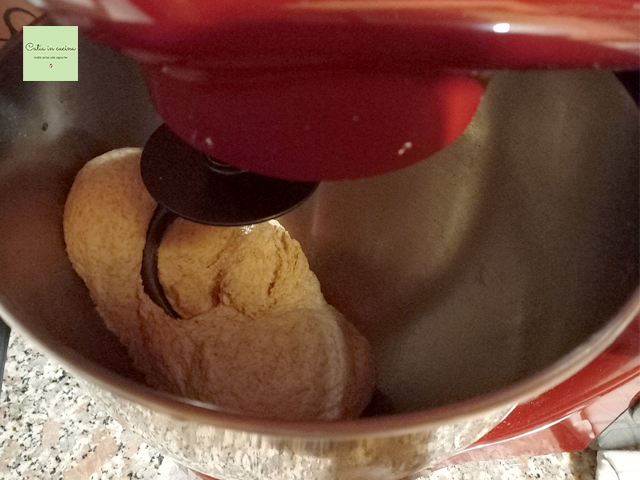
Grease the bowl of the stand mixer (or if preferred transfer the dough to another bowl) with a teaspoon of oil to prevent the dough from sticking to the sides during rising, and let it rise at room temperature for about 10 hours, with the bowl covered with plastic wrap.
End. (But take a look at the notes after the photo!)
Here it is, I show you my beer dough, flipped from the bowl onto the cutting board after exactly 9 hours and 45 minutes, and ready to be turned into a br…
…come on… I’ll reveal it with the next recipe! 😃
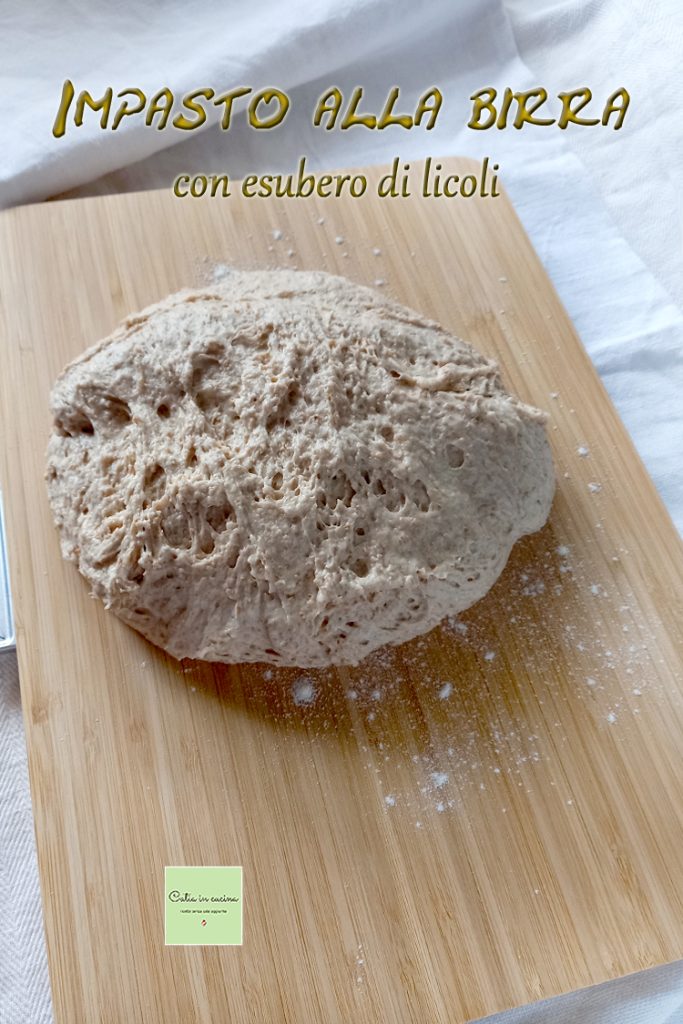
☝ During the first hour of rising, it can be helpful to proceed with some stretch and fold folds (for 2 or 3 times, every 15 minutes or so). These are reinforcement folds performed by stretching (stretch) the edges of the dough and then folding them (fold) towards the center. They help to incorporate air into the dough and promote gluten network development (for more details and some photos of this type of folds, take a look at this autolyse bread and these spiced mini buns).
👉 Since room temperature is not stable and varies according to the seasons, it is good to monitor the rising and consider rising hours as indicative. The dough will be risen when it has doubled.
☝ The use of excess lengthens the rising time a bit, with a refreshed and active licoli 8 hours may be enough.
👉 If the beer is not enough (if you are also recycling leftover beer) the missing part can be simply replaced with water.
👉 It is possible to replace whole wheat flour with more all-purpose flour, or with type 1 and type 2 flour (changing the flour may also slightly change the amount of beer to use).
Salt-Free Tips
 Like all my recipes, and therefore all my leavened doughs, this beer dough is entirely salt-free. 😉
If you are interested in reducing or eliminating salt, always remember to:
Reduce salt gradually, as the palate must slowly adapt and not notice the progressive reduction.
Use spices. Chili pepper, pepper, curry, nutmeg, cinnamon, cloves, cumin…
Use aromatic herbs. Basil, parsley, oregano, thyme, sage, marjoram, rosemary, mint…
Use seeds. Sesame, pine nuts, almonds, walnuts…
Use spicy vegetables or fruits. Garlic, onion, lemon, orange…
Use my salt-free vegetable granules and gomasio.
Prefer fresh foods.
Avoid cooking in water, prefer cooking methods that don’t disperse flavors (grill, foil, steam, microwave)
Avoid bringing the salt shaker to the table!
Occasionally indulge a break from the rule. It lifts the mood and helps to persevere.
If you do not want, or cannot, give up salt:
You can still try my recipes by salting according to your habits.
Follow Me!
On my WhatsApp channel and on Instagram, on the Facebook page, in Pinterest and in my two groups: Catia’s Group, In the Kitchen and Beyond and Just What I Was Looking For! and if you like… subscribe to my Newsletter.
On my WhatsApp channel and on Instagram, on the Facebook page, in Pinterest and in my two groups: Catia’s Group, In the Kitchen and Beyond and Just What I Was Looking For! and if you like… subscribe to my Newsletter.
SPECIAL: Guide to the Best Stand Mixers of 2023
