
The bulgur stuffed peppers were an experiment I did by chance, just to try.
But the result was so good and they were so beautiful to see that I couldn’t resist the temptation to photograph them.
And now I’ll give you the recipe; I hope you like it too! 😀
I have always been very attracted to photos of stuffed peppers, complete with a stem cap, seen in magazines, books, and cooking blogs. But for some unknown reason, I never wanted to try cooking them.
Actually, yes, a little bit I know.
Usually, at least in my memories, they were stuffed with rice and the idea of filling peppers with rice never really attracted me. I imagined cutting the pepper and seeing all the loose rice fall onto the plate, and I didn’t like the idea.
But now that I’ve tried it with bulgur, which behaved, um, more or less as I expected from rice, 🤭 it didn’t seem so bad 😊
And anyway… I really have to say that the nice impression these bulgur stuffed peppers made on the plate more than compensated me!
And the next step… will be trying with rice!! Haha! 😀
If you don’t know bulgur, I’ll briefly explain what it is: it’s a derivative of durum wheat, reduced to granules similar to couscous but with a coarser grain. Unlike couscous, it is made from germinated and whole seeds, so it is a good source of fiber, as well as vitamins and minerals. It originates from Turkey, while couscous is from Africa.
And now here’s the recipe!
〰 〰 〰
Other recipes with peppers:
- Difficulty: Easy
- Cost: Affordable
- Preparation time: 15 Minutes
- Portions: 4
- Cooking methods: Oven
- Cuisine: International
- Seasonality: All seasons
Ingredients
- 4 peppers (or 6, if small)
- 1 cup bulgur
- 1/2 onion
- 1 carrot
- 1 stalk celery
- 2 cups water
- black olives (quantity to taste)
- 1 tbsp extra virgin olive oil
- pepper
Tools
- Saucepan
- Frying Pan
- Chopper
Steps
Cook the bulgur following the instructions on the package. I cooked it in water, to which I added a teaspoon of oil, for about 15 minutes. Drain it, pour it into a bowl, and fluff it with a fork if necessary.
Wash and chop the celery and carrot into pieces. Chop them in the blender along with the onion.
Rinse the olives and chop them coarsely.
In a pan, sauté the vegetable mixture in a little oil. For even lighter cooking, you can cook them with the lid closed and a few tablespoons of water or vegetable broth. Add the chopped olives.
Pour the bulgur into the pan and let it absorb flavors.
Optionally season with herbs of your choice and with pepper or chili pepper.Wash the peppers.
Cut off the top, remove seeds and filaments, and fill the peppers with the bulgur and vegetables.
Place the peppers in a baking dish lined with parchment paper. The use of parchment paper ensures light cooking because the peppers do not stick to the bottom of the dish even without adding any seasoning.Close the peppers with their tops.
Bake in the oven at 350-400°F for about half an hour. Remove the caps halfway through cooking to prevent them from getting too roasted.
The cooking time may vary, not only depending on the oven but also on personal taste.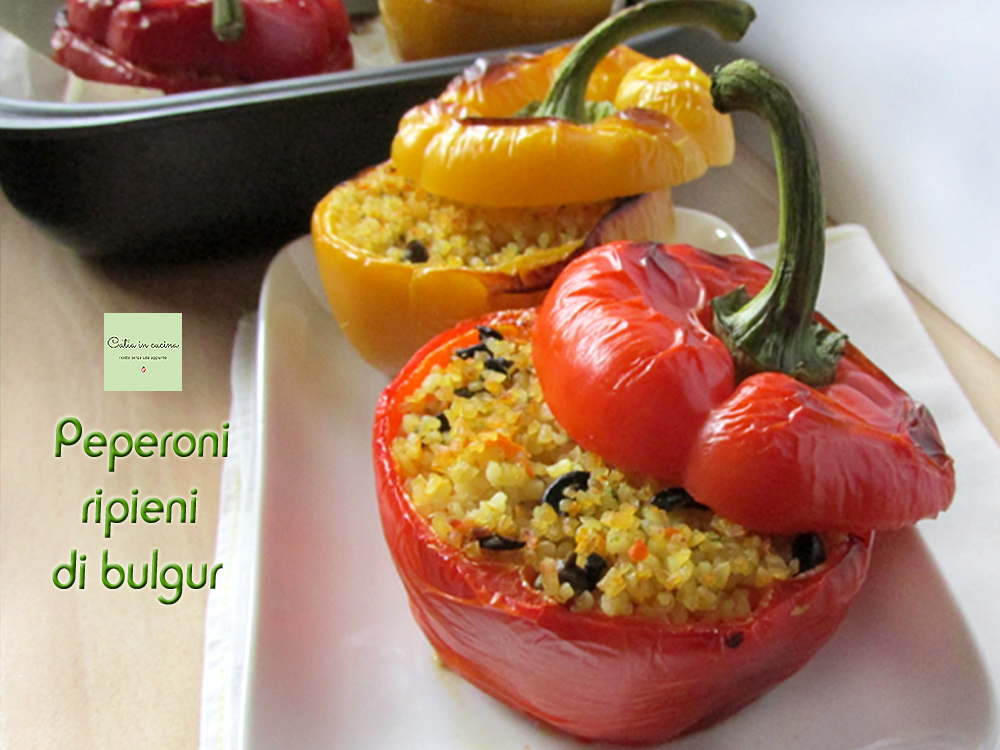
This recipe is intentionally vegan. It can be turned vegetarian by adding diced cheese or grated parmesan, and in this case, it can safely be considered a main dish. The addition of cheese certainly makes the filling more compact.
Of course, you can replace carrot and celery with any preferred vegetables.Enjoy!
Salt-Free Tips
 I remind you that I cook without added salt. If you’re wondering why 😊 it’s all told in this article of mine.
If you want or need to reduce salt in your diet, I invite you to start doing so by following these very simple tips:
If you’re interested in reducing or eliminating salt, always remember to:
▫ Gradually decrease the salt, your palate needs to get used to it slowly and should not notice the progressive reduction.
▫ Use spices. Chili pepper, pepper, curry, nutmeg, cinnamon, cloves, cumin…
▫ Use aromatic herbs. Basil, parsley, oregano, thyme, sage, marjoram, rosemary, mint…
▫ Use seeds. Sesame, pine nuts, almonds, walnuts…
▫ Use pungent vegetables or fruit. Garlic, onion, lemon, orange…
▫ Use my salt-free vegetable granules and gomasio.
▫ Prefer fresh foods.
▫ Avoid boiling, prefer cooking that does not disperse flavors (grill, en papillote, steam, microwave)
▫ Avoid bringing the salt shaker to the table!
▫ Occasionally allow yourself a little indulgence. It’s good for mood and helps perseverance.
If you don’t want or can’t give up salt:
▫ You can still try my recipes by salting according to your habits.
Follow me!
On my new WhatsApp channel and on Instagram, on the Facebook page, on Pinterest and in my two groups: Catia’s group, in the kitchen and beyond and Exactly what I was looking for! and if you like, subscribe to my Newsletter.
