
Celery salt is a great alternative seasoning instead of regular salt, especially useful to get used to gradually reducing salt by adding it to salt (i.e., substituting part of it) exactly as I suggested for gomasio.
Celery salt has been on the waiting list, in the list of must-have recipes that I absolutely have to tell you about, for a long time. Finally, the photos are ready, and I can sit down here to write the recipe.
What could it take, you might say, to write this recipe? What makes it different from the others?
Paradoxically, it is always the recipes I repeat the most that fall behind. Most of the time because they give me trouble with the photos 😀 and yet, logically it should be the opposite, since I have many opportunities to take the photos. (Of this celery salt, if you knew the photographic history I have behind it!). But then… all these photos… in the end, they have led me to something useful… sometimes nothing is in vain. If I had taken perfect photos at the first attempt and had written the recipe right after the first experiment and the first photos, I wouldn’t have been able to share with you a discovery I made recently, a detail about this celery salt, that would have otherwise escaped me!
Perhaps it’s not the discovery of discoveries, but I… well, I said “ooohhh, but loooook! just take a look…” More or less like children, when they are amazed by little.
And cooking, and experimenting in the kitchen like this one, still manages to amaze me. How wonderful!
Want to know what it’s about? I’ll reveal it to you at the end! 😀
⏳⏳⏳
You can find more useful dehydrations here! 👇
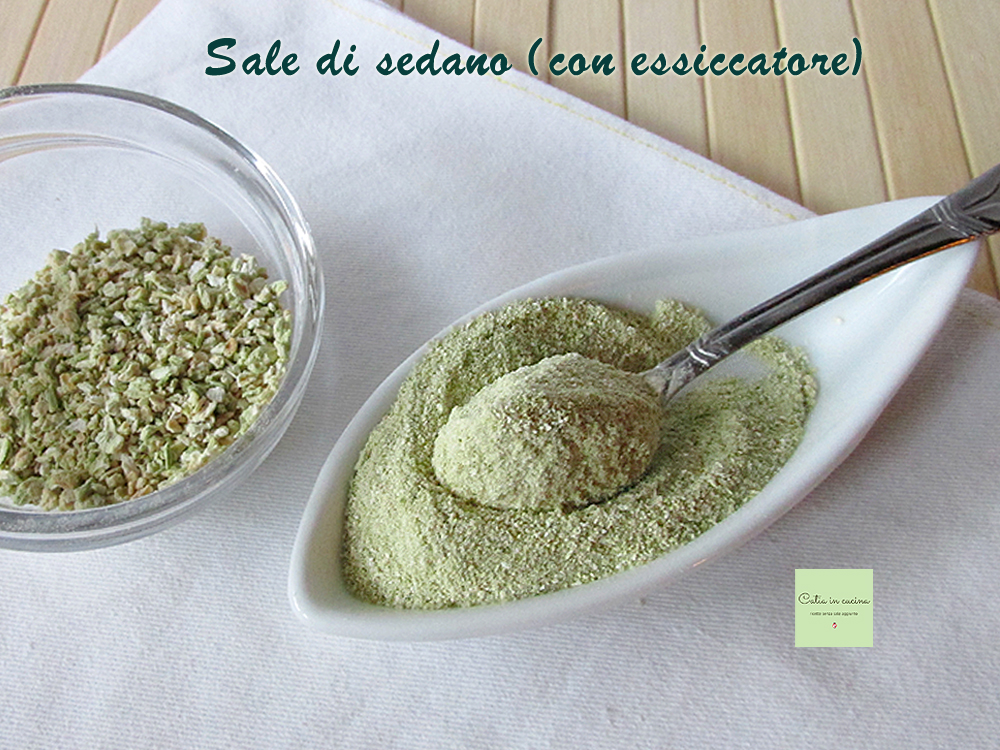
- Difficulty: Very Easy
- Cost: Cheap
- Preparation time: 6 Hours
- Cooking methods: No Cooking
- Cuisine: Healthy
- Seasonality: All Seasons
Ingredients
- green celery
Tools
- Dehydrator
- Food Processor
- Sieve
Steps
Wash the celery and slice it.
As I already mentioned in the recipe for vegetable granules, it’s better not to cut the celery lengthwise: the fibers need to be cut, otherwise, during dehydration, they’ll turn into hardened threads and will be very difficult to chop.Place the sliced celery on the dehydrator trays and start it.
After 2-3 hours, when the celery pieces have dried a bit, remove them and blend them, or rather chop them.Line the trays with parchment paper or foil and put the chopped celery back to dehydrate, this time until dry (about another 3 hours if the temperature is 140-150°F).
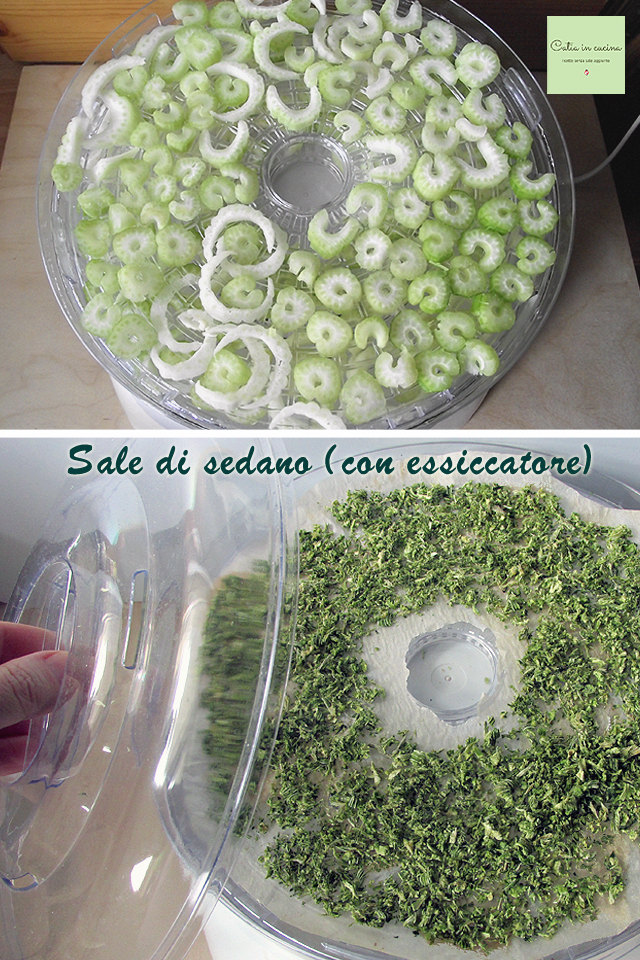
Alternatively, you can chop the celery right from the start. I’ve tried this option as well, but I haven’t noticed great differences, neither in the final yield nor in the dehydration times. Therefore, at least for now, I prefer this two-step method.
Chop the dried celery into a fine grain, the finest possible. A strong blender is necessary, possibly a coffee grinder (not a mini-chopper, just to be clear). My blender usually does a pretty good job (it’s the same one I mentioned and showed you in the recipe for sun-dried tomato and tofu pesto), but of all the tools I have, it’s the only one that manages, thanks to its speed. And anyway, the best grinding I get is what you see in the photo below. The reason: celery has fibers that become quite hard once dehydrated, and they offer resistance to grinding, at least that’s how it is for me. That’s why it’s important to cut the fibers by slicing the celery thinly.
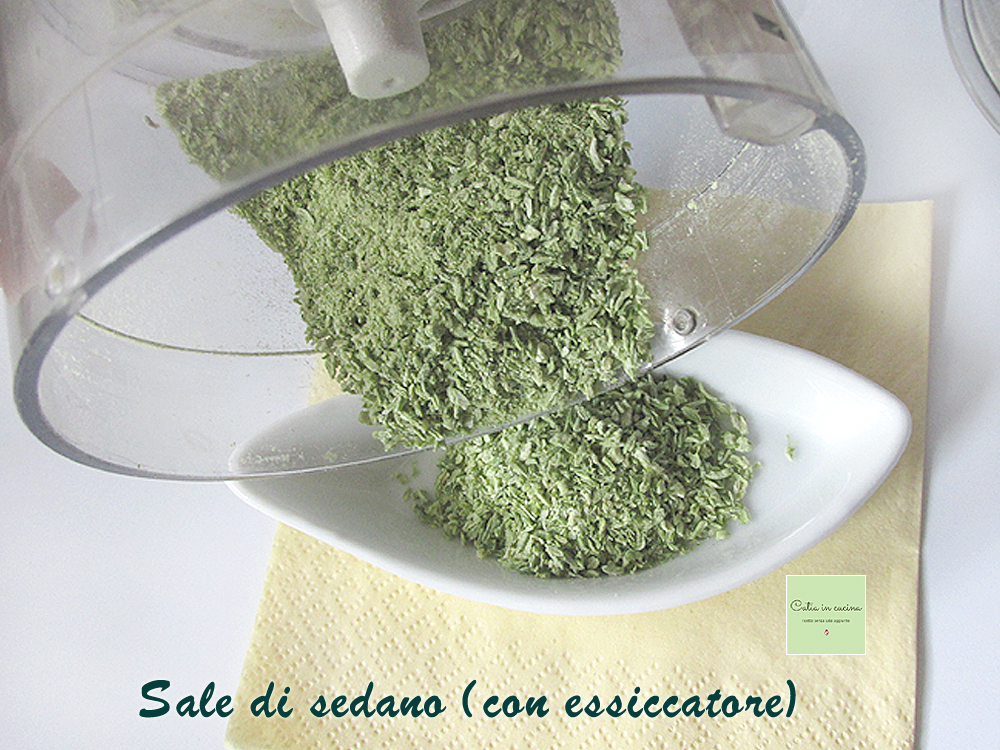
If you can’t grind it as finely as you’d like, you can safely use it as it is, which works just fine.
And in any case… there’s a remedy, I have the solution! (heheh!). Since fine celery salt is excellent both in “coarse salt” version and “fine salt” version, all you need to do is sift the obtained celery grind, and you can boast two different types of celery salt made by your own hands. What an idea, huh!! And then don’t say I’m not creative! 😀
Here’s the fine celery salt:
and the coarse celery salt:
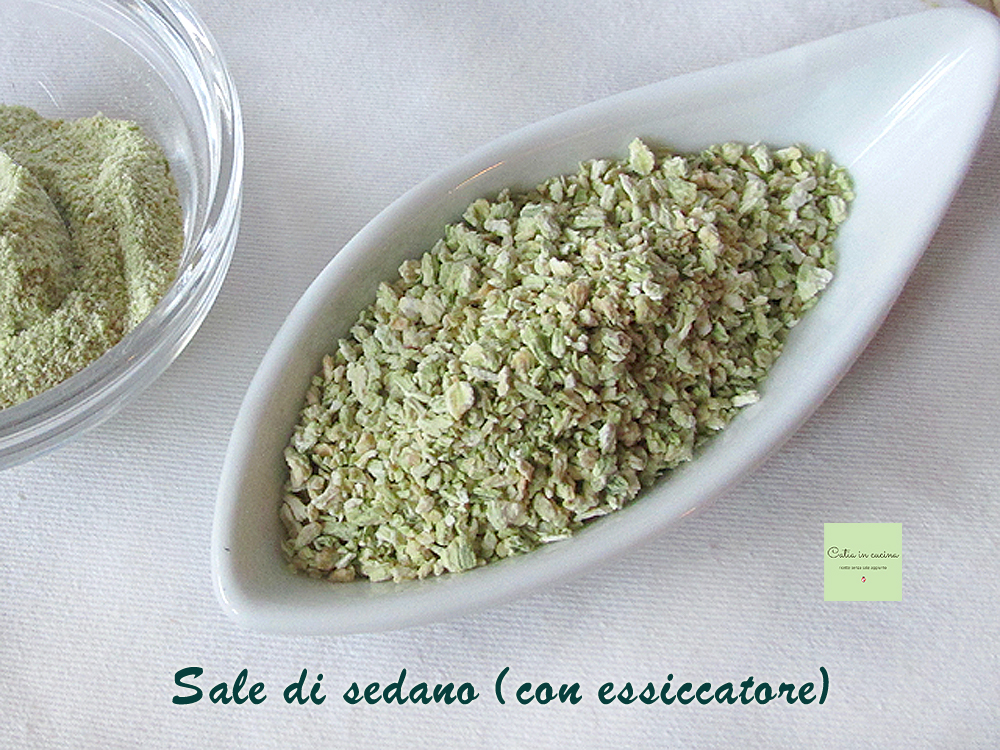
As you can see, in these two photos the green color seems more faded: this is from a previous production (as proof of multiple photo sessions) where I used white celery. At the moment, my advice is to use green celery, I find it more “flavorful”.
I use the fine celery salt raw directly in dishes, and the coarse one I use in cooking, mainly in sauces, or I add it to risottos, or vegetable broth, wherever I like, really.
🙂
Great! Now that I’ve told you how it’s made, I’ll leave you with some useful information about this fantastic celery salt:
1. Celery has many properties: detoxifying, digestive, diuretic, contains lots of vitamin A, but also B, C, E, K. It contains minerals, among which potassium is significant, which as a counterbalance to sodium, is protective against hypertension, making celery suitable in the diet of those taking antihypertensive medications (source: here).
2. Celery is a “flavorful” vegetable, as are other vegetables, like artichoke, fennel, cabbages, all naturally flavorful, as I mentioned some time ago talking about Chinese cabbage.
The idea of turning celery into “salt” I found truly ingenious. And I’ll tell you… for some time now, I’ve been thinking about trying to turn other vegetables into salt too. Who knows… we’ll see… 😉3. Of course, don’t expect celery salt to completely replace salt, much less overnight. Unless you’re already used to a low-sodium diet, unless your palate has already been adequately “reconditioned,” don’t put celery salt in your saltshaker instead of salt (!) thinking you can replace it one-to-one overnight. That’s not how it works. If you want to reduce salt, you have to do it gradually. Always remember that.
 4. In the perspective of a gradual reduction in salt, celery salt can be a valid alternative as a flavor enhancer, both raw (the fine one) and in cooking (the coarse one). Try tasting it on its own, a pinch of the teaspoon, you’ll find it really flavorful! (Hey, but be objective! Don’t taste it after tasting salt eh!).
👉 So. My advice is to start using it as a flavoring for salt, adding it to salt gradually in larger doses, while simultaneously and proportionally decreasing the amount of salt. Additionally, a useful use is to add it to gomasio to obtain celery salt gomasio, follow the link and read the article! 😉5. To be honest, packaged celery salt does exist on the market, but it’s not the same thing: the packaged kind (known for being an ingredient in the famous Bloody Mary) is a celery-flavored salt, which is quite different from this homemade celery salt, which is made of pure dehydrated celery and nothing else.
🌞 And now I’ll reveal that detail I mentioned in the introduction. 😉
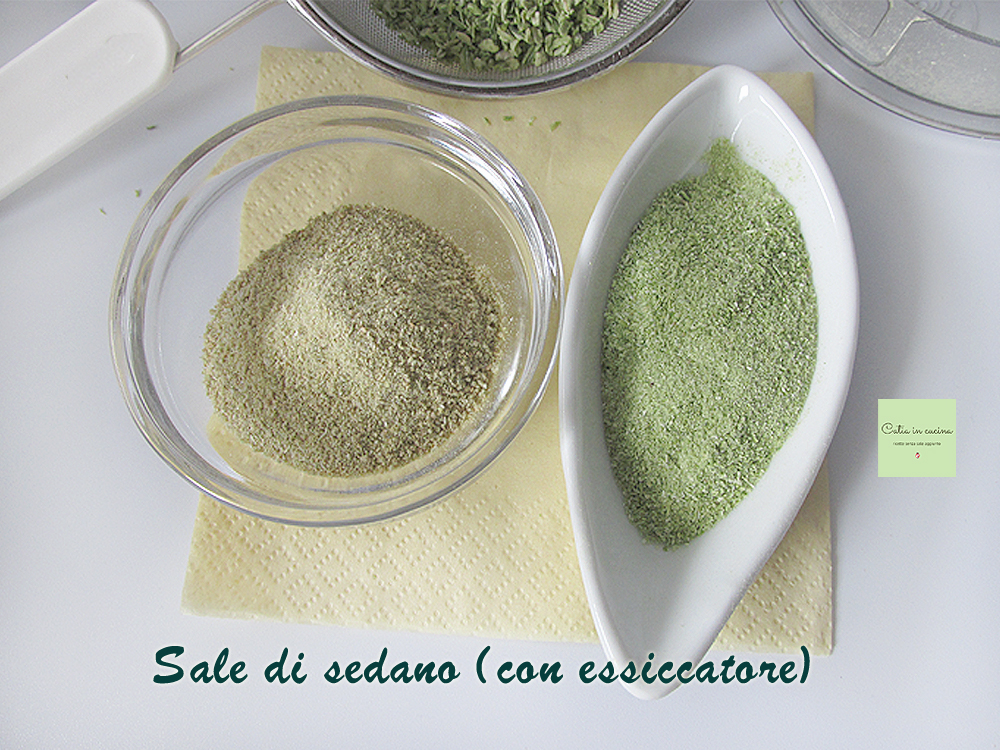
Well: over the months of experimentation and production, I’ve discovered that within two months, my celery salt, kept in a glass jar, changed color. I wouldn’t have noticed if I hadn’t produced some more and if I hadn’t had the idea to mix the two batches. Maybe it’s a minor discovery, but it’s something I’ve noticed and it surprised me, so I’m telling you: celery salt changes color over time! (at least in my house, as seen in the photo below).There’s not much difference in taste, although in my opinion, it loses a bit in flavor as well as color. So, in conclusion, based on my experience, for the shelf life of homemade celery salt I’d give an optimal 1 month.
Great, I’m done!, I’ve reached the end. 😊
But a thank you is due. A due thank you. I thank Erica, La Cuocherellona, because the first time I learned of the existence of celery salt was thanks to this article of hers. Thank you Erica! 😊
Celery salt is one of the many new things I’ve learned since embarking on this sea of food blogging. I just have to say that… maybe I did well to embark! How wonderful!
Salt-Free Tips
Today’s salt-free tips are represented by the entire recipe. 😊 I especially recommend following point 4, that is: find the right proportion of celery salt to use instead of a portion of the salt, then gradually reduce the salt by replacing it with celery salt. It will be a gradual but very important, and effective decline. And don’t forget to add it to gomasio to obtain the delicious and useful celery salt gomasio. 💪
Follow Me!
In my new WhatsApp channel and, hear hear! I’m now also on Instagram! 😀
As always, you can find me on my Facebook page, on my Pinterest boards, in my two groups: The group of Catia, in the kitchen and beyond and Just what I was looking for! and if you feel like it… subscribe to my Newsletter.
As always, you can find me on my Facebook page, on my Pinterest boards, in my two groups: The group of Catia, in the kitchen and beyond and Just what I was looking for! and if you feel like it… subscribe to my Newsletter.
