
The chestnut flour polenta is not a usual recipe for those born in a seaside place. In fact, until now not only had I never made it, but I had never even eaten it. The only recipe based on chestnut flour that I knew until today was the castagnaccio, and even that is a rather recent discovery.
As often happens to me, a few days ago I made a sudden decision. While channel surfing, I stumbled upon a Geo documentary on Rai3 about the Romagna hinterland and the Tuscan-Romagna Apennines, and just the few minutes dedicated to a chestnut flour polenta – prepared by a farmer/woodsman (for breakfast 💛) and enjoyed with some raviggiolo, a delicious fresh cheese – were enough to make me decide to try this recipe that was still unknown to me.
So. Since I hadn’t yet decided on the Light and Tasty recipe to cook today (topic of the day: autumn colors), I had no doubt that a chestnut flour polenta would be the right recipe, and in the right color, even if I had never cooked it. Always try, never surrender… who said that anyway? 😄
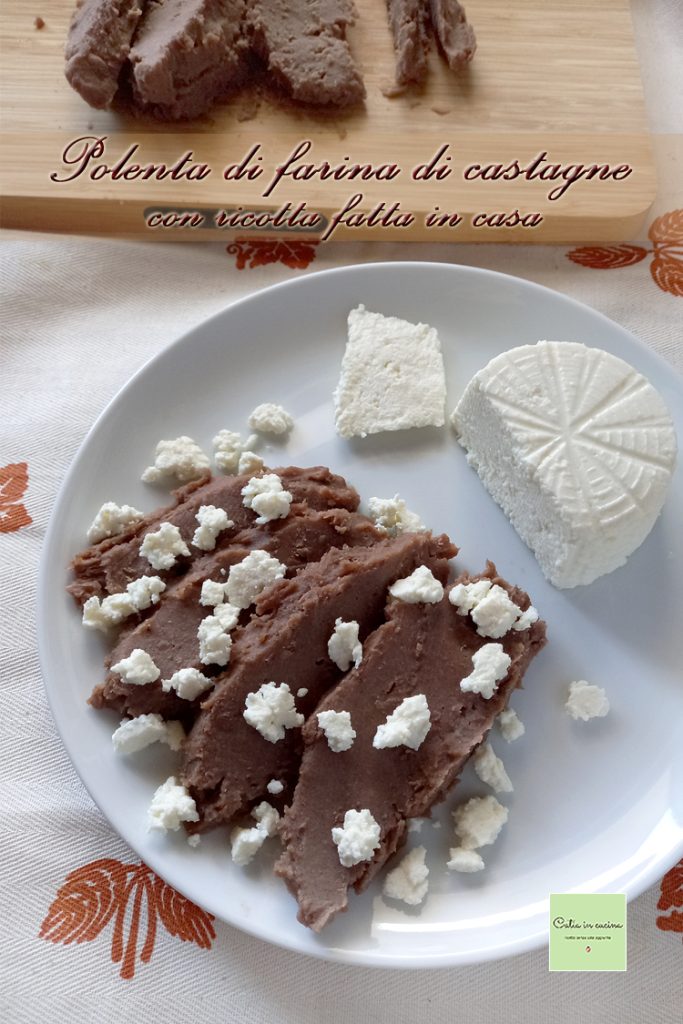
I replaced the raviggiolo, which, uh, I didn’t have on hand, with a fresh cheese I made myself, and wow I did it! Here is my first chestnut flour polenta!
It has an autumnal color that is as autumnal as it can be, so it’s perfect for today, right?
〰️〰️〰️
I’m also sharing other autumn ideas here, take a look (but after reading the recipe! 😊):
- Difficulty: Easy
- Cost: Economical
- Preparation time: 10 Minutes
- Portions: 2
- Cooking methods: Stovetop
- Cuisine: Italian Regional
- Seasonality: Autumn
Ingredients
- 1 3/4 cups chestnut flour
- 2 1/8 cups water
- 7 oz ricotta (homemade)
Tools
- Wooden Spoon
- Cutting Board
- Kitchen Twine
Steps
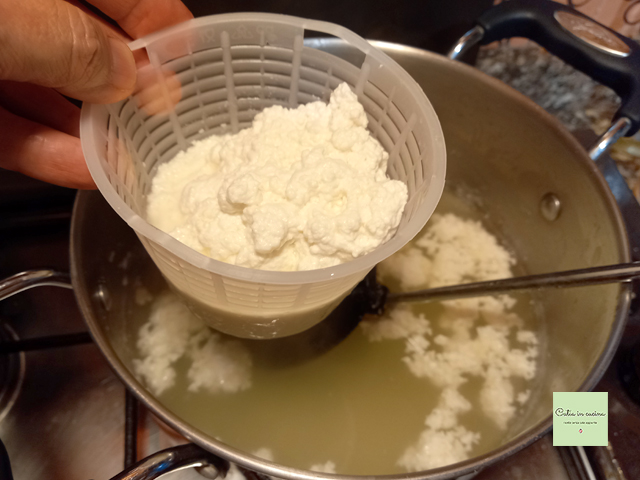
(The day before). First, produce the ricotta (or fresh cheese).
☝ Note: the ingredient list form does not allow me to insert two links, so I’ve indicated only the ricotta link, and the rest I’ll explain here:
The procedures for producing fresh cheese and ricotta (maybe take a look at the two recipes) are essentially similar, both are produced by curdling milk with lemon or vinegar, the only difference is that one is preparatory to the other (meaning first you get the fresh cheese, then with the second curdling the ricotta).
For this recipe, I performed both steps and then combined the two productions in the same basket.
To obtain about 7 oz (200 g) of cheese/ricotta, I used 1 liter of fresh semi-skimmed milk.
Leave the basket in the fridge for a day.
(The next day). Prepare the chestnut flour polenta:
1. Bring the water to a boil.
2. Sift the chestnut flour (highly recommended action).
3. When the water boils, pour the chestnut flour all at once. Do not stir the flour.
4. Close the lid, lower the flame to the minimum, and let it simmer for 10-15 minutes.
☝ I’m not sure that closing the lid is the optimal procedure, but without the lid, the mixture stuck to the bottom (I welcome advice and consultation for improvement!).
5. After about 15 minutes, remove the pot from the heat.
6. Stir well using a wooden spoon.
7. Put the pot back on the smallest burner (at the lowest possible flame) with the lid closed.
8. Cook for another 30 minutes, during which open the lid a couple of times to check that it does not stick to the bottom of the pot (a little sticking happens anyway) and to stir.
☝ The polenta is dense and quite laborious to stir, but that’s how it should be.
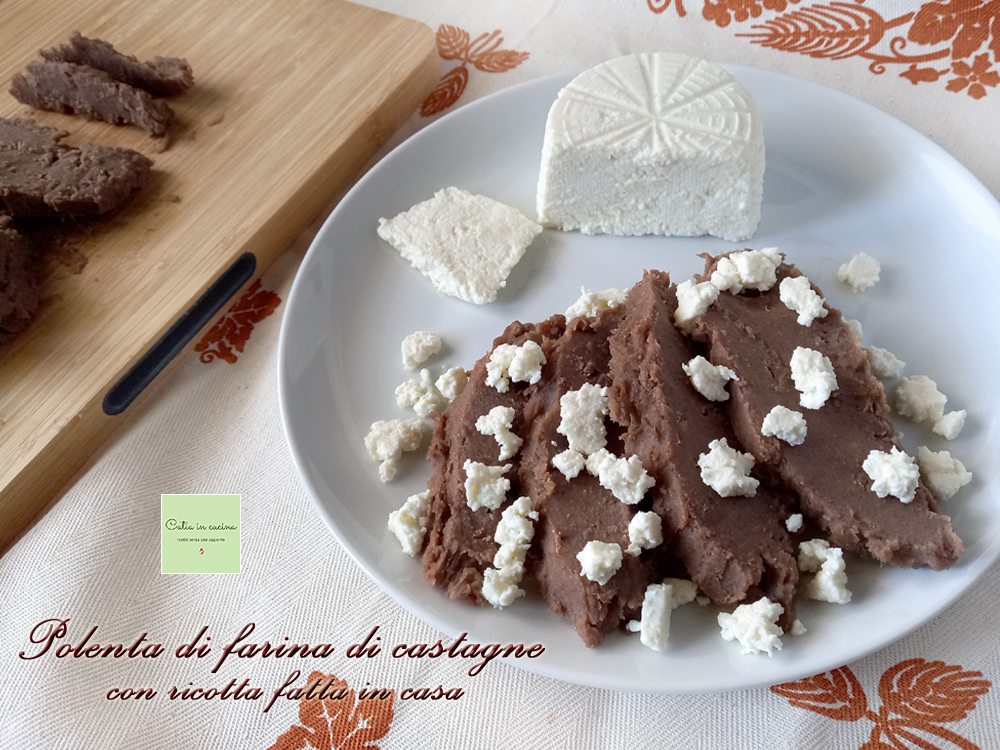
9. Pour the polenta onto a cutting board and slice it using a string (I used kitchen twine).
Serve with the homemade cheese/ricotta (or with other cheese of your choice).
Chestnut flour polenta is excellent both hot and cold (though I confess I prefer it warm 😊).
👉 For cutting with the string. For the string to make a good cut, it is good to pass it starting from the base of the polenta, cutting the slices with a movement from the bottom up (I, in my perfect inexperience, initially tried the opposite, i.e., pressing the string from top to bottom, but it definitely works worse!).
☝ The freshness of the flour. Making this recipe, I learned something I didn’t know: chestnut flour has a bitter aftertaste that is proportional to the age of the flour (“old” flour is more bitter than fresh), so it is preferable to use freshly milled flour. We are at the beginning of October, chestnut harvesting has started, and soon the production of new flour will begin, so let’s remember to buy it as soon as possible. If needed, to best preserve it, you can store it in the fridge or freezer.
Salt-Free Tips
 Remember that I cook without added salt. If you haven’t yet, I invite you to read this article of mine -> Cooking without salt, my journey. 😊
If you’re interested in reducing or eliminating salt, always remember to:
– Gradually reduce the salt, the palate must get used to it slowly and should not notice the progressive reduction.
– Use spices. Chili, pepper, curry, nutmeg, cinnamon, cloves, cumin…
– Use aromatic herbs. Basil, parsley, oregano, thyme, sage, marjoram, rosemary, mint…
– Use seeds. Sesame, pine nuts, almonds, walnuts…
– Use spicy vegetables or fruit. Garlic, onion, lemon, orange…
– Use my salt-free vegetable granulate and gomasio.
– Prefer fresh foods.
– Avoid cooking in water, prefer cooking methods that do not disperse flavors (griddle, en papillote, steam, microwave)
– Avoid bringing the salt shaker to the table!
– Occasionally allow a little indulgence. It boosts your mood and helps you persevere.
If you don’t want, or can’t, give up salt:
You can still try my recipes by salting according to your habits.
What autumn colors did my Light and Tasty colleagues choose?
Carla Emilia : Pumpkin and Leek Gratin
Daniela Autumn Galette with Apples and Chestnuts
Elena Baked Pumpkin with Feta
Franca Autumn Persimmon Tart
Milena: Ricotta and Autumn Fruit Dessert
Serena Delica Pumpkin Risotto
Follow me!
On my WhatsApp channel and on Instagram, on the Facebook page, on Pinterest and in my two groups: Catia’s group, in the kitchen and beyond and Just what I was looking for! and if you want… subscribe to my Newsletter.
