
Today we talk about a basic recipe that cannot be missing from everyone’s personal recipe book: the crazy dough, a basic dough that for a long time I identified with the oil-based shortcrust. Two doughs that now I understand to be slightly… the same… different… um…
😀
In my cookbooks, and I have many, there is no crazy dough. In my books, I found various versions of shortcrust pastry and various versions of puff pastry but no crazy dough, so I was lacking a precise idea about crazy dough.
While making the Easter pie (which I will talk about in the next recipe), after some research online, I understood that in crazy dough a tablespoon of wine or vinegar is added to the basic ingredients, which are flour, water, and oil, the same as the oil-based shortcrust (often also called butter-free shortcrust).
Then, however, I also found many recipes where doughs without wine or vinegar are called crazy dough (as in the case of the Ligurian version, if I understood correctly).
I also understood that the amount of oil varies from recipe to recipe and that extra virgin olive oil is widely used, although seed oil is also popular.
In short, we are back to the usual: every book has its recipe, everyone cooks according to their regional, family tradition, habit, or experience. And thank goodness it is so, because that’s what I love to do 😛
In the end, I did this: on the first occasion, that is, for my first Easter pie which I made on Easter day, I followed a Ligurian crazy dough recipe, one of the many I found, which on paper suited me because it contained only two tablespoons of oil. The dough I obtained was good, certainly light, but it didn’t fully convince me, once cooked it was dry, not crunchy or flaky, just dry. Maybe I got the cooking wrong, or maybe the oil I’m using at the moment (a rather full-bodied and flavorful oil) is not the most suitable oil for this recipe, I don’t know, but I was left with the itch to want to make a second attempt, done my way.
The second time (the recipe I’m talking about today) I changed the oil and varied the amount. I couldn’t decide whether to add the wine (or vinegar) and I decided not to, but I don’t rule out trying other water-oil proportions in future occasions, along with the addition of wine or vinegar, after which I will update this recipe with all my considerations.
For now, this crazy dough, or shortcrust whatever it is, has satisfied me, both in making and tasting. It’s a stretchy dough that I managed to roll out thinly without tearing, it slightly flaked on the surface when cooked (being more oily, it’s obvious to say but that’s how it is), and it’s also more enjoyable to eat.
So here’s the recipe. I recommend it for the Easter pie and generally for all rustic pies, in place of classic shortcrust made with butter (you can find HERE my shortcrust with butter in semi-wholegrain version).
〰〰〰
Below are other versions and recipes with crazy dough 👇
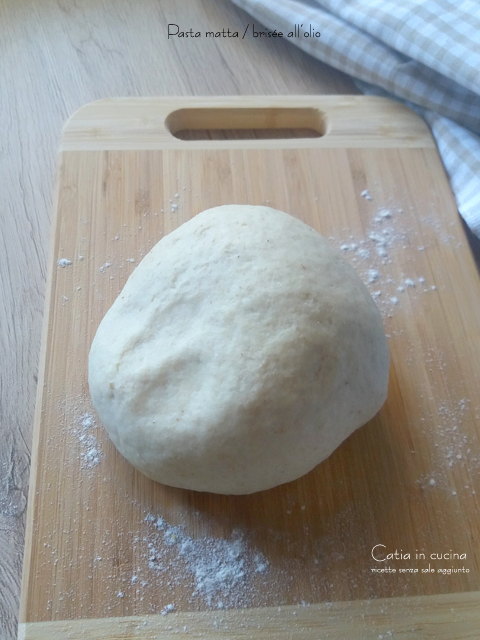
- Difficulty: Easy
- Cost: Cheap
- Rest time: 30 Minutes
- Preparation time: 10 Minutes
- Portions: 1 block
- Cuisine: Italian
- Seasonality: All seasons
Ingredients
- 10 1/2 oz type 1 flour
- 1/4 cup corn oil (cold pressed)
- as needed water (I used about 2/3 cup)
Tools
- Bowl
- Pastry Board
Steps
Pour the flour into a bowl, or on the pastry board arranging it as a fountain.
Add the oil.
Mix by adding water little by little. The total amount will depend on the type of flour used, but it will be around 5 1/4 oz, give or take. I used type 1 flour and precisely 5 1/2 oz of water (but don’t get used to this meticulousness because it’s not in my DNA, you know that).
Work by hand until you get an elastic dough.
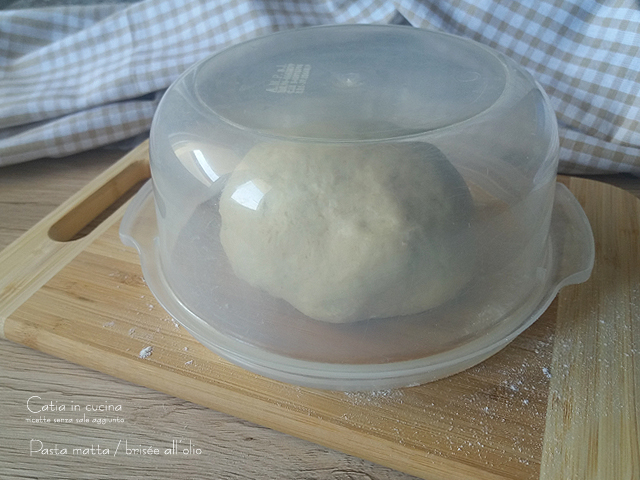
It can be used immediately, but a rest of 30-40 minutes is recommended. I let it rest at room temperature, not in the fridge, covered by a container:
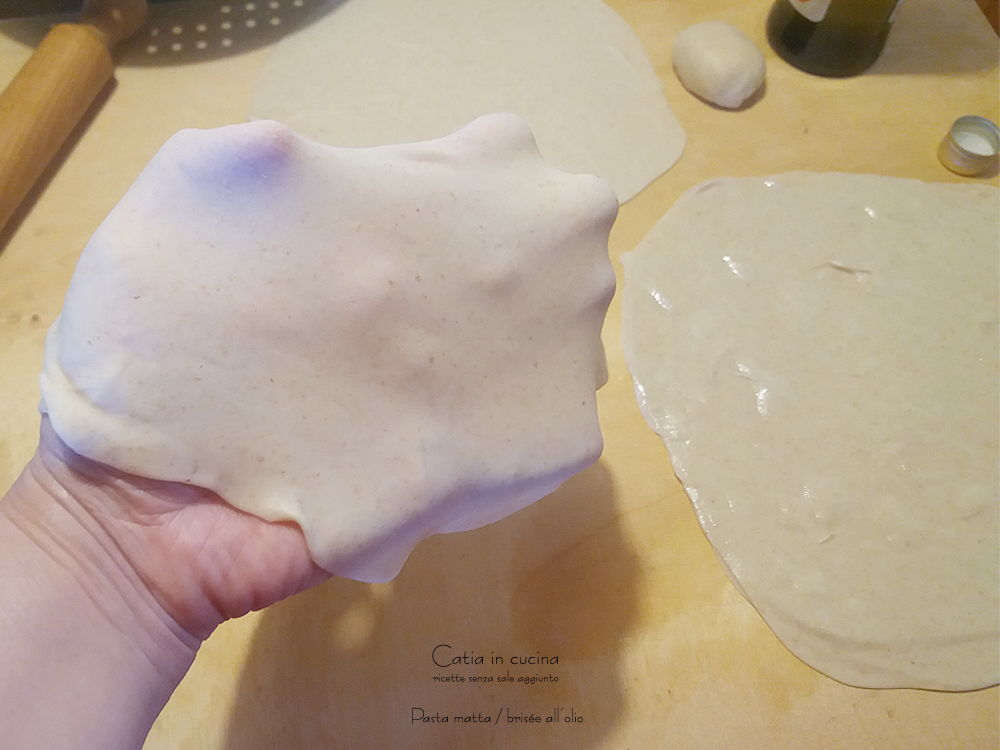
You can use your crazy dough for your filled pies, rolling it out more or less thinly as required by the recipe. For the Easter pie, I rolled it out very thin in four layers for the base and two layers for the cover, and I was very satisfied with the elasticity of this dough:
Salt-free Tips
 It is absolutely not necessary to add salt to this type of dough (and apparently this is said by the purists of Ligurian crazy dough, which is a guarantee for me), because the lack of salt favors the elasticity of the dough.
Since it is generally used very thinly in well-filled pies, salt-free crazy dough can also be used without taste problems by those who are not used to a low-sodium diet. Don’t believe it? Well, you’ll just have to try! 😀
If you are interested in reducing or eliminating salt, always remember to:
▫ Decrease the salt gradually, the palate must get used to it gradually and should not notice the progressive reduction.
▫ Use spices. Chili pepper, pepper, curry, nutmeg, cinnamon, cloves, cumin…
▫ Use aromatic herbs. Basil, parsley, oregano, thyme, sage, marjoram, rosemary, mint…
▫ Use seeds. Sesame, pine nuts, almonds, walnuts…
▫ Use spicy vegetables or fruits. Garlic, onion, lemon, orange…
▫ Use my salt-free vegetable granules
▫ Prefer fresh foods.
▫ Avoid cooking in water, prefer cooking methods that don’t disperse flavors (grill, foil, steam, microwave)
▫ Avoid bringing the salt shaker to the table!
▫ Occasionally allow yourself a break from the rule. It’s good for the mood and helps perseverance.
If you don’t want, or can’t, give up salt:
▫ You can still try my recipes, salting them according to your habits.
Follow me!
In my new WhatsApp channel and on Instagram!
As always, you can also find me on my Facebook page, on my Pinterest boards, in my two groups: Catia’s group, in the kitchen and beyond and Just what I was looking for! and if you wish… subscribe to my Newsletter.
As always, you can also find me on my Facebook page, on my Pinterest boards, in my two groups: Catia’s group, in the kitchen and beyond and Just what I was looking for! and if you wish… subscribe to my Newsletter.
