
Have you ever tried making cream kefir? 😊
I never would have thought of trying it, to be honest, if I hadn’t seen it in a post from the KefirMania and more group. A group I am proudly part of, which is definitely the best (in my opinion) Facebook group on the topic of kefir, managed by competent and honest people, two qualities that in the kefir world don’t always exist or coexist (in my opinion).
Lately, interest in kefir (both milk and water) has exploded. Even just four years ago, when it was given to me, practically no one knew about it and I had published a couple of articles (which you can find here in this collection) where I defined it as homemade yogurt with live cultures – simply because that’s what I was told it was. And there were few blogs or websites talking about kefir.
Now it’s being talked about everywhere, on the web, on TV shows, in magazines, even other bloggers have started producing it and writing recipes, and acquaintances and friends who some time ago had said no thanks to my grain donation offers because they didn’t know it, now they’ve all changed their minds 😄 and they produce it and take it regularly after receiving it from others who had received it from others… 😃 Not to mention the many packaged versions (in liquid form like milk and/or thick like yogurt) that have appeared in supermarkets.
In short, kefir is the food of the moment.
Over the years, I’ve learned to produce it the right way, after the initial mistakes, and I’ve learned to make it good and tasty by enriching it with flavors or using it in cooking. And it’s not because I don’t like it plain, I’m a lover of particular flavors – well, of all flavors, even normal ones 😄 – and therefore the tangy taste of kefir has never bothered me, quite the opposite.
But whether for the curiosity to experiment that drives me or because I’m always looking for ways and ingredients to vary the adolescently monotonous diet of my children, I ended up trying a bit of everything with (and for) kefir, experimenting with both sweet and savory… let’s say… not sweet recipes (yes, as you know I cook without salt), ranging from recipes to make kefir pleasant without altering its properties, to those for using excess kefir. The first are all no-cook recipes, or accompaniment sauces, the second are cooked recipes. In which it is known that bacteria do not survive (due to heat) but in which excess kefir can replace or accompany other dairy products with excellent results.
Well. All this preamble to tell you what? To tell you that good Facebook groups are incredibly useful. They teach us what we don’t know, they stimulate us, they give us ideas. And this recipe of mine today is yes, an experiment among the many I have done, but it is above all the result of a discovery made thanks to a post that arrived with the notifications from the KefirMania and more group. So I want to thank here whoever posted this proposal in the group that day – which maybe wasn’t even a new idea, but for me it was, and it was enlightening – that is the idea of using cream instead of milk to get cream kefir, or to put it another way to get fermented cream.
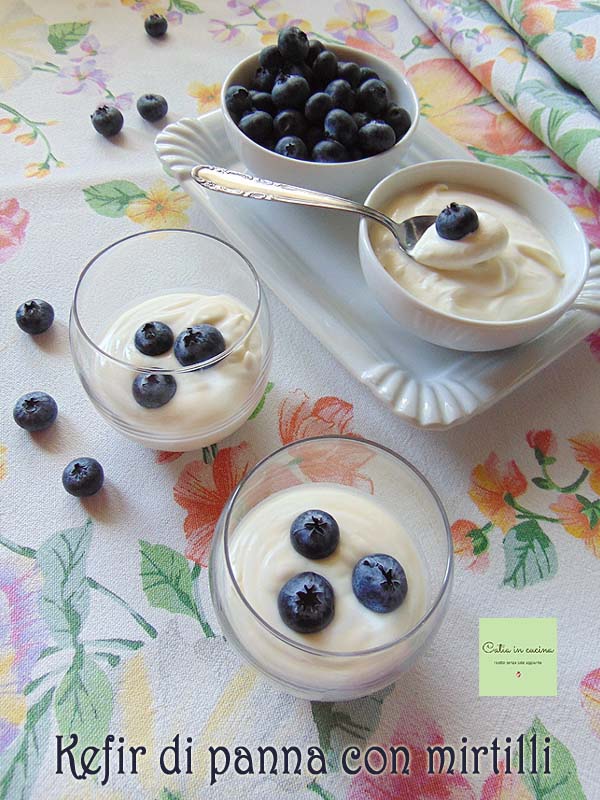
It has a great taste, it’s ideal to use as a filling for desserts because it’s compact even though it’s not whipped cream, and it’s also great just as I used it today: as a spoon dessert, just lightly sweetened and simply enriched with fresh fruit.
It’s good with any type of fruit but I found it perfect paired with blueberries. Do you want to try it too?
⏳ ⏳ ⏳
👇 More ideas for using milk kefir without altering its properties:
- Difficulty: Very Easy
- Cost: Economical
- Preparation time: 1 Day
- Portions: 4 servings
- Cooking methods: No Cooking
- Cuisine: Wellness
- Seasonality: All Seasons
Ingredients
- 0.7 oz kefir grains (also called kefirian)
- 0.85 cup fresh liquid cream
- 2 teaspoons powdered sugar
- to taste blueberries
Tools
- Container
- Strainer
How to Make Cream Kefir with Blueberries
👉 Note: The quantities I gave you in the ingredient list are indicative because, obviously, they depend on how many kefir grains you have or how many you intend to use for this particular fermentation with cream. Fermentation should not be continuous and repeated so as not to damage the grains, but it can be done only sporadically or, even better, it can be done with a portion of the grains (in excess) keeping the normal daily production of kefir separate. In any case, I used the standard grains/milk ratio of 1 to 10.
Place the kefir grains in a glass or food-grade plastic container and pour in the liquid cream.
Cover the jar with a gauze or a napkin secured with an elastic band, or with the jar lid resting on top, not screwed on, and let ferment in a sheltered place for 24 hours.
The ambient temperature should not exceed 82 degrees Fahrenheit, so in summer – especially during these boiling hot June days! – it may be useful to place the jar in a cooler with a cold pack. This way, the temperature will be lower than the room temperature, but not as cold as the fridge, allowing the correct fermentation time.
After 24 hours, or even a few more hours (homemade productions can always be subject to variations), strain the cream, now fermented.
In the following sequence of three photos, I show you my cream kefir before straining, during, and finally after straining is completed.
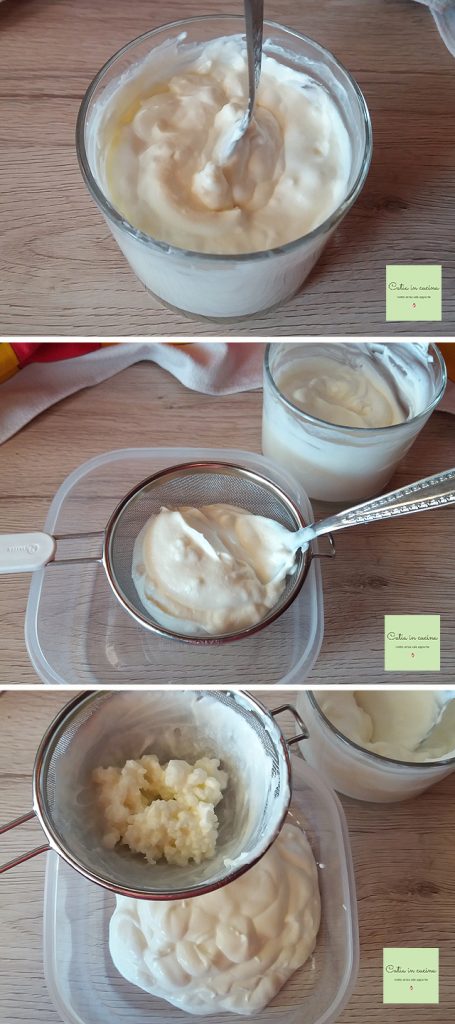
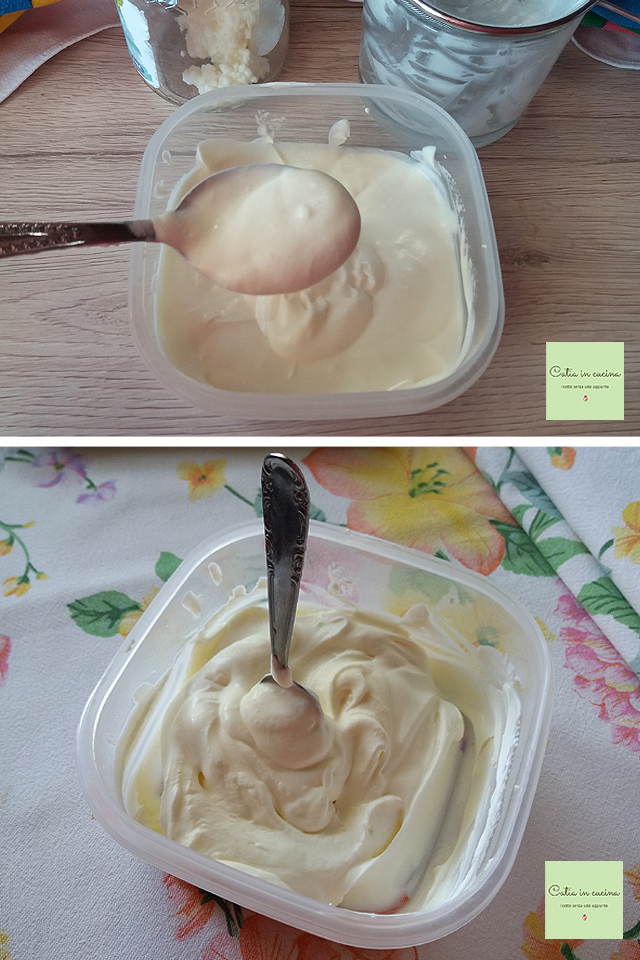
What you get is a cream kefir that can already be consumed as is. However, to get a more compact product, it’s good to proceed with the so-called second fermentation, which involves putting the freshly strained kefir in the fridge for a few hours in a container with a closed lid.
After a few hours of second fermentation, even regular milk kefir becomes compact, but this is even more evident with cream kefir. As clearly shown in the two following photos, the difference between before and after is evident: after a few hours, the spoon inserted into the fermented cream stands upright on its own.
At this point, you can add sugar (I used a couple of teaspoons, but adjust to your taste) mixing it in to dissolve. I decided to use powdered sugar to ensure it dissolved well immediately.
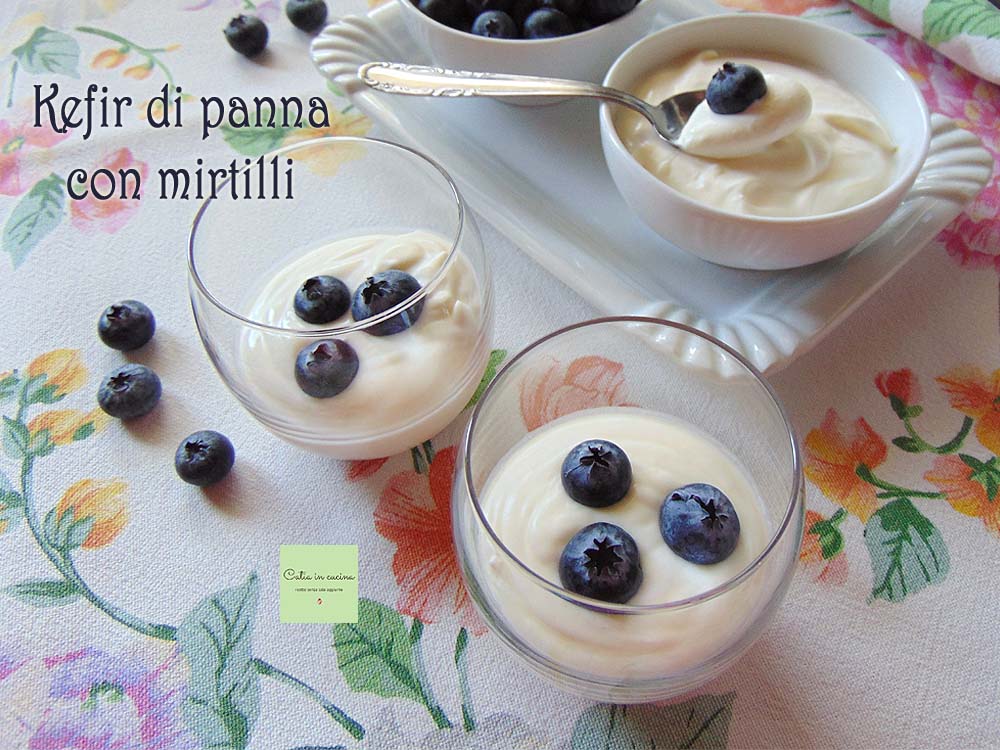
Finally, add the blueberries to turn it into a great spoon dessert, ideal as a dessert or a healthy and nutritious snack rich in probiotics. 🙂
Enjoy!
Follow me!
In my new WhatsApp channel and on Instagram, on my Facebook page and Pinterest, in my two groups: Il gruppo di Catia, in cucina e oltre and Just what I was looking for! and if you like… subscribe to my Newsletter.
In my new WhatsApp channel and on Instagram, on my Facebook page and Pinterest, in my two groups: Il gruppo di Catia, in cucina e oltre and Just what I was looking for! and if you like… subscribe to my Newsletter.
