
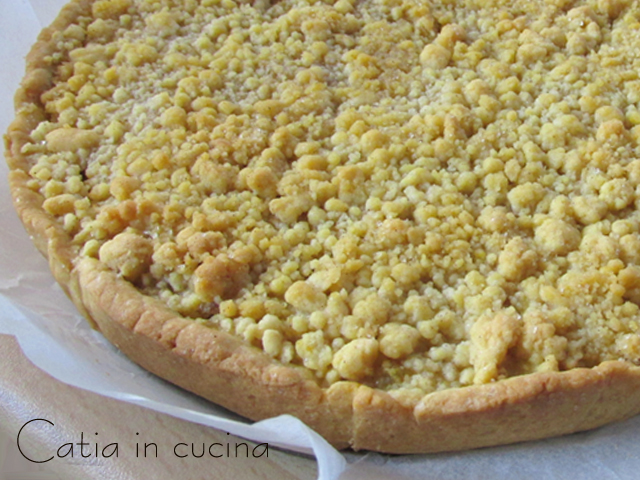
I wanted to try making a classic pastiera, instead… I produced a crumbly pastiera-style tart which certainly isn’t a traditional recipe, but it passed our tasting test with flying colors yesterday. And the “oops, it’s already gone” test this morning at breakfast. 😄
Yes, it had to be said.
What? That I would follow a traditional pastiera recipe by hand and manage not to change it, not to personalize it and, above all, not to make it a light version. That’s what.
Actually, I do have a traditional recipe.
My friend Carmela gave it to me years ago. Her pastiera is famous; it’s always at her daughter’s birthday parties — her daughter has been my daughter’s friend since kindergarten. But I just can’t do it. Her recipe calls for a huge number of eggs!!
I also checked the recipe printed on the jar of cooked wheat I bought: there too!! 😯 Six yolks (I mean, six yolks!!) and 500 grams of sugar just for the filling!!
No no, I can’t do it! 😄
So I started my preparation.
First of all preparing my classic shortcrust pastry (this one) which contains only one egg and 80 grams of butter. And since the amount of cooked wheat would definitely have been too much for my standard dough ball, I increased the flour to get a larger dough but left everything else unchanged.
Ah ah! I can already hear your comments: How? You increase the flour and not the rest? Ah ah! No.
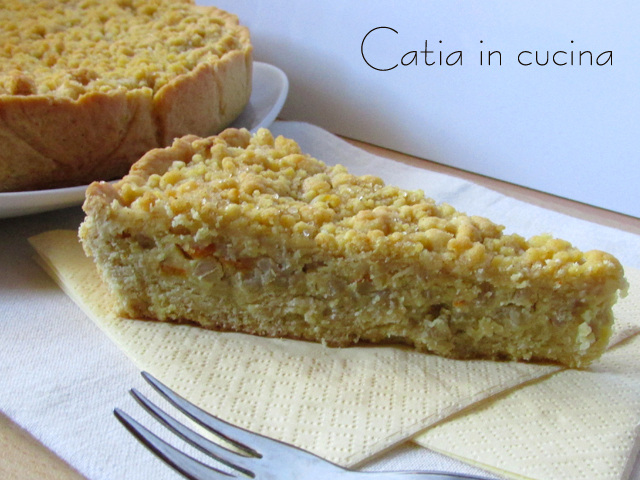
Well, anyway, despite all my modifications and “lightenings” I assure you my crumbly pastiera-style tart is not bad to look at and, I promise you, also good to eat!
So, if you trust me… follow this recipe! 😉
❀ ❀ ❀
- Difficulty: Easy
- Cost: Budget-friendly
- Rest time: 1 Day 30 Minutes
- Preparation time: 1 Hour
- Cooking time: 35 Minutes
- Portions: 8
- Cooking methods: Oven
- Cuisine: Italian
- Seasonality: Easter, All seasons
Ingredients
👉 Note: the filling made with one jar of cooked wheat is enough for two tarts, so if you want to use it all at once you should make 2 dough balls by doubling the dough quantities (or, conversely, to make a single tart you should use half the filling).
- 350 g farina 0
- 3 cups all-purpose flour (about 350 g)
- 100 g zucchero di canna
- 1 egg
- 80 g burro
- 6 tbsp butter (about 80 g (≈ 6 tbsp, ~3/4 stick))
- Half packet baking powder
- 1 tbsp orange sugar syrup (i.e. the syrup left from boiling my candied orange peels; you can substitute with 1 tbsp sweetened orange juice or simply grated orange zest + 1 tbsp sugar water)
- 580 g grano cotto (1 jar (about 20.5 oz / 1.3 lb; roughly 3 cups cooked))
- 250 g latte (I used 125 g milk + 125 g water)
- 1 cup liquid (milk + water) (about 250 g total — I used 1/2 cup milk + 1/2 cup water)
- 70 g scorze d'arancia candita (candied orange peel — about 1/3 cup (70 g))
- 200 g ricotta (about 3/4 cup (200 g))
- 1 egg
- 50 g zucchero (+ 1 tablespoon on top (50 g ≈ 1/4 cup))
- 1 packet vanillina (vanillin packet)
- cannella in polvere (ground cinnamon, to taste)
- 2 teaspoons amido di mais (cornstarch — optional)
Tools
- Casseruola
- Teglia a cerniera
Steps
Proceed as explained in the my classic shortcrust pastry recipe.
The only two differences are: 1) the addition of one tablespoon of caramelized syrup and 2) a larger quantity of flour (and the use of 100 grams of brown sugar instead of 80 g granulated).1) Anyone who has made candied orange peels at least once (here is my first recipe and here the second with cinnamon), knows that the last step is boiling the peels in a sugar-water syrup. After this boiling, I always have a fragrant sugary residue left at the bottom of the pot. Why throw it away? Never. So I put it in the dough. You can easily substitute it with orange juice, or with one tablespoon of sugar water + grated orange zest or powdered orange peel. I might even dare to suggest caramel, but I’ll stop at the possible substitutions. If you have other ideas they’re welcome 🙂 but don’t give up on making candied peels… try them and you won’t regret it, my word.
2) The larger amount of flour obviously resulted in a less compact dough. If the dough is hard to work, add a tablespoon or two of water or orange juice. Once you obtain the dough ball, put it in the fridge to rest.
In the meantime prepare the filling.
Boil the cooked wheat with the 1 cup of milk+water, 50 g candied orange peels and a pinch of cinnamon.
Boil for about 10 minutes over moderate heat; the liquid should be fully absorbed. Actually my mixture remained rather soft.Transfer it to a bowl and let it cool until lukewarm.
Add the ricotta and mix well.
Beat the whole egg with the sugar (I used brown sugar both in the filling and in the pastry, and I had used it also in the production of the candied peels made specifically for this recipe). Pour the egg and sugar into the mixture.Mix well with a spoon, add the remaining candied peel (or even more), another pinch of cinnamon and one packet of vanillin.
Since after adding the beaten egg my mixture softened, I thought to add a couple of teaspoons of cornstarch.
☝ Now that I’ve eaten the tart I believe they weren’t indispensable. After baking and resting, I’m sure the filling firms up even without cornstarch. But I used it, so it’s part of the ingredients.Line a removable-edge pan about 9 1/2 in in diameter with parchment paper.
Crumble the pastry by hand over the bottom of the pan and press all the crumbs together with your hands until you obtain a compact, hole-free base.
Using small amounts of dough at a time, form the side by pressing the pastry onto the pan edge.
👉 Be careful not to use all the dough; leave about 150 grams as it will be needed for the crumbly topping.Once the shortcrust “shell” is ready, fill it with half of the wheat-and-ricotta filling.
Level with the back of a spoon.Crumble the remaining 150 grams of pastry in a bowl, add 1 tablespoon of brown sugar and a pinch of cinnamon to the crumbs.
Distribute the crumbs over the filling.Bake at 428°F. After about ten minutes lower to 392°F, bake for a total of 30–35 minutes. If the shortcrust browns too quickly, lower to 356°F. It’s important that the filling, which is quite moist, cooks through without the pastry darkening too much. In any case, adjust the temperature according to your oven.
After baking I unclipped the ring and left the crumbly pastiera-style tart to cool inside the turned-off oven.
I let it rest until the next day. Normal tarts, and I believe the true pastiera too, are usually better the day after, so I didn’t want to risk cutting it too soon. Of course, it was hard to resist the temptation to taste it, especially for my kids! 😄
I wish you a Happy Easter and see you at the next (post-Easter) recipe.
Oh! Remember that if you want to make two tarts you just need to double the dough quantities and use all the filling. If instead you want to make only one like I did… what will you do with the leftover filling? If you want to know how I used it… click here!!! You’ll discover a nice little recipe! 😉💪😋
Follow me!
On the WhatsApp channel and on Instagram, on the Facebook page and Pinterest boards, in my two groups: Il gruppo di Catia, in cucina e oltre and Proprio quello che stavo cercando! — and if you like… subscribe to my Newsletter
