
Dear friends passionate about home drying, good morning! 🙂 I know! I know you want to dry tomatoes today! But the season is what it is and you don’t know how to do it. Isn’t that right?
😀
A few days have passed since I showed you the photo, on my fb page, of my dried tomatoes with my faithful dehydrator. I was too curious to try this experiment, and the result fully satisfied me. The method, the timing, the result. And also the taste.
Then, I immediately repeated the operation, lest the beginner’s luck had favored me. But no no, they turned out great even the second time (only with a longer drying time, I’ll explain why in the procedure).
I’m sure someone will say drying tomatoes in the sun is better, and they turn out tastier.
Yes no maybe yes maybe no I don’t know, I found them exactly the same as the ones I’ve always bought, both in texture and flavor, except that mine are unsalted (of course! Did you have any doubts?! 😊).
Rather, I’m sure what matters most is the quality of the tomato, if the tomato tastes good raw, if it comes from a garden we know, if it has been picked ripe, it will certainly be a good tomato even when dried, and independently, I think, of how it was dried.
And then, if a person, just anyone, doesn’t live in beautiful sunny places like Calabria, or Sicily for example,
if they worked all summer and didn’t have time to make use of the little scorching sun they saw the rays of from the window,
if when they had the time, it was raining
if then, the same person finally went on vacation, deliberately forgetting the tomatoes to dry (but remembering very well to eat tomatoes in abundance)
well, I assure you that in all these cases having a dehydrator is satisfying. Take my word for it.
Anyway, the real reason I wanted to do this test had to do with the no salt. I really wanted to see, try, and taste, some unsalted dried tomatoes.
Because it seems they don’t exist. Do you know of any?
Those in oil jars are usually salted excessively.
Even the loose ones you buy are salted, of course. Even though soaking removes some of the salt, they remain quite salty, and I’m not sure if they are allowed for those who have to eat low-sodium, but I think not, given how flavorful they are.
What is certain is that… knowing that you can dry tomatoes without using salt, knowing that the result is more than good, so much so that we consumed them as we like, and then we made the sun-dried tomato and tofu pesto, and then we added them in a cheese sandwich, and the few left I put in a jar with oil… well, knowing all this cleared up all my doubts!! They are delicious! Naturally, they are more delicate, I would say sweeter, than the salted ones I have always bought until now, and they are delicious. Oh, did I already write that they are delicious? 😀
〰 〰 〰
Other ideas to best utilize the dehydrator:
- Difficulty: Very Easy
- Cost: Economical
- Preparation time: 10 Minutes
- Cooking methods: Other
- Cuisine: Regional Italian
- Seasonality: Summer
Ingredients
- Ripe tomatoes (like San Marzano)
Tools
- Dehydrator
Here’s How to Dry Tomatoes with a Dehydrator (and Without Salt)
Wash tomatoes well and cut them in half lengthwise.
Remove the seeds. As you can clearly see from the photos below, I also removed the central “cord” along with the seeds.
Buying dried tomatoes from various places (from village fairs to supermarkets) I had noticed that they are not always the same, sometimes I bought them with seeds still clearly visible, other times I realized that they had been stripped of all the inside. So I did the same to give the dehydrator a bit less work to do.
☝ The discarded seeds (you can see them in the plate in the background) I obviously didn’t throw away, by now you know I don’t like waste. I added some to the sauce, the remaining ones I put in the guacamole (the lunch of that day).
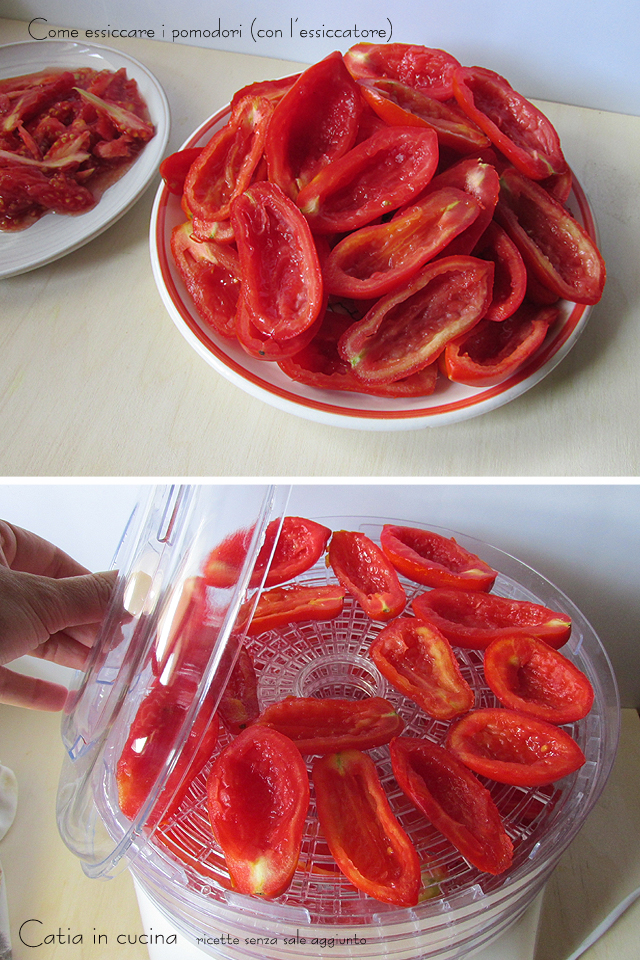
Start the dehydrator.
My dehydrator has only two temperature options, unfortunately not specified. Some time ago I researched and concluded that the maximum temperature (which I set) is between 140 and 158 Fahrenheit. Those with a dehydrator with adjustable temperature can decide the precise temperature (149? 154?) based on their own experience and knowledge of their appliance.
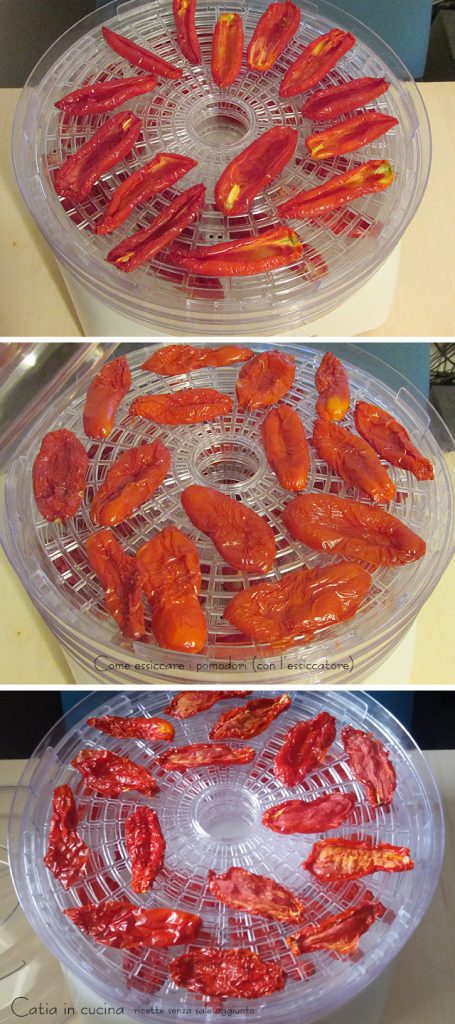
As I show you in the photos below, after 7 hours my tomatoes started to dry and curl, so I spread them out one by one and turned them so that they wouldn’t curl again and would dry open.
After another 7 hours I checked them, and some I turned again.
After another 2 hours the smaller and thinner tomatoes I could already “collect.” For the more pulpy and larger tomatoes, 2 more hours were needed.
Total: 16 hours for the smaller tomatoes, 18 hours for the larger ones.
End of first experiment.
Second experiment:
I did a second experiment which I could title “how to dry tomatoes leaving them at maximum humidity with all their seeds” 🙂
I have no photos to show you. I didn’t photograph them because in reality, externally they were not different from those without seeds that you see in this article, except for the fact that they have visible seeds (during drying they all stick to the tomato). And they were identical in taste.
The only real difference is in the drying times.
For this second drying, I took 25 hours and when I decided to turn off the dehydrator only a portion of the tomatoes had dried, while some were not yet completely dry. Despite this, I decided to stop the operation because I felt it wasn’t worth keeping the appliance on for more hours (I can’t say how many, maybe two, maybe three, indeed the tomatoes of this second drying were quite pulpy).
And so I took the opportunity to do a test: I tasted them at that stage, that is when they are not yet dry but almost, to see if they had the same taste and flavor as rehydrated dried tomatoes. I seasoned them with oil, garlic, and oregano as we like them and our conclusion is they are good, yes, but not as good as dried tomatoes rehydrated in water and vinegar.
From this test, I deduced that it is necessary to complete the drying process and that to do it in the best way it is preferable to remove the seeds. Maybe one can make a middle ground: remove the seeds but leave the central cord (I don’t know if it’s really called that, but I think you understood) that I had removed during the first drying.
Drying tomatoes with seeds (we are still talking about using the dehydrator) is possible, it just requires more time, and in my opinion, it is slightly too long if you relate it to the amount of tomatoes that a rather small dehydrator like mine can contain.
As always, these are my opinions due to my experience. I will certainly have the opportunity to dry the tomatoes again and I will keep you informed of any news, if any, with updates at the end of this article.
For today I’m done, I’ve told you everything! Now you too can dry tomatoes using that powerful appliance that is the dehydrator.
 And, above all, you can make them without salt. Finally, even those who had given up on dried tomatoes because of the salt can now enjoy tasty unsalted dried tomatoes in oil like these: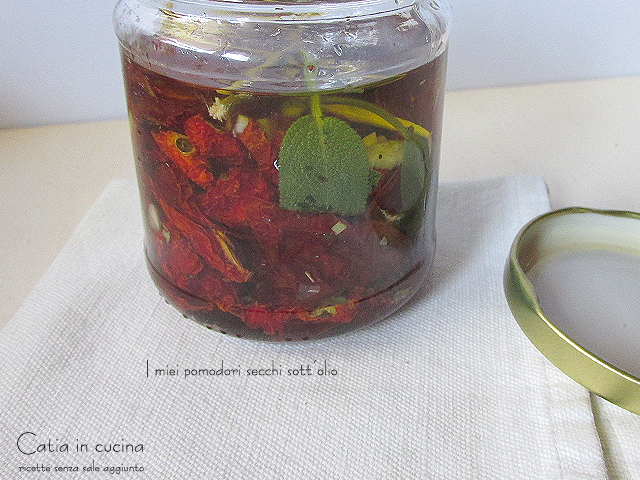
or you can make a delicious unsalted dried tomato and tofu pesto without salt:
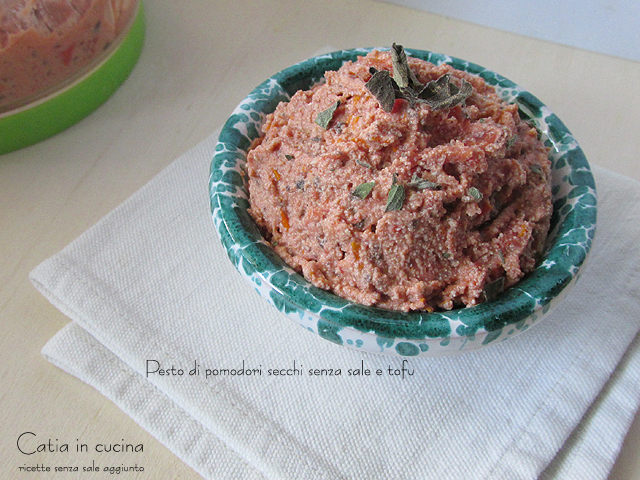
or you can try one of my other recipes with dried tomatoes:
– dried tomatoes with Tropea spring onion
– dried cherry tomatoes with garlic and olives
– dried tomato pesto with mixed seeds
My dehydrator (visible in the photos in this article) is this old model –> Clatronic/Bomann, a simple model that despite its simplicity works great, and which made me passionate about dehydration. If you’re looking for a dehydrator, a more recent but similar model is this –> Melchioni
—
Check out my review on the Clatronic DR 448 CB dehydrator
—
Follow me!
On my WhatsApp channel and on Instagram, on the Facebook page, in Pinterest and in my two groups: Il gruppo di Catia, in cucina e oltre and Proprio quello che stavo cercando! and if you want… subscribe to my Newsletter.
On my WhatsApp channel and on Instagram, on the Facebook page, in Pinterest and in my two groups: Il gruppo di Catia, in cucina e oltre and Proprio quello che stavo cercando! and if you want… subscribe to my Newsletter.
