
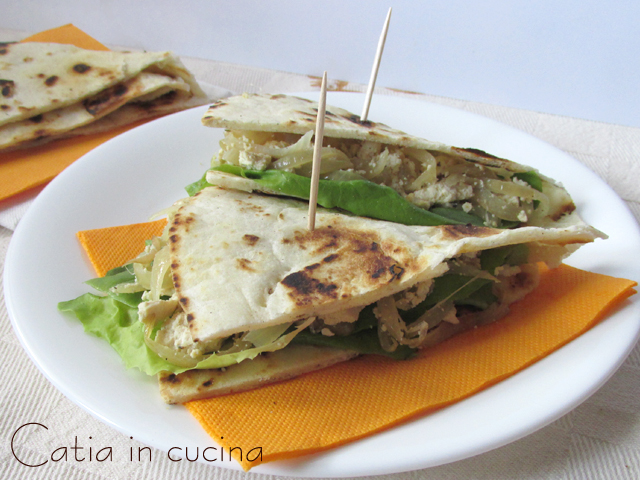
For a true Romagnolo (and I am one 😃), stuffing a flatbread with tofu and onion may seem like an unusual, if not daring, way to eat the piada.
The Romagnolo knows, deeply and inherently, that the piada is eaten with everything, and not just with ham as some might believe. But by “everything” we usually mean traditional products.
Oh, yes. The piada is eaten… let me explain: besides with ham, an evergreen classic, it’s also eaten with sausage, roast pork, fish (especially with sardines), with salad, grilled vegetables, onion, raw or cooked, field herbs (and I won’t mention “rosole” and “scarpegni” to avoid getting too region-specific!), with pecorino cheese, squacquerone, stracchino, and even with potatoes. Or with mixes of two, three, or more of these ingredients at a time, like stracchino+arugula, sardines+salad, sausage+potatoes+mozzarella, ham+stracchino+arugula+tomatoes, and I won’t go on because the list could be endless.
And tofu, then? What does it have to do with flatbread?
Nothing. It has nothing to do with it.
Except that tofu, mixed with onion (and maybe even with potatoes), fits perfectly in the piada and is a delight to eat, take it from me, a true Romagnola! 😀
Apart from the fact that, thanks to new vegetarian and vegan trends, for some people such a combination is not that unusual anymore but is dictated by their culinary habits and needs, I think a flatbread with tofu and onion is also a good example of fusion cuisine.
Fusion? For those few 😊 who don’t know this definition, here’s a phrase that explains the concept of fusion cuisine taken from a small book, actually a recipe book (which I’ve had for a few years and cherish because it has a short introductory chapter that I really like), titled Cucina Creativa e Fusion (ed. Baule Volante). The phrase is this: “… taking inspiration from many gastronomic traditions, mixing and integrating them with each other, to create new dishes that are, at the same time, traditional and original”.
And since I’m at it, I’ll also share this really nice phrase, which I think all cooking enthusiasts should keep in mind: “Creativity also involves not being afraid of unusual and original combinations”.
Now you know why I like the idea of stuffing the piada, one of the cornerstones of traditional Romagnolo cuisine, in this… modern way.
Come on, go for it! Sometimes it can be useful to try something unconventional. You might discover you like it! 🤩
〰 〰 〰
Below, I offer you: a piada with traditional filling and another alternative piada idea. Also, for tofu lovers, I add the collection of all my tofu recipes, take a look! 😉👈
- Difficulty: Easy
- Cost: Economical
- Preparation time: 10 Minutes
- Portions: 2
- Cooking methods: Stove
- Cuisine: Fusion
- Seasonality: All seasons
Ingredients
The quantities of the ingredients for the filling are suitable for stuffing 2 flatbreads. Give or take. Naturally, it depends on how much you want to fill them. 😉
- 2 flatbreads (with oil)
- 1 block tofu
- 2 onions (or one, if large)
- extra virgin olive oil
- pepper
- rosemary
- salad (optional)
- 2 potatoes (for the potato variant)
Tools
- Frying pan
- Crespelle pan
Steps
First, slice and cook the onion. It’s very simple: soften it in the pan with extra virgin olive oil, stirring it with a spoon. It cooks quickly, and when the onion turns an amber color, it’s ready.
Crumble the tofu with your hands, then use a fork to break it into fairly small crumbs. Put it in the pan where the onion was cooked, add a drizzle of oil, a sprig of chopped rosemary, and pepper. Let the tofu absorb the flavors.
Cook (or heat, if precooked) the flatbread by placing it on the appropriate “teggia” or griddle or pan, being careful not to overcook it, otherwise, it will dry out.
Remove the flatbread from the heat and fill it with the (warm) tofu mixture, optionally adding a leaf of lettuce.
👉 Be careful not to put too much filling on the edge, or tofu crumbs may fall out.
Close the flatbread, pressing it slightly with your hands to compact the filling a bit. If desired, you can put it back on the griddle for a few seconds.
Enjoy immediately while hot.
To my taste, the addition of a lettuce leaf or a tuft of arugula is also appreciated.
Potato variant
This variant would be, wanting to draw a parallel, the vegan version of the flatbread with potatoes, sausage, and onion.
It’s enough to add one or two (depending on their size) boiled potatoes for each flatbread. Don’t forget to add some pepper.Naturally, the potatoes must be boiled beforehand. I always cook them in the microwave (you can find here my tutorial), but they can be boiled in any preferred way.
Adding the potatoes to the pan, where onion and tofu are already present, should be done as the third step, which means after the tofu.
Mix the potatoes with tofu and onion, mashing them a bit with a fork. The advantage of this version is that the potatoes act as a binder for the tofu crumbs.
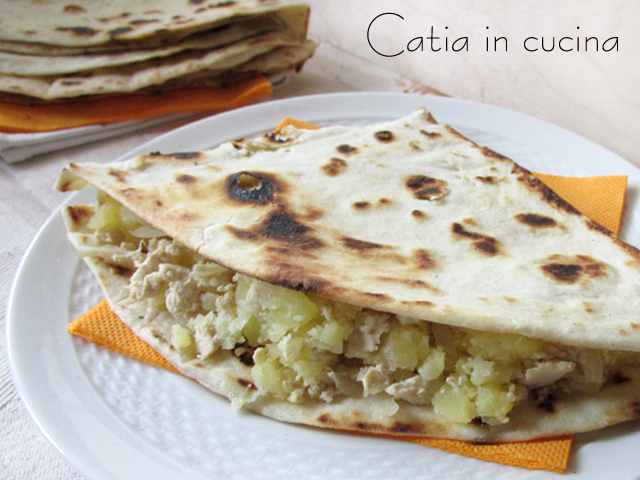
I remind you that the beauty of the piada – whatever filling it has, and therefore also this flatbread with tofu and onion – is that it can be eaten at any time and at all hours: it’s an excellent snack, a perfect quick lunch, a rich and imaginative dinner, or, cut into wedges, an excellent finger food for appetizers, brunches, and all kinds of buffets.
Enjoy your piada!
Note (+ update)
This filling is vegan, so to consider this recipe as vegan (and, of course, also vegetarian), you need to use the oil-based piadina and not the traditional piadina (strictly made with lard).At the time of the first draft of this recipe (in far back October 2014), I hadn’t yet published the recipe for the oil-based piada, but now it’s on the blog and I can finally update it by adding the link. So you can finally prepare your oil-based piada with your hands and won’t be forced to buy precooked ones (and have to read all the labels of precooked piadas available in supermarkets!).
In the last ten years, some things have changed; now the oil-based piada is much more widespread, although verifying the ingredients is still advisable. I repeat my warning not to limit yourself to reading only the front of the package because even if it says piadina with oil (or with oil), sometimes, unfortunately (I have personally verified it), lard can still be present among the ingredients. On one occasion, I found palm oil among the ingredients, an ingredient certainly not from Romagna (!) and of which – although vegetable – the piada can do without. So when you buy packaged piada, always read the list of ingredients!
🧂 My advice remains to always prepare it at home, it’s much healthier and also significantly less salty (some precooked piadas are really too salty) since you can decide the amount of salt (or decide not to salt it at all 😉)
Salt-Free Tips
 I remind you that I cook without adding salt. 😉
In this recipe, the only naturally salted ingredient is tofu. Before using it, it’s good to rinse the block under running water to remove the excess salt from the brine.
If you are interested in reducing or eliminating salt, always remember to:
▪ Reduce salt gradually, the palate needs to get used to it slowly and shouldn’t notice the progressive reduction.
▪ Use spices. Chili, pepper, curry, nutmeg, cinnamon, cloves, cumin…
▪ Use aromatic herbs. Basil, parsley, oregano, thyme, sage, marjoram, rosemary, mint…
▪ Use seeds. Sesame, pine nuts, almonds, walnuts…
▪ Use spicy vegetables or fruit. Garlic, onion, lemon, orange…
▪ Use my salt-free vegetable granules and gomasio.
▪ Prefer fresh foods.
▪ Avoid cooking in water, prefer methods that preserve flavors (griddle, foil, steam, microwave)
▪ Avoid bringing the salt shaker to the table!
▪ Occasionally break the rule. It’s good for the mood and helps to persevere.
If you don’t want, or can’t, give up salt:
▪ You can still try my recipes by salting according to your habits.
Follow me!
In my new WhatsApp channel and on Instagram, on the Facebook page and Pinterest, in my two groups: Il gruppo di Catia, in cucina e oltre and Proprio quello che stavo cercando! and if you like… subscribe to my Newsletter.
In my new WhatsApp channel and on Instagram, on the Facebook page and Pinterest, in my two groups: Il gruppo di Catia, in cucina e oltre and Proprio quello che stavo cercando! and if you like… subscribe to my Newsletter.
