
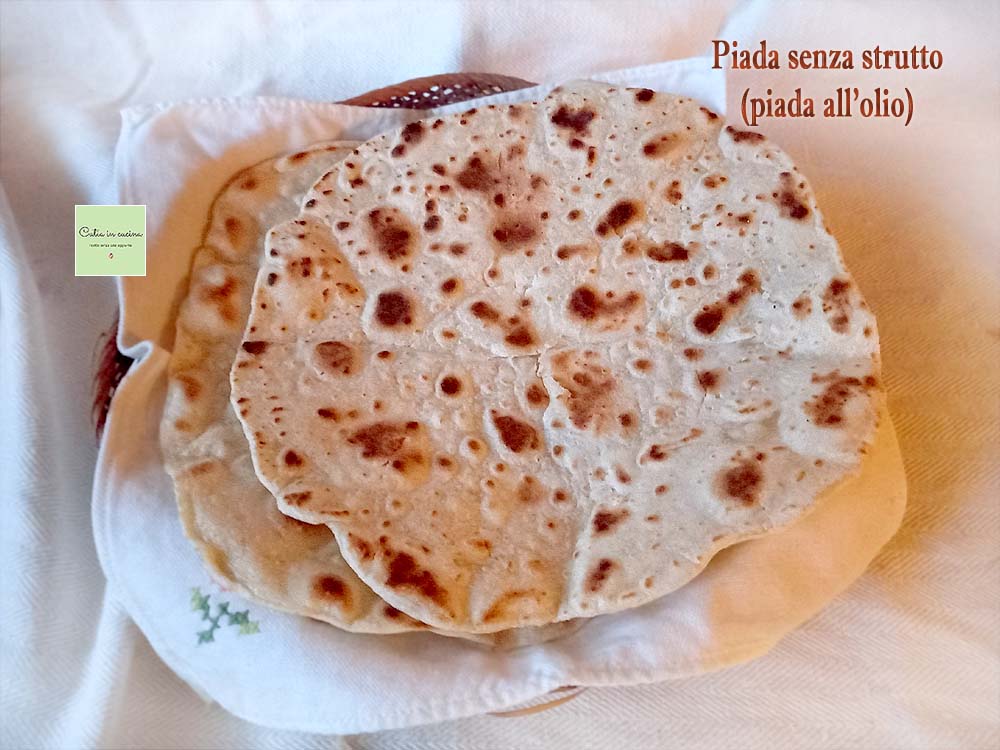
By popular demand, here is the recipe for my flatbread without lard, or oil flatbread.
Many of you have asked why I don’t have a recipe for flatbread without lard on my blog, especially since I love vegetarian cooking so much. The reason is, it may seem strange, but truly, that I rarely, almost never, make flatbread with oil.
As you already know, for me, the flatbread recipe is not just a part of the Romagna tradition but a true memory food. One of those indispensable pillars for which the simple definition of original Romagna recipe doesn’t do justice.
For years now, I’ve had a personal sense that the ‘true’ flatbread only existed in those times when it was made solely with lard and cooked only on the griddle (or testo), on the tripod in the fireplace, or on the economic stove after removing the right number of rings and placing the griddle in their place… Perhaps it’s not entirely so, but within me, that’s how I live it. The flatbread as a symbol of an era. Nothing like the Romagna flatbread everyone knows now. Not to mention that now many of us have to deal with induction stoves, the ultimate confirmation of my ‘personal sensation’ mentioned above.
In my culinary evolution, there’s a before, made of traditional, regional, family, memory recipes to which I’m very attached (as everyone is attached to those of their own experience), and there’s an after, where my way of cooking and eating has changed. Both are important. Flatbread is part of the before.
In my house, the word flatbread inherently means “with lard.” There’s no specification; it’s implied. So I don’t make oil flatbread often because it’s not automatic for me. It’s an imprinting. When I don’t have, or can’t get from my mom, lard (since ‘you don’t buy it at the supermarket’, it must be local, it’s a dogma), I make something else. Focaccias, pitas, balloon breads, pseudo-flatbreads with excess sourdough, not flatbreads.
Not that flatbread without lard didn’t exist even in those times. Yes, it existed, but it was an exception, indeed, a fallback. In my childhood memories, it existed only sporadically, only when the lard was finished (and it was a serious deprivation).
I have a vivid memory, a precise scene: me, a 5-6 year-old girl, in the kitchen – the old kitchen, the one with the table with the side hole for the rolling pin – with my mom, who is about to make flatbread for dinner while I watch her, as I almost always do. I see her pouring oil into the flour well, and I ask, “why are you using oil today?” A question that may seem trivial, but it isn’t: flatbread without lard was so much an heresy that my five-year-old self wanted to know why. Mom’s answer: we don’t have bread tonight, and the lard is finished.
Why specify that the bread (back then it was bought every morning) was finished? And why specify that the lard was finished?
Simple: because at the time, flatbread wasn’t a so-called typical dish, it wasn’t a recipe for summer tourists, and it certainly wasn’t street food (not at all, for me the ‘true’ flatbread will never be street food). It was bread. Flatbread was the main substitute for bread (crackers? sliced bread? not at all).
It was made every time ‘we ran out of bread’, or every time the fridge was half-empty, but there were always two leaves of lettuce and two slices of ham (there was always a small supply of cold cuts from January onward). And by making flatbreads, a dinner without bread became a real dinner.
In short, the current concept of I’ll make a flatbread because I’m in a hurry didn’t exist. Meals were always serious matters to be consumed sitting at the table, never quickly. And flatbread was among the serious things because it had to be made, meaning kneaded, rolled, and cooked, and certainly not taken out of a bag and that’s it. Meanwhile, the ham was taken out and sliced with a knife slowly, also not taken out of a bag and that’s it.
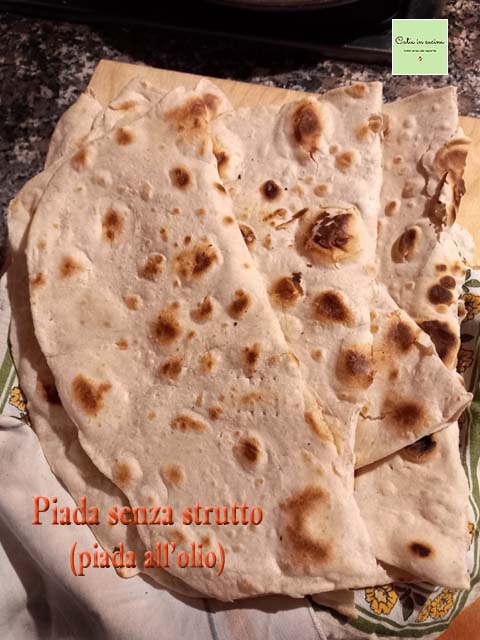
Once cooked, all the flatbreads – which since we were kneading, we made a certain quantity, and the next day they could be eaten dry, for a snack – were placed (folded in half or cut into quarters) in a basket covered with a napkin to keep them warm, a basket that was brought to the table instead of the bread basket.
In all this, the oil flatbread option was nonexistent; there was no doubt about which was the priority ingredient. Only in one case could the ingredients of the flatbread be a topic of conversation, when during dinner someone (meaning dad) would say: tonight the flatbread is different. And mom: oh well, we’re out of lard!
〰〰〰
👇 My other traditional recipes: 👇
- Difficulty: Easy
- Cost: Economical
- Rest time: 30 Minutes
- Preparation time: 10 Minutes
- Portions: 5-6 flatbreads
- Cooking methods: Stove
- Cuisine: Italian Regional
- Region: Emilia-Romagna
- Seasonality: All seasons
Ingredients
- 450 g all-purpose flour
- 50 g mild extra virgin olive oil (or seed oil)
- 90 g water
- 90 g milk
- 1 pinch (salt)
Tools
- Bowl
- Fork
- Pastry Board
- Rolling Pin
- Cast Iron Griddle
Steps
Pour the flour into a bowl (or directly onto the pastry board) and make a well in the center.
Pour the oil, then add the milk and water (+ the pinch of salt, if using).
👉 My mom used half milk and half water, but you can use all water (like in the lard version), especially if using extra virgin olive oil. Seed oil usually makes the flatbread drier, that’s why milk is added: to compensate for the tendency to dry out typical of oil flatbread compared to that with lard.
Work it by hand briefly then transfer the dough onto the pastry board.
☝ It’s important to mention that the amounts of water and milk are indicative (they may vary by 10 or 20 grams) since, as always, the flour absorption may vary. I made this recipe 3 times before deciding to write it down and I never used the same weight of water and milk. As with lard flatbread and all doughs in general, working by feeling remains the best.
Knead by hand until a well-mixed but rough dough is obtained, no need to refine it too much.
Let the dough rest covered with the bowl for at least half an hour (if desired, up to a few hours).
Divide the dough into small loaves and roll them out with the rolling pin to obtain a thin dough disc.
The number of flatbreads depends on how large (and how thin) you want to make them (the Rimini flatbread is wide and thin). With the ingredients from this recipe, you get 5-6 flatbreads.
Place the griddle (or testo, or non-stick plate) on the fire to heat.
👉 As already described in the traditional flatbread recipe, the so-called Romagna testo – in many areas it is made of terracotta, in others of cast iron, here it’s called teggia and made of iron – has now been replaced by non-stick plates (multi-use, also usable for cooking vegetables or other) similar to crepe plates.
☝ Once the plate is heated, cook the flatbreads over medium flame, or adjust the flame as needed, to prevent the flatbread from burning on the surface.
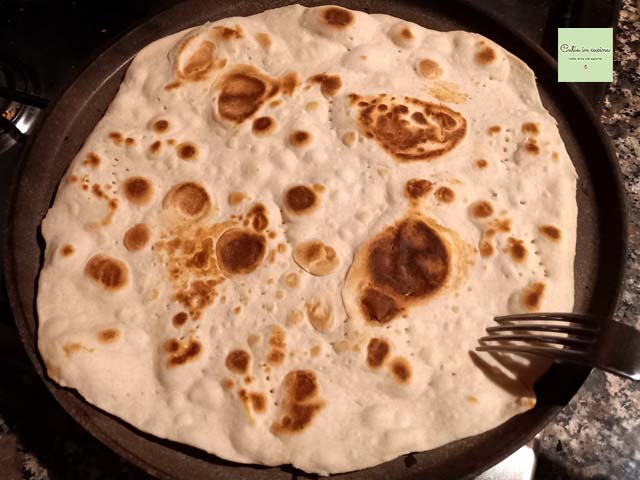
Place a flatbread on the plate. As it heats (in a minute or slightly more), bubbles form, which should be pierced with a fork to prevent them from inflating too much. Do not let the flatbread sit still, move it continuously to prevent it from burning on the back of the bubbles.
Check the cooking by lifting one edge with the fork, then flip the flatbread and cook it on the other side, always rotating it.
In 3-4 minutes the flatbread is cooked. Be careful not to cook it too long, otherwise it will dry out.
Here it is, the flatbread without lard is cooked to perfection. 😊
All that’s left to do is to fold it in half and serve it immediately. It’s delicious. Even without lard, it’s delicious, it must be said. 😊
Salt-Free Tips
 For my usual salt-free tips, I can only repeat what I explained in the traditional flatbread recipe with lard: since mom obviously adds a pinch of salt, even in this recipe I decided to include it in the ingredients to respect mom’s original recipe, even though for her, this oil version is occasional, as I told. If you are used to a low-sodium diet like me, I’m sure you won’t feel the need to add salt here either. 😊
If you are interested in reducing or eliminating salt, always remember to:
▫ Gradually decrease the salt; the palate needs to get used to it slowly and should not notice the progressive reduction.
▫ Use spices. Chili, pepper, curry, nutmeg, cinnamon, cloves, cumin…
▫ Use aromatic herbs. Basil, parsley, oregano, thyme, sage, marjoram, rosemary, mint…
▫ Use seeds. Sesame, pine nuts, almonds, walnuts…
▫ Use spicy vegetables or fruit. Garlic, onion, lemon, orange…
▫ Use my salt-free vegetable granule and gomasio.
▫ Prefer fresh foods.
▫ Avoid water-based cooking, prefer methods that do not disperse flavors (griddle, foil, steam, microwave)
▫ Avoid bringing the salt shaker to the table!
▫ Allow yourself an occasional indulgence. It’s good for mood and helps perseverance.
If you don’t want or can’t give up salt:
▫ You can still try my recipes by salting according to your habits.
Follow Me!
On the WhatsApp channel and on Instagram, on the Facebook page, on the Pinterest boards, in my two groups: The group of Catia, in the kitchen and beyond and Just what I was looking for! and if you like… subscribe to the Newsletter
On the WhatsApp channel and on Instagram, on the Facebook page, on the Pinterest boards, in my two groups: The group of Catia, in the kitchen and beyond and Just what I was looking for! and if you like… subscribe to the Newsletter
FAQ (Questions and Answers)
Can you cook flatbread on induction stoves?
The answer is yes, using a plate suitable for induction. But what I’d give to show my grandmothers an induction stove, and to have their opinion on the flatbreads that, just a few nights ago, I cooked at my mom’s house!
In the new house, my mom has an induction stove and also an ‘induction Romagna testo’ (from a well-known brand), but I must say that, yes, we cooked them, but with results I would define as difficult. The plate never manages to heat adequately despite the maximum temperature level of the stove, and thus the cooking time for each flatbread doubled (and good thing we make the flatbreads thin).
Moreover, the induction concentrates heat only in the center of the plate, so our typical wide Rimini flatbreads suffered a lot at the edges. Next time we’ll try to make smaller flatbreads.
Certainly not all stoves are the same, but I can report that even my daughter and sister-in-law, who have induction stoves different from mom’s, encountered the same problem, even using different plates or regular non-stick pans.
We’ll also try other types of plates or pans until, I’m sure, we’ll find one that allows us to remain faithful, as much as possible, to tradition. 🤗
