
Remembering what I said in the previous muffins (the apple ones without eggs, remember?), the “good the first time” worked great this time: the much-feared-yes-so-feared gluten-free muffins turned out well on the very first try! Yes yes yes!!
Are you surprised by my enthusiasm? Hey, enthusiasm is needed here, these are my first gluten-free muffins! We have to celebrate!
They’re also lactose-free (meaning without milk and derivatives), but with that “without” I was a bit faster and figured it out earlier, already at the time of the lemon ring cake which is one of the cornerstones of cakes in my house. And I might even think about making it gluten-free at this point. 😛
And they are also salt-free…
Heh heh heh, well okay… of course, you’ll say, it’s a dessert!
Ehhhh, yes! Of course, it’s a dessert, but trust me, I see quite a bit of pinches here and there, when not actual splashes, of salt even in sweets!… Okay, this salt-free thing is a joke 😉 although it’s undeniable that it’s true, but it’s a topic that matters to me, as you can imagine as you’re inside this blog.
If you remember, I already talked to you about the hidden salt issue in packaged sweets in the filled cookies recipe, so I won’t bore you with a repetition. I’ll just tell you that it’s true that this is indeed a whole different matter compared to the mere pinch that everyone but me ( 😃) uses in homemade sweets, where the pinch should serve to enhance the flavors. But it’s also true that you can easily do without it, and without suffering, believe me. And so, since I don’t have salt at home, well… in these gluten-free muffins no pinch of salt, beyond habits, or decisions, or lifestyles.
In fact, after this gluten-free experience, I’d say I can declare that going without a pinch of salt works well in this category too!
Okay, now that I’ve convinced you not to use salt 😀 I’ll tell you how someone convinced me to try a gluten-free recipe. 😊
All thanks to Leti, from the blog Without is good, and her contest The Free Food Lover.
Leti suggested I participate and sparked my curiosity. Then she encouraged it by inviting me to participate also in the GlutenFreeExpo, which I attended a couple of Sundays ago and mentioned in the latest newsletter (and you haven’t subscribed yet??? subscribe!!!), besides on the fb page when I showed you the photo I took, very excited, with Sonia Peronaci. Lovely things, as someone would say (🤩).
At the GlutenFreeExpo I wandered around the stands looking like a perfect newbie for a couple of hours. Toward the end of the afternoon, I started to understand something and stopped at a stand to get explanations about the flours to use for a dessert. My question was slightly interested… but I’d say I did well. 😀
I have to say that even before this useful and productive day, I had stocked my pantry with rice flour, corn starch, potato starch, buckwheat flour, and various types of corn flour. The latter with the precise intent of reworking the polenta cake I made last year, a dessert which when I spoke about it in the newsletter I referred to as “unconsciously gluten-free”.
Because it’s true, it’s exactly like that: there are recipes that are gluten-free by default, but we gluten-free novices don’t worry about whether they are because in our daily life it doesn’t matter to us.
However, then it might happen that the curiosity to cook not only “unaware” recipes but also “aware” gluten-free recipes arises.
At first, the idea of tackling a gluten-free dessert scared me. I was plagued by doubts like “it won’t rise,” “it won’t be soft,” “it will be gritty”… Legitimate doubts, eh, since the few experiments I had done in the past with rice flour had left me with the memory of a gritty taste and no desire to try again.
But in the end, it’s true that a good time comes for everything, things can go wrong for ages and then suddenly resolve in an instant. And that’s how I discovered in an instant that there are fine-milled gluten-free flours specific for sweets, which make desserts softer, and therefore more enjoyable to eat, compared to those from my past failed experiments. And I understood, to give an example, that a finely milled corn flour specifically for use in sweets works better than the corn flour usually used for preparing polenta. And now, go ahead and tell me that was a no-brainer to think of, say it without hesitation… because I, on the other hand, hadn’t thought of it!
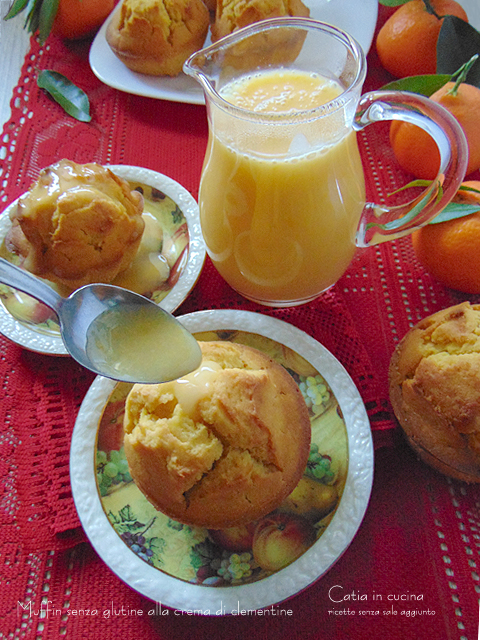
So, now that you’re exhausted after reading all these introductory explanations… sit at my table, as I know you’re drooling! Please, take one of these gluten-free muffins with clementine cream! 😋
They are gluten-free muffins with a simple taste, a taste of home, a taste of homemade ring cake, and they are super good for breakfast. Dunk them in your coffee, you’ll taste such goodness!
- Difficulty: Medium
- Cost: Economical
- Preparation time: 30 Minutes
- Portions: 6
- Cooking methods: Oven
- Cuisine: Italian
- Seasonality: Autumn, Winter
Ingredients
- 1/2 cup rice flour (finely milled for sweets)
- 1/2 cup corn flour (finely milled for sweets)
- 2/3 cup potato starch
- 7/8 cup brown sugar
- 2 tbsp corn oil
- 1 1/3 tsp cream of tartar
- 1/2 tsp baking soda
- 1 egg
- 3 fresh clementines (peeled, weighed 155 g)
- 5 fresh clementines (to extract 160 g of juice)
- 2/3 cup almond milk
- 1/4 cup brown sugar
- 1 tbsp cornstarch
- 2 tbsp cognac (or another pure distilled spirit, gluten-free)
Tools
- Muffin Pan
- Food Chopper
- Bowl
Steps
Pour the flours and starch in a bowl. Add brown sugar and cream of tartar+baking soda.
Mix well with a spoon until any lumps are gone, and all powders have become a single flour.
In a separate bowl, beat the egg with a fork.
Peel the three mandarins and blend the segments with a food processor. The juice will be coarse, and some segments’ fibers will remain, but don’t worry, they will disappear after baking.
Add the mandarin puree and oil to the egg, mix, then pour everything into the flour mixture.
Mix until you get a well-blended batter, then pour it into a 6-muffin pan.
Bake in a static oven at 392°F for about 20 minutes; halfway through, lower to 356°F. As always, I recommend adjusting time and temperature to your oven, although they shouldn’t differ too much.
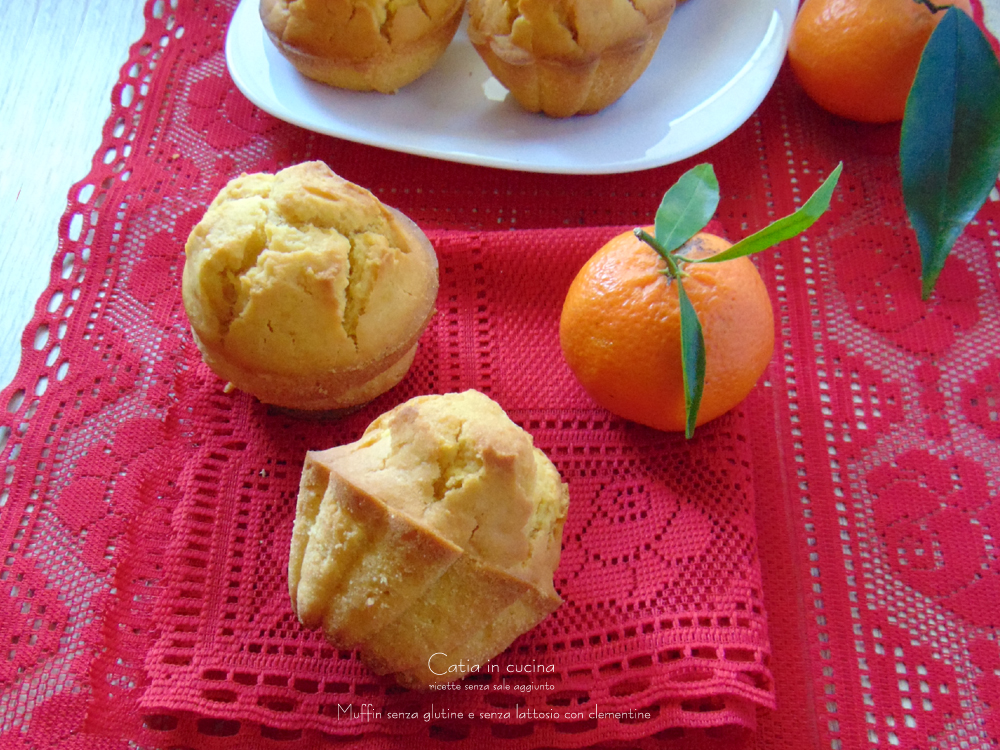
Cut the mandarins in half and squeeze their juice with a juicer. To get 160 grams of juice, I squeezed 5.
Pour the juice into a saucepan, add the sugar, and put the saucepan on the stove.
Stir, then when the sugar is dissolved, add the corn starch, preferably sifted to avoid lumps.
Continue stirring, slowly adding the almond milk, and keep going until it boils.
Add the liquor and simmer for a minute or two before turning the heat off.
With only 10 grams of corn starch used, you get a thickened cream that remains quite liquid; I did this deliberately because my intention was to drizzle it over the muffins and create a cream bed on the plate, even if in this photo the cream bed is not visible, it is actually under the sliced muffin.
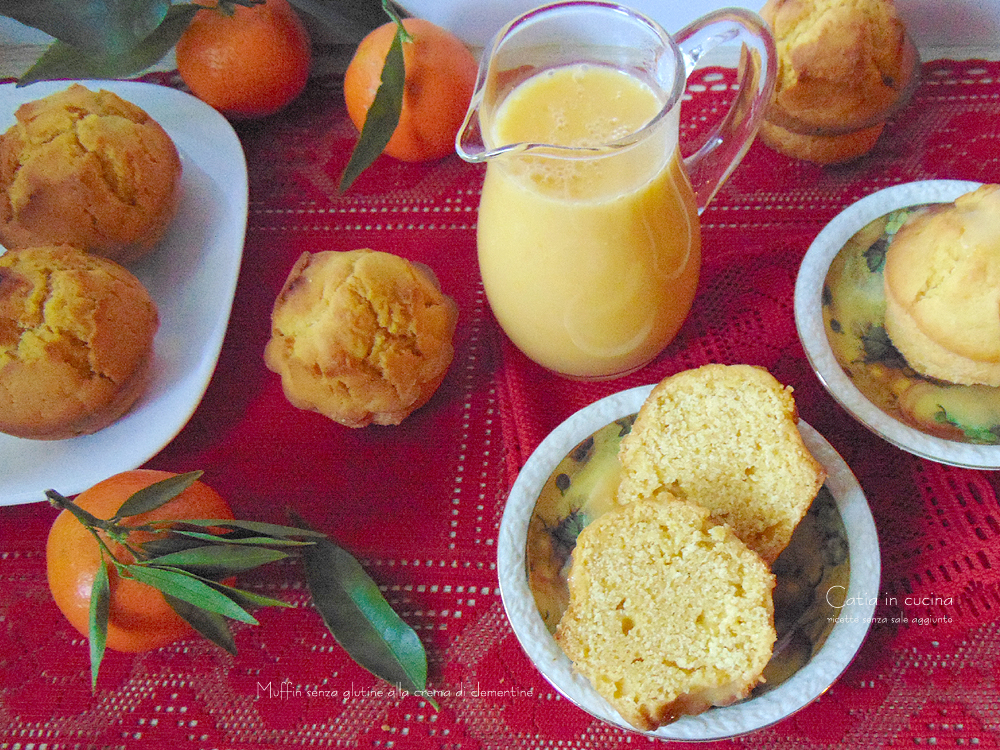
We did various tests. The one we liked the most was the version with sliced muffins drizzled with warm cream, all eaten with a fork.
By putting it in the fridge for a few hours, the cream firms up slightly while still remaining soft, so anyone who prefers to use it cold rather than warm will have to wait a couple of hours before having a snack, or vice versa, decide to prepare it a bit in advance. 😉
In any case, it was a good idea to make a cream to pour over the muffins, it gave me great satisfaction!
Enjoy!
Follow me!
On WhatsApp channel and on Instagram, on Facebook page, on Pinterest and in my two groups: Catia’s group, in the kitchen and beyond and Exactly what I was looking for! and if you like… subscribe to my Newsletter.
On WhatsApp channel and on Instagram, on Facebook page, on Pinterest and in my two groups: Catia’s group, in the kitchen and beyond and Exactly what I was looking for! and if you like… subscribe to my Newsletter.
