
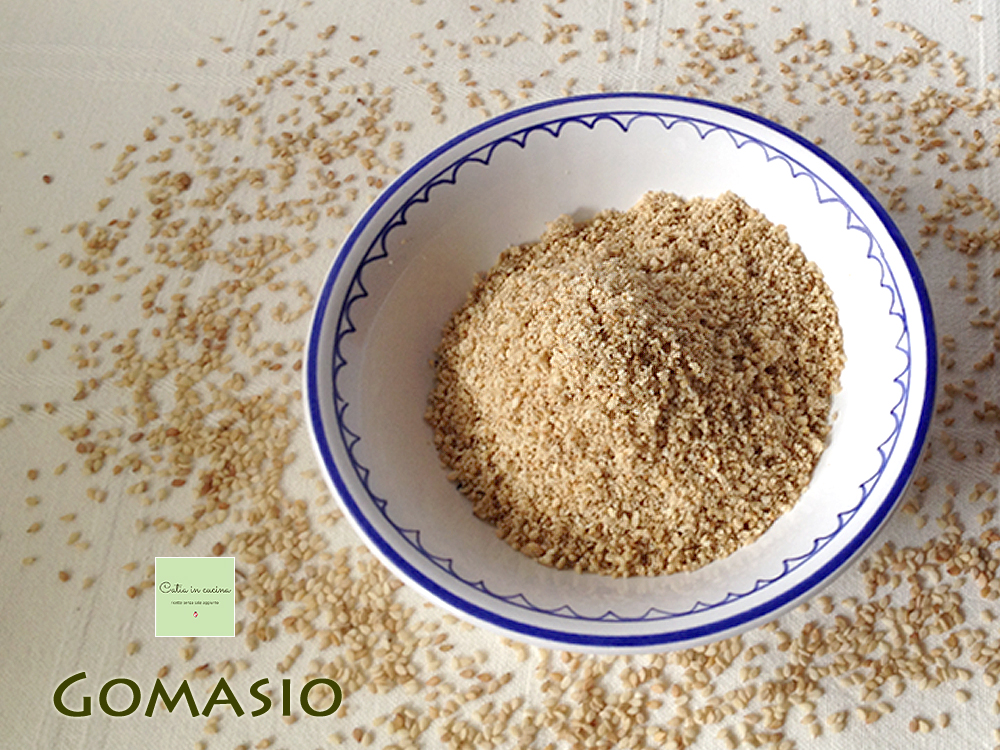
Anyone cooking without salt must know about gomasio, a seasoning of oriental origin, used in macrobiotic cooking.
It has a pleasant taste, enhances foods while adding very little salt, and can be useful in the “scaling practice”, meaning it can be prepared with progressively less salt until, if desired, all salt is eliminated.
And it can be used by everyone, not just those on a low-sodium diet. 😉
☰ ☰ ☰
- Difficulty: Easy
- Cost: Economical
- Preparation time: 1 Minute
- Cooking methods: Stove
- Cuisine: Italian
- Seasonality: All seasons
Ingredients
- 20 teaspoons sesame seeds
- 1 teaspoon salt
Tools
- Pan
- Chopper
- Mortar marble with pestle
Gomasio should be used instead of salt for seasoning raw dishes.
I use it on vegetables, especially salads, on plain pasta, in breadcrumbs for breading, and, in general, in all dishes where the absence of salt might be more noticeable (it can sometimes happen depending on the cooking method).
You can find ready-made gomasio in jars for sale, but it is so simple to make it yourself that I personally never felt the need to buy it.
For those unfamiliar with it, the name gomasio might evoke some exotic product, but it is essentially very simple in both ingredients — just sesame seeds and salt — and use in cooking. The name comes from the combination of the Japanese words for sesame (goma) and salt (shio), and the process for preparing it is straightforward.
Basically, you toast the salt and sesame in a ratio of about 1:14, meaning 1 teaspoon of salt and 14 teaspoons of sesame. Proportions can vary according to taste and habit, but generally, you can range from 1:6 to 1:20.
Toast in a pan or oven (I prefer using a pan) the sesame seeds and salt (I usually use the 1:20 ratio).
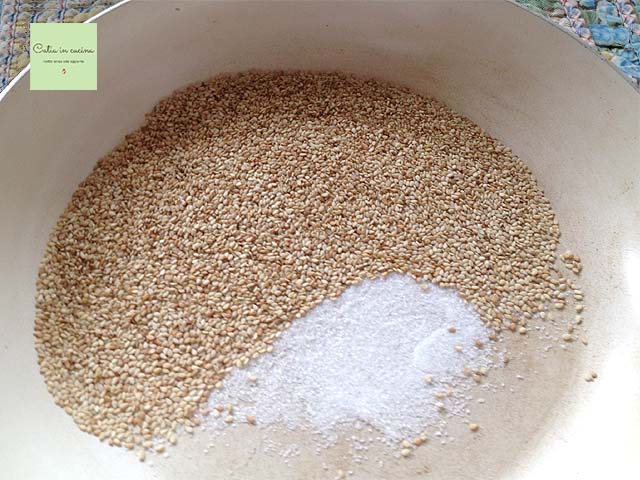
Some toast sesame and salt separately, some together. It may not be the original method, but I have always toasted them together, also because I always used the 1:20 ratio (until I eliminated the salt completely) and the idea of toasting a single teaspoon of salt alone… made me smile a bit. If you wonder why the salt is toasted as well, the purpose is to remove its moisture.
After toasting (be careful not to let the sesame darken, or it will become bitter), salt and sesame need to be crushed in a mortar.
Note on toasting: if you have never toasted sesame seeds before, I advise not to leave the pan unattended on the stove (it really is ready in a few minutes) but to stir the sesame with a spoon constantly (or move the pan) and then at the first popping sounds from the seeds, turn off the heat; otherwise, the transition from toasted to burnt happens in a flash. If needed, immediately transfer the hot seeds to a plate to stop the cooking process.
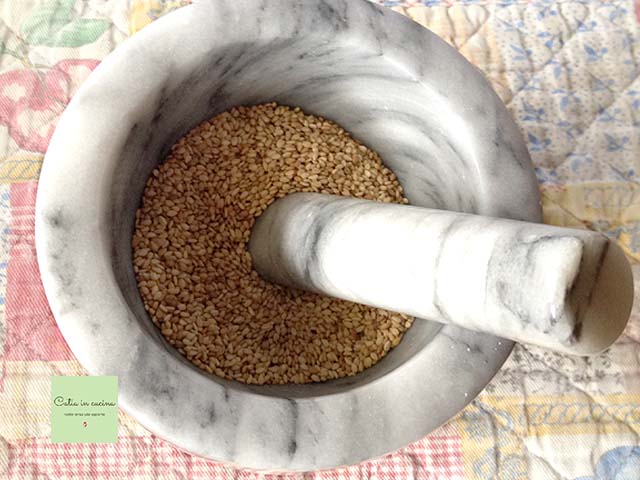
If you find the mortar cumbersome, you can use a small food processor (for convenience, I prefer using the blades, and I hope purists of the original recipe will forgive me. 🙂)
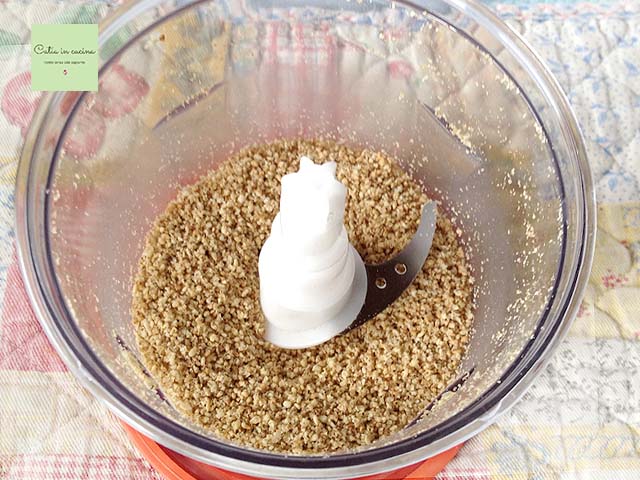
👉 Alternatively, I have experimented with great satisfaction using a grinder (the classic coffee grinder, you can see one in the Tools section). It has the advantage, compared to the chopper, of grinding very quickly, thus avoiding the possibility of the blades heating up (which should be avoided).
It is necessary to mention that the traditional mortar specifically for gomasio (called suribachi) is the most suitable, as it has special grooves that aid in crushing the seeds.
Choose the method you prefer; you can evaluate it by looking at the items I have selected for you under the Tools section.
However it is crushed or ground, gomasio should be stored in a glass jar or another food-safe container, sealed. It should keep for about a week; some say two weeks, but I usually store it longer (in this case, I put it in the fridge).
My advice is to prepare a minimal amount so that you always have it fresh; after all, making gomasio is so simple that it isn’t a problem to do it once a week.
Salt-Free Tips
 Gomasio is a valuable aid in transitioning to salt-free cooking. My advice is to start with the 1:6 ratio and gradually reduce the salt over time, and I assure you that you can completely eliminate salt without too much sacrifice.
If you’re interested in more information about salt-free cooking and the journey my family has taken, I refer you to my article Cooking Without Salt.
Remember that reducing salt is considered good practice not only for the prevention of cardiovascular diseases, which is very important as it is now proven that excessive salt intake is linked to the risks of stroke and heart attack, but it is also useful for reducing fluid retention, consequently “helping” in weight loss diets and cellulite treatment.
If you have questions, or if you want to talk about your salt-free experience, or if you simply want to chat, write to me! You can leave a comment here at the end of this article, or visit me on my Facebook page.
Or… join my group Catia’s group, in the kitchen and beyond where I have prepared a dedicated section for low-sodium cooking with useful links to documents and specific recipes.
🥰
