
Today I will tell you about my Greek-style salad, that is, a Greek salad that is not quite Greek but “style”.
Even though I have never been to Greece, I am very attracted to Greek recipes. So far, all those I have seen online or read about in my cookbooks have proven suitable for me. That’s why every summer I often prepare Greek-style salads that are basically derived from the many recipes I’ve seen, read, or eaten (at street food events! :-D) and to which I have often made my own modifications.
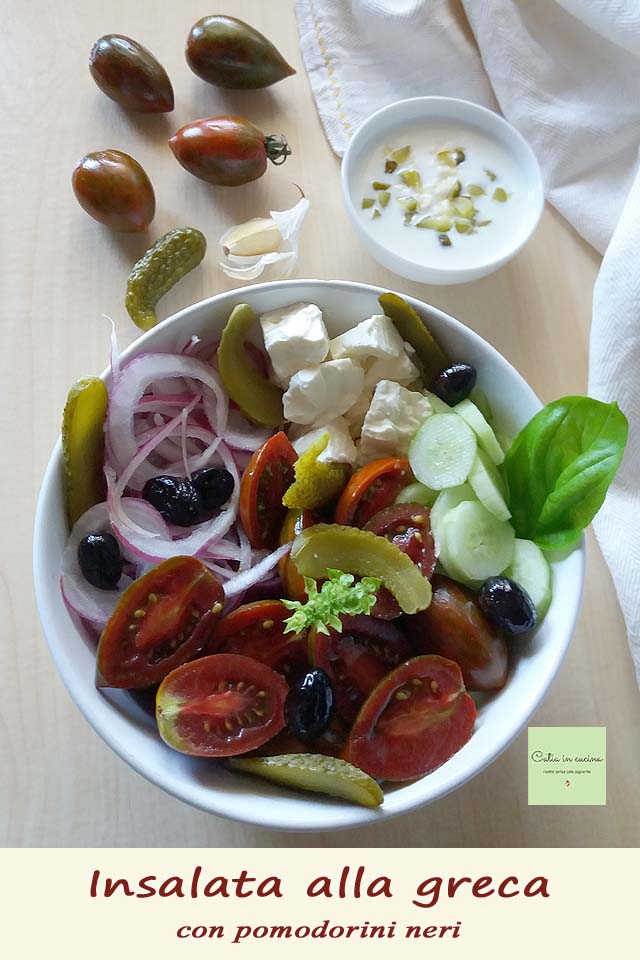
Thanks to my enterprising greengrocer, who often encourages me to make original purchases, yesterday I bought some black striped cherry tomatoes. I had seen them around, but I hadn’t yet had the chance to taste them, so they immediately went into my Greek-style salad. 🙂
They are darker cherry tomatoes and perhaps less attractive to look at, let’s say they’re less sunny than the beautiful red ones we’re always used to, but they are really good, they are firm and full-bodied and have a full flavor that pairs excellently with feta and red onion.
Then at the last minute, I decided to accompany this Greek-style salad with a sauce based on kefir, which turned out to be the perfect match.
Have I convinced you to try it? I hope so! 😀
👇 Other mixed salads: 👇
- Difficulty: Very easy
- Cost: Economical
- Preparation time: 5 Minutes
- Portions: 2 people
- Cooking methods: No cooking
- Cuisine: Italian
- Seasonality: Spring, Summer
Ingredients
- 10.5 oz Black Cherry Tomatoes
- 1 Cucumber
- 3 oz Feta
- 1 Red Onion (small or half if large)
- 6 Black Olives (Greek style)
- 1 Pickled Gherkin (depending on size)
- 1 tbsp Extra Virgin Olive Oil
- Basil
- Oregano
- 3.5 oz Kefir (or Greek yogurt or plain yogurt)
- 1 clove Garlic
- 2 Pickled Gherkin
- Pepper
- Lemon Zest (optional)
Tools
- Knife
- Salad Bowl
Preparation
The process doesn’t require much explanation, it’s simply enough to: wash the tomatoes and peel the cucumber, cut them into pieces or slice them, slice the onion and cut or crumble the feta, then season everything with oil, olives, aromatic herbs, and pickles.
Some useful information:
The feta should always be rinsed under a stream of running water or soaked for a few minutes in a bowl. To better desalt it, soak it after cutting it.
The red onion is usually good just like that, freshly sliced, and doesn’t require washing or soaking, but if it tastes too strong for you, or if you decide to use other varieties of onion, you can soak it for 10 minutes in water and vinegar after slicing it.
Oregano is never missing at my house, and I always use it in this salad, sometimes I also add mint and other times basil as I did today.
The pickles are optional; since they are also present in the accompanying sauce, they can be omitted.
Regarding the olives, I like them all and often change varieties, so for this salad, I use the ones I have at home at the moment: usually black, but sometimes green, sometimes pitted, sometimes Taggiasca. Currently, I am using black olives with pits labeled on the package as “Greek-style.” I discovered only after the first taste that they are particularly tasty, indeed quite salty, perhaps too much for us who are used to eating without salt (and for this reason, in the note at the end of the recipe today, I will leave you some more detailed explanations than usual.).
For the accompanying sauce:
Season the kefir – or if you don’t use kefir, yogurt, Greek or plain unsweetened, is fine – with finely chopped garlic, pickles, and a sprinkle of pepper. I also recommend adding grated lemon zest (which is not visible in the photo because I added it later).
Serve the Greek-style salad with the sauce on the side, to be poured over the salad on individual plates. If salads dressed with sauces are not for you (but try it first!), this salad is also delicious dressed with just oil, or with oil and lemon, or oil and vinegar.
Come on, you have plenty of choices!
Bon Appétit! 😀
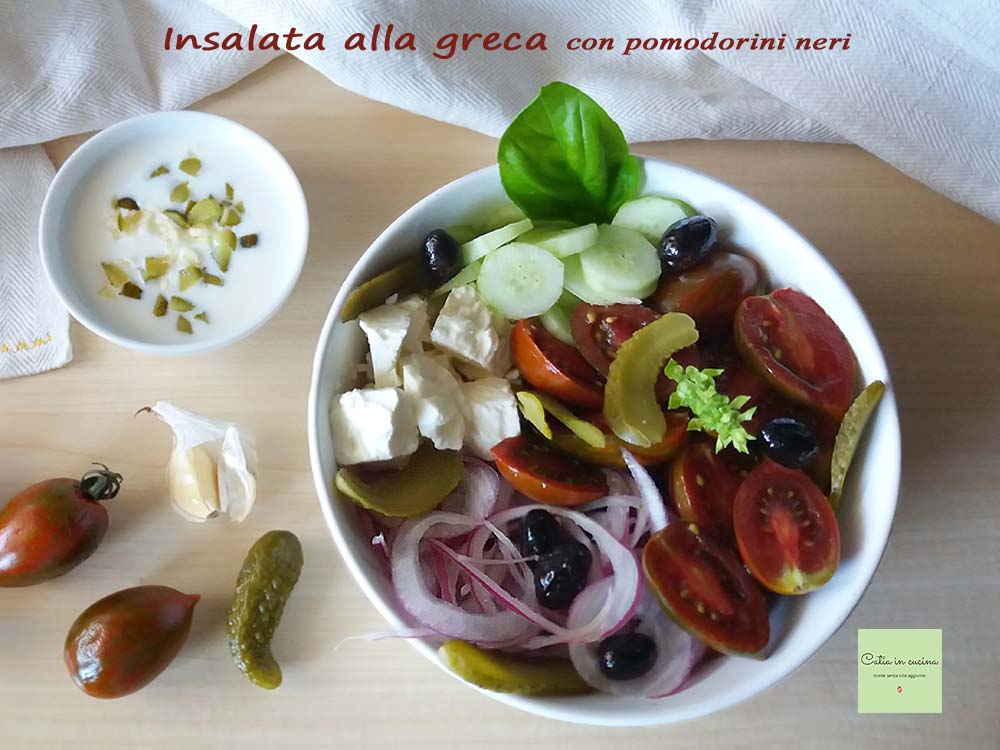
And if you can’t find black cherry tomatoes, don’t worry, this Greek salad is excellent with all types of tomatoes, the important thing is that they are well-ripened and have the flavor of summer. 🙂
Enjoy!
Tips Without Salt
 In the spirit of “let’s try to reduce the salt from dishes,” I renew the invitation to desalt the feta before using it.
And I also invite you to use olives sparingly.
About olives: olives – and other products in brine or under salt, like capers or dried tomatoes – are discouraged in low-sodium diets. Generally, I use these products occasionally and in small amounts (in this recipe three per person) (and sometimes serve a decorative purpose for photos 😀) but, especially, when portioning, I avoid letting them end up in my husband’s plate 😉 the main recipient of our more than twenty-year salt-free cooking.
I want to pass on this small trick to decrease or limit to the minimum possible the use of salty products like olives: don’t use them whole but cut them into small pieces (or slices if they are pitted). You’ll discover that this way, even with just one or two olives per person, you can decorate and flavor the entire portion simply by placing some pieces or slices here and there. I assure you that sometimes it’s all a matter of sight: if olives are needed in this recipe, if we eliminate them entirely, we deprive ourselves of a color that could be characteristic of the recipe. A color we then associate with a flavor.
Since very often we eat with our eyes, it is a fact, that piece can be enough to satisfy our eye and our palate. In short, if we manage to use two olives instead of the eight whole olives we would have wanted to use… we will have significantly reduced the salt present in the recipe 🙂 Does it seem trivial? Maybe it is, but for me it isn’t, and I’m happy to share these little daily tricks with you because they help reduce the salt from our dishes without having to necessarily decrease our pleasure of being at the table. 🙂
If you are interested in reducing or eliminating salt, always remember to:
▫ Gradually reduce the salt, the palate must gradually adapt and should not notice the progressive reduction.
▫ Use spices. Chili, pepper, curry, nutmeg, cinnamon, cloves, cumin…
▫ Use aromatic herbs. Basil, parsley, oregano, thyme, sage, marjoram, rosemary, mint…
▫ Use seeds. Sesame, pine nuts, almonds, nuts…
▫ Use spicy vegetables or fruits. Garlic, onion, lemon, orange…
▫ Use my salt-free vegetable granules and gomasio.
▫ Prefer fresh foods.
▫ Avoid cooking in water, prefer cooking methods that do not disperse flavors (grill, foil, steam, microwave)
▫ Avoid bringing the salt shaker to the table!
▫ Sometimes allow yourself a break from the rule. It is good for the mood and helps to persevere.
If you do not want, or cannot, give up salt:
▫ You can still try my recipes by salting according to your habits.
Follow me!
In my new WhatsApp channel and on Instagram, on the Facebook page and Pinterest, in my two groups: Il gruppo di Catia, in cucina e oltre and Exactly what I was looking for! and if you like… subscribe to my Newsletter.
