
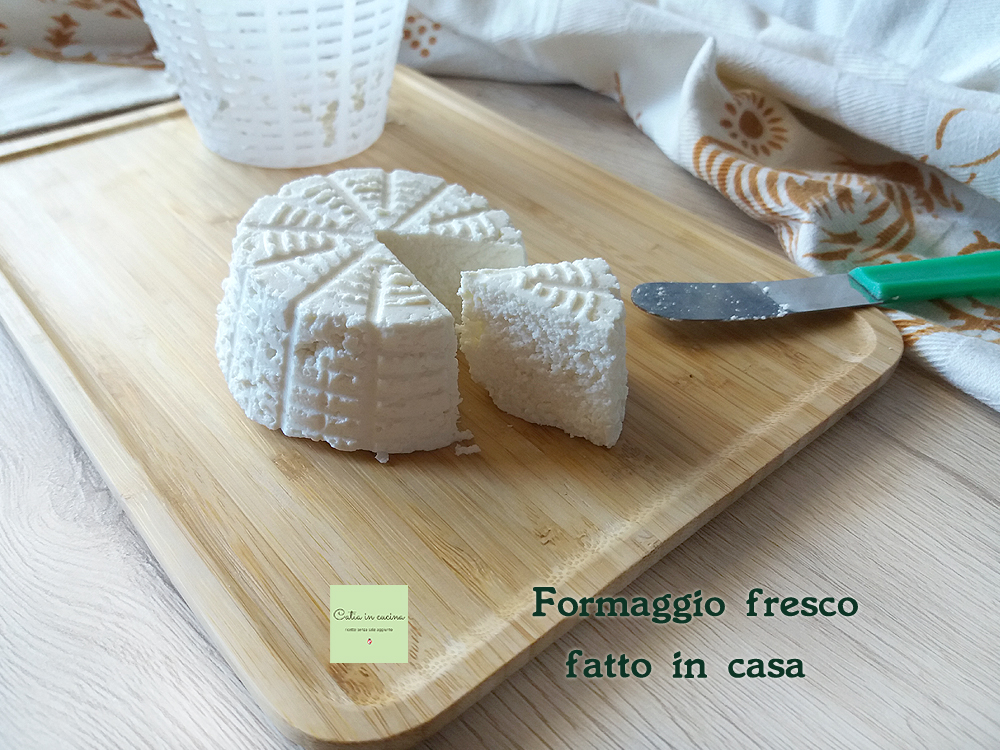
For years I’ve been regularly making homemade fresh cheese (without salt) (*) It’s a cheese obtained by milk coagulation, and it’s really simple to make.
In cheese production, coagulation usually occurs via rennet. But in home production, vinegar or lemon is often used, whether out of aversion to animal rennet or for convenience if, like me, you are not in the habit of buying rennet.
Then, once you have made the cheese, you can, if you wish, make ricotta by reheating (hence re-cooked) the whey left after separating the milk).
Initially, and for a long time, as the inexperienced person I was (and still am), I believed that this homemade fresh cheese was ricotta. Only after years did I discover that the cheese obtained by this method, i.e., by coagulation and emergence of the curd, is actually not ricotta. And it is, as far as I could ascertain, called primosale.
Then a few days ago I stumbled upon a further discovery, after which I even changed the title of this recipe: curiosity led me to read the Primosale entry on Wikipedia, and from curiosity to curiosity I also clicked on the Tuma entry. There it is explained that tuma, or toma, is a sheep’s cheese produced “without any added salt“, and this… immediately made me say “well, blow me down!!”. 😀
Meaning: since everything that comes out of my kitchen is always without added salt, the first thought I had at that moment was: but then my homemade fresh cheese, which I first thought was ricotta and then thought was primosale, perhaps I should call it tuma?
I didn’t want to use this name in the title to respect the true origin of the true tuma, and regardless of the official designation of this fresh cheese, what matters to us is that we like it, and for us, it is a very valid salt-free alternative to fresh cheeses of which we are so greedy in this family.
Therefore, if you too must or want to follow a low-sodium diet for whatever reason, you can stop giving up the cheeses you love so much because you can make them at home with your own hands using this very simple method that I explain in the recipe.
I must truthfully say that lately – and finally – I have found some fresh cheeses sold with low salt content (specifically, it was stracchino and mozzarella) and this bodes well for the future because common awareness is finally appreciating this truth: that less salt does not mean less taste but means healthier, without a shadow of a doubt.
But in the meantime, I am quite happy to make my own fresh cheese.
As is the case with everything homemade, I assure you it is very satisfying. For me, it’s wonderful to make a bit of everything at home, from bread to crackers, from mayonnaise to vegetable granulate, up to this fresh cheese that I don’t quite know what to call… 🙂
It’s great eaten as is, or on bread, drizzled with a bit of oil, or it can be used to season pasta or stuff filled pasta. In short, let’s get creative!
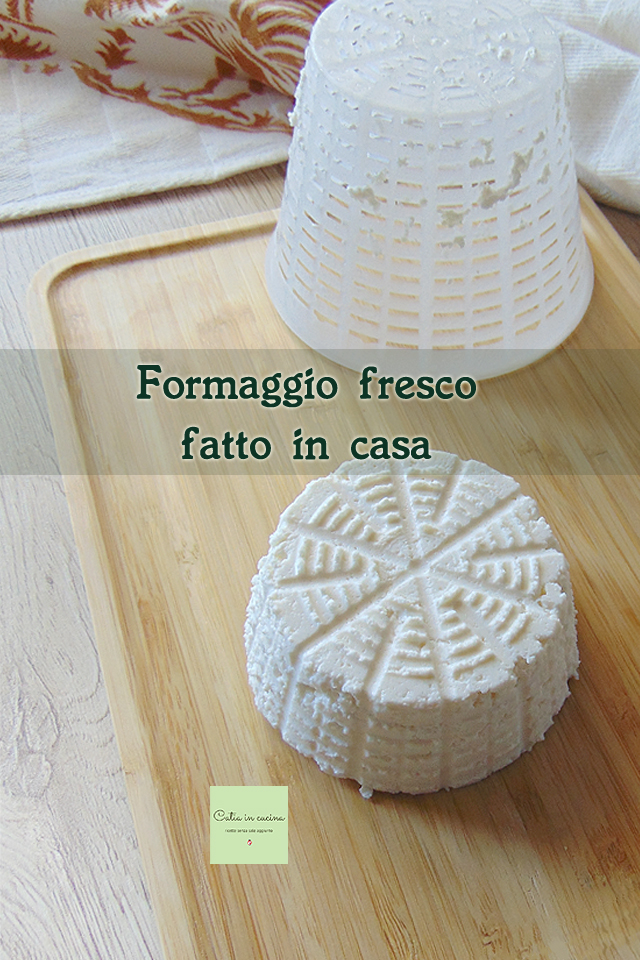
- Difficulty: Easy
- Cost: Very cheap
- Rest time: 8 Hours
- Preparation time: 2 Minutes
- Portions: 2
- Cooking methods: Stovetop
- Cuisine: Italian
- Seasonality: All seasons
- Energy 319.20 (Kcal)
- Carbohydrates 23.69 (g) of which sugars 23.58 (g)
- Proteins 16.50 (g)
- Fat 18.00 (g) of which saturated 11.34 (g)of which unsaturated 6.56 (g)
- Fibers 0.00 (g)
- Sodium 1.00 (mg)
Indicative values for a portion of 100 g processed in an automated way starting from the nutritional information available on the CREA* and FoodData Central** databases. It is not food and / or nutritional advice.
* CREATES Food and Nutrition Research Center: https://www.crea.gov.it/alimenti-e-nutrizione https://www.alimentinutrizione.it ** U.S. Department of Agriculture, Agricultural Research Service. FoodData Central, 2019. https://fdc.nal.usda.gov
Ingredients for about 200 g of cheese
- 1 quart whole milk
- 3 tbsps white wine vinegar (or apple cider vinegar)
Tools
- Pot
- Slotted Spoon
- Mold or perforated basket or cheese mold
Procedure
This recipe is widespread, so much so that it was even featured in my son’s first-grade textbook, and he enthusiastically asked me to copy it from there, that day being remembered in our family as the “first day we made cheese”.
Over the years I have repeated the recipe many times both with vinegar and lemon, both with fresh ‘fresh’ milk (i.e., fresh milk, usually high quality, before the expiration date) and with expired fresh milk – yes, yes, expired (up to 3-4 days after the expiration date). This is something I learned was possible only after years, lamenting all the times I had thrown away expired milk, not knowing it could be used in this wonderful way. I’ve also tried making it with raw milk from the dispenser.
Concluding that the fresh cheese you get is always good, albeit with slight differences due to the different type of milk, the duration of draining, the use of vinegar or lemon (minimal difference but in my opinion, there is).
The recipe I write below is the basic recipe. But you can enrich it by adding aromas, herbs, or spices (exactly as I described for the spreadable fresh cheese). In the future, I will certainly talk about these flavored versions.
For now, let’s start with the basics:
Pour the milk into a pot and bring it to a simmer (but do not let it boil).
Pour the vinegar into the milk.
Lower the heat to the minimum and stir well with a spoon. Immediately, the milk will start to coagulate, separating from the liquid part, i.e., the whey.
Let it simmer gently over low heat for about a minute, then turn off the heat and cover with the lid.
Let it rest for at least 10 minutes (but it can be extended peacefully).
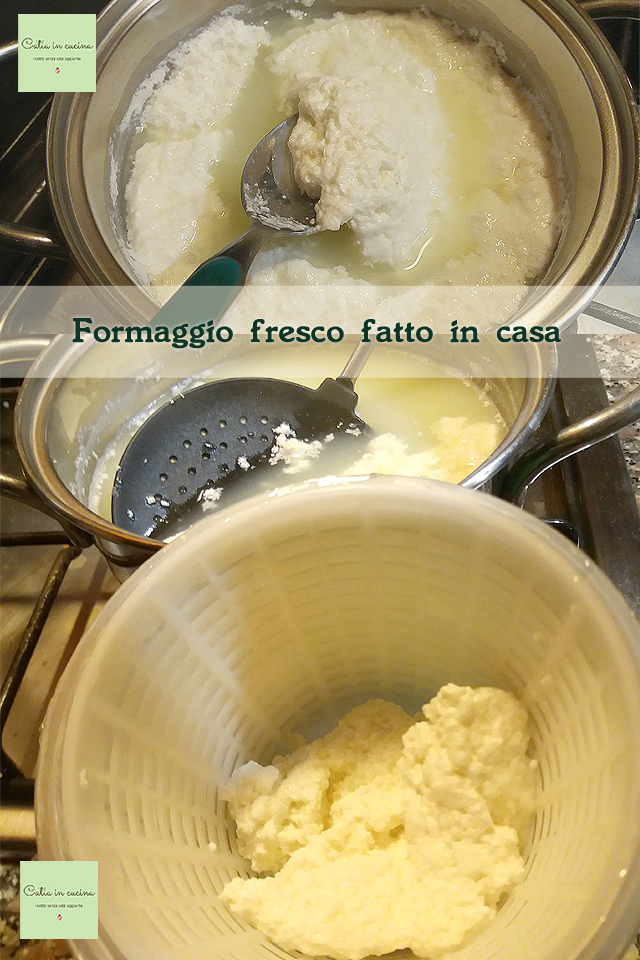
Collect all the curd with a skimmer and let it drain in a cheese mold or, if you don’t have a mold, in a simple colander.
Years ago, as an inexperienced person, I didn’t know that cheese molds were available for retail, believing they were only distributed to producers (for the sake of having random beliefs 😄), so I remedied by recycling the molds from purchased ricottas, well washed of course (which I still use sometimes).
Then I discovered that they can be purchased and that they can be found in various shapes and sizes. If you’re curious to take a look, at the following link you can find molds of various shapes, also suitable for other types of cheese –> Cheese and Ricotta Molds
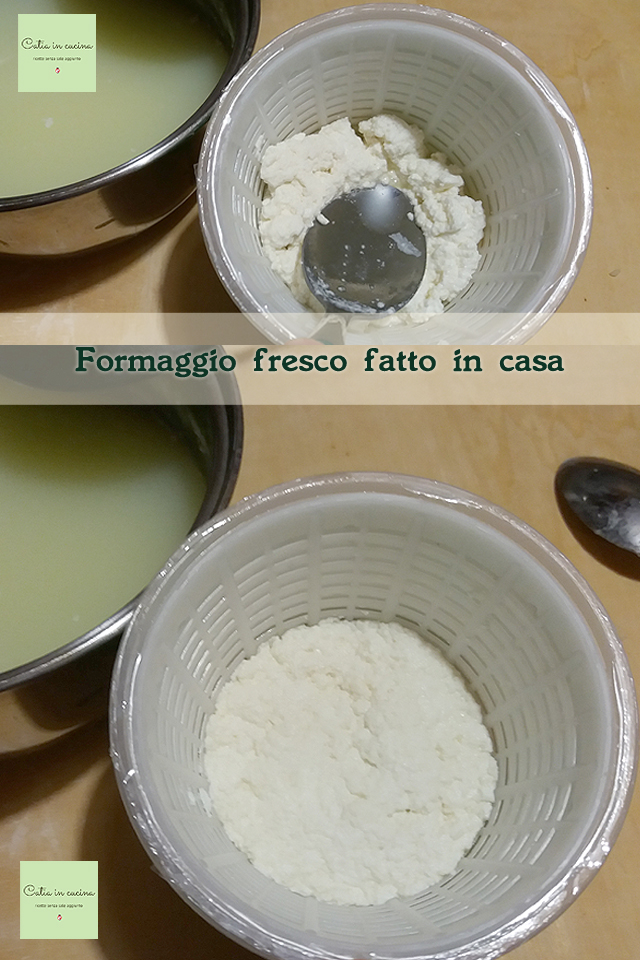
After collecting all the curd and putting it in the mold, press it with the back of a spoon to compact it.
If desired, you can obtain flakes, like cottage cheese, in which case it’s enough to flake the curd with a fork.
Let it cool, then store in the fridge until fully chilled.
During the rest in the fridge, the cheese will lose more whey (therefore, a collection container should be foreseen).
The longer it rests, the drier the cheese will become.
Storage: I’ve never stored it for long periods because I usually make it for table consumption, and the next day we eat it. Except for one occasion when I stored it for 3 days. So my personal indication of certain storability, in the fridge, is 3 days. 😉
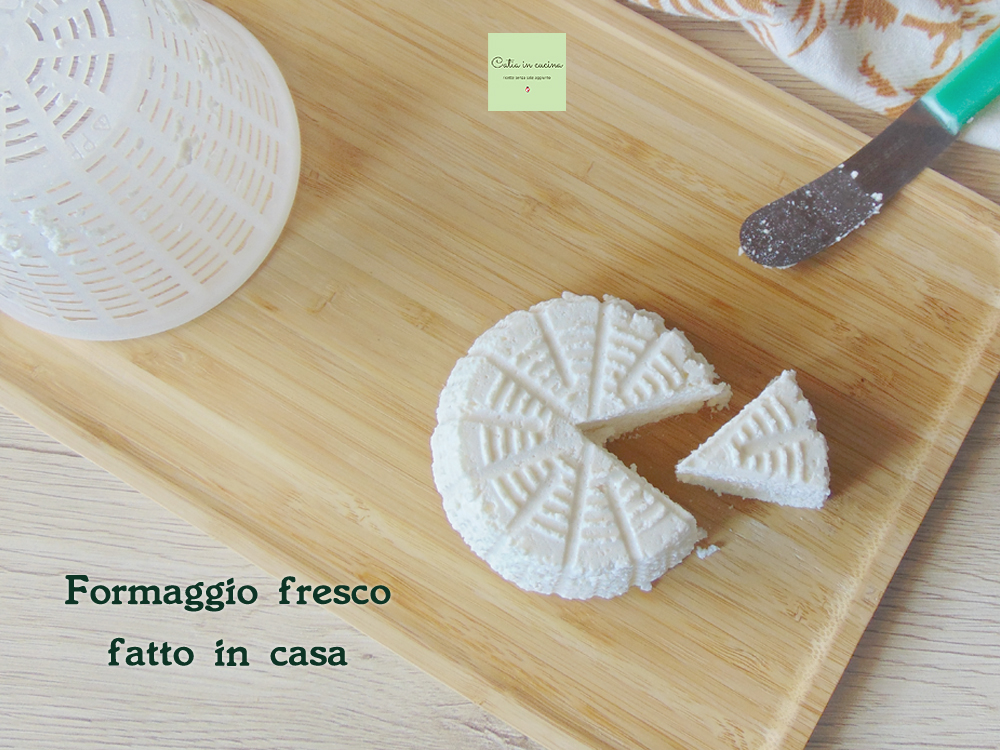
The main variant is:
You can use lemon instead of vinegar. You get the same result, but I have a preference for vinegar, for two reasons: 1, because it happened that with lemon, coagulation was slow, and in those cases, I solved it by simply adding vinegar; and 2, because depending on the type of vinegar used (especially if the vinegar is homemade), a slight aftertaste may remain in the cheese, which we like a lot. Let me know if it’s the same for you!
Alternatively, you can opt for apple cider vinegar, which is more delicate.
Other variants can be obtained by flavoring the cheese with herbs, spices, or seeds, which I will delve into. Such explorations will certainly translate into recipes.
Tips on using whey: the whey remaining after making fresh cheese can be used to make ricotta, the most well-known use, which you can read about in the dedicated recipe. But the whey can also be simply used in doughs (all, from bread to pizza to breadsticks, etc.) or even as a base for puddings instead of milk (for example, this peach pudding).
(*) Salt-free Tips
 Homemade food production can be a necessity for those who must follow a low-sodium diet, i.e., when certain foods cannot be consumed or their consumption must be limited. Or, homemade production can be a choice: because it’s fun to produce things yourself, or because you are committed to the art of eating healthy, or because after many years of a low-sodium diet, as is our case, you end up naturally attracted to ‘true’ flavors, and you naturally appreciate the flavors that nature has given to foods, without additions, and thus not adding even salt.
If you see yourself in these descriptions, welcome to my blog! 🙂
If you are interested in reducing or eliminating salt, always remember to:
– Gradually decrease the salt, the palate should get used to it slowly and should not notice the progressive reduction.
– Use spices. Chili pepper, black pepper, curry, nutmeg, cinnamon, cloves, cumin…
– Use herbs. Basil, parsley, oregano, thyme, sage, marjoram, rosemary, mint…
– Use seeds. Sesame, pine nuts, almonds, walnuts…
– Use spicy vegetables or fruit. Garlic, onion, lemon, orange…
– Use my salt-free vegetable granulate
– Prefer fresh foods.
– Avoid boiling foods, prefer cooking methods that do not disperse flavors (grill, foil, steam, microwave)
– Avoid bringing the salt shaker to the table!
– Sometimes allow yourself a cheat. It’s good for the mood and helps to persevere.
If you don’t want or can’t give up salt:
You can still try my recipes by salting according to your habits.
Follow me!
on my Facebook page and on my Pinterest boards
in my two groups:
Catia’s group, in the kitchen and beyond and Exactly what I was looking for!
and if you like… subscribe to my Newsletter
