
I’ve long promised you the recipe for my homemade ricotta (since the time of homemade fresh cheese). And thanks to Light and Tasty, today I finally keep that promise. 😊
The appointment with our weekly light column today features a recipe with ricotta. Therefore, I hope to please you and my colleagues in the Team by taking this opportunity to propose the recipe for self-producing ricotta instead of a recipe using ricotta as an ingredient.
Anyone who knows my kitchen and this blog of mine already knows that I love self-production and that I cook without added salt. And that self-production is important for those who must (or want to) follow a low-sodium diet.
In my experience, perhaps because we’re all fond of it in the family, one of the most challenging foods to manage in a low-sodium diet is cheese.
For meat and fish, the problem does not arise; it is enough to choose fresh products. With cheeses, you can’t do that, because cheeses without salt practically don’t exist.
In recent years, finally, there are some timid examples of low-salt cheese; I found stracchino or mozzarella, and for me, it is an achievement that I had awaited for years and welcomed with hope in this recipe. But the possibility of finding totally salt-free cheese on the market is remote if not impossible, for obvious production and preservation reasons.
That’s why self-producing cheese can be useful, even if it’s just a simple ricotta, or the fresh cheese of which ricotta is a corollary. Or spreadable cheese. 😊
So… come on, it’s a really easy self-production that gives much satisfaction and can be done, beyond health motivations, just for the pleasure of producing something good made with your own hands. A production that can also be done with children, you’ll see they’ll happily eat their self-produced ricotta!
Here you go, all you have to do is produce some fresh cheese, save the whey, and then re-cook it (hence re-cotta) to make your delicious homemade ricotta. Voila! 🙆♀️
Here are some of my self-productions, all very useful for cooking low-sodium:
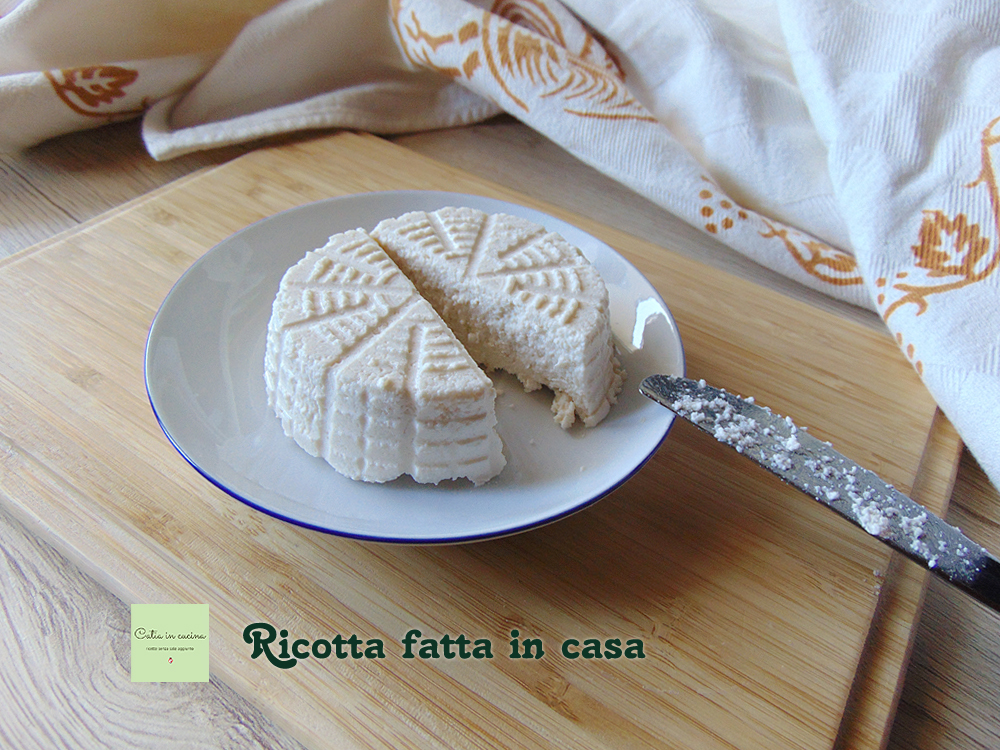
- Difficulty: Very Easy
- Cost: Very Cheap
- Rest time: 1 Day
- Preparation time: 20 Minutes
- Cooking methods: Stove
- Cuisine: Healthy
Ingredients
- whey (left after making fresh cheese)
- whole milk
- lemon juice (or white vinegar)
Tools
- Saucepan stainless steel with lid
- Skimmer or slotted spoon
- Container / cheese mold
Steps
After making fresh cheese, bring the remaining whey to a boil in the saucepan again.
Pour more milk into the whey (as needed, for a minimum production 1 liter is fine).
From this point on, the process is the same as described for the previous fresh cheese production:
– bring the whey to a boil, but without letting it boil
– pour in the lemon juice (for ricotta I prefer lemon, but vinegar can also be used), 2 tablespoons for 1 liter of milk added to the whey
– reduce heat to the minimum and mix well with a spoon
– simmer with the flame at minimum for a minute, turn off the heat and close with the lid
– let it rest (resting time can vary, with the last production I waited about an hour)
– collect the curd with the skimmer and let it drain in a cheese mold (like this one).
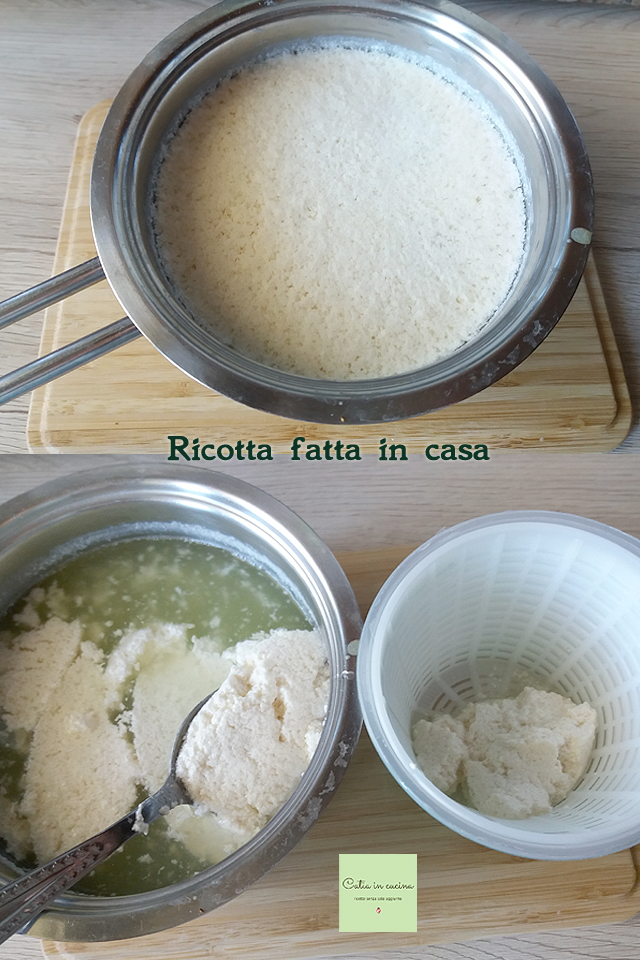
Compared to fresh cheese production, the ricotta curd usually has a finer texture.
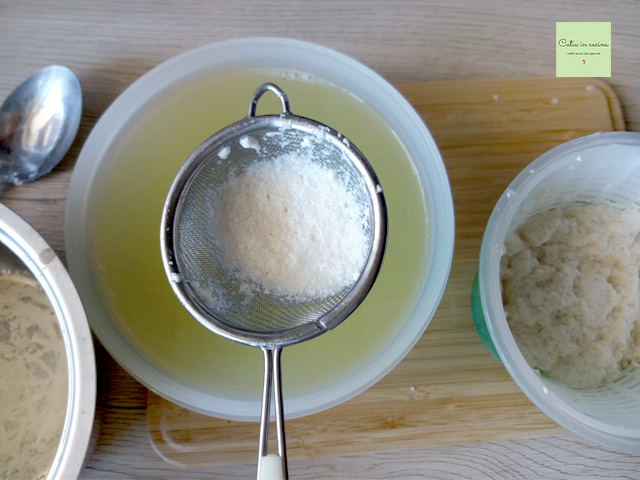
To collect every small residue that escaped the skimmer’s mesh, I finally filter the remaining whey with a finer strainer.
As seen in the following photo, it’s not much that is collected, but for me, it’s still worth collecting. 🙂
Collected all the curd in the cheese mold, press gently with the back of a spoon to compact it.
Place the cheese mold in the fridge (inside its container, or a plate is fine to collect the residual whey drainage).
Leave in the fridge until the next day.
Storage: just like fresh cheese, at our house ricotta doesn’t last long, we usually eat it all quickly, but it can be stored (in the fridge) for a few days without problems.
I’ve never tried re-cooking the remaining whey; I usually use it for bread dough. A very useful use indeed.
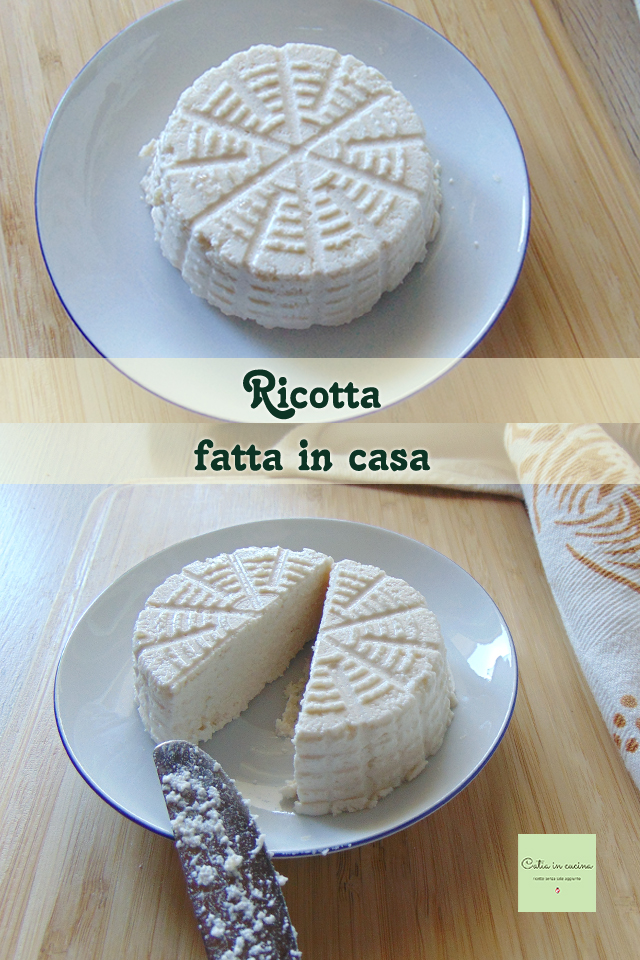
This excellent homemade ricotta, entirely salt-free, is delicious eaten alone, as it is natural and has a flavor! Mmmmh!
But it can be seasoned with extra virgin olive oil and a pinch of pepper or enriched with aromatic herbs or spices just as with fresh cheese.
Additionally, it can be used for cooking, as an ingredient for fillings or desserts, or to dress pasta.
Try using it for my Light and Tasty colleagues’ recipes! 😉 Here they are:
Carla: Chicken breast with ricotta and mushrooms in yogurt cream
Daniela: Mini brioche without yeast with ricotta and walnuts
Elena: Wholemeal spaghetti with ricotta and almonds
Franca: Ricotta tortelloni with aromatic herbs
Milena: Pears with ricotta cream, chocolate, and hazelnuts
Serena: Ricotta cake
Salt-Free Tips
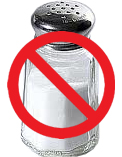 If you’re interested in reducing or eliminating salt, always remember to:
Reduce salt gradually, the palate needs to get accustomed slowly and shouldn’t notice the progressive reduction.
Use spices. Chili, pepper, curry, nutmeg, cinnamon, cloves, cumin…
Use aromatic herbs. Basil, parsley, oregano, thyme, sage, marjoram, rosemary, mint…
Use seeds. Sesame, pine nuts, almonds, walnuts…
Use spicy vegetables or fruits. Garlic, onion, lemon, orange…
Use my vegetable granule without salt and the gomasio.
Prefer fresh foods.
Avoid cooking in water; prefer cooking methods that don’t disperse flavors (grill, foil, steam, microwave)
Avoid bringing the saltshaker to the table!
Allow yourself occasionally to break the rule. It’s good for the mood and helps perseverance.
If you cannot, or do not want to, give up salt:
You can still try my recipes by salting according to your habits.
Follow Me!
In my WhatsApp channel and on Instagram, on the Facebook page, in Pinterest and in my two groups: Catia’s group, in the kitchen and beyond and Just what I was looking for! and if you like… subscribe to my Newsletter.
