
Just like with potatoes, cooking zucchini in the microwave is such a well-established habit for me that I almost don’t remember how to cook them any other way! 😀
Moreover, since I cook without salt (you already know that, right?), for me, cooking zucchini in the microwave is a clever way to preserve all their flavor, so if you’ve never tried… you absolutely must! 😀
And then… my son – known zucchini eater and known non-eater of almost any other vegetable – prefers them cooked this way… so, ahem, who am I to break this lovely spell of “I like microwave-cooked zucchini better”? 😂
⠘ ⠘ ⠘
If you like zucchini, come on… try them like this too! 😃👇
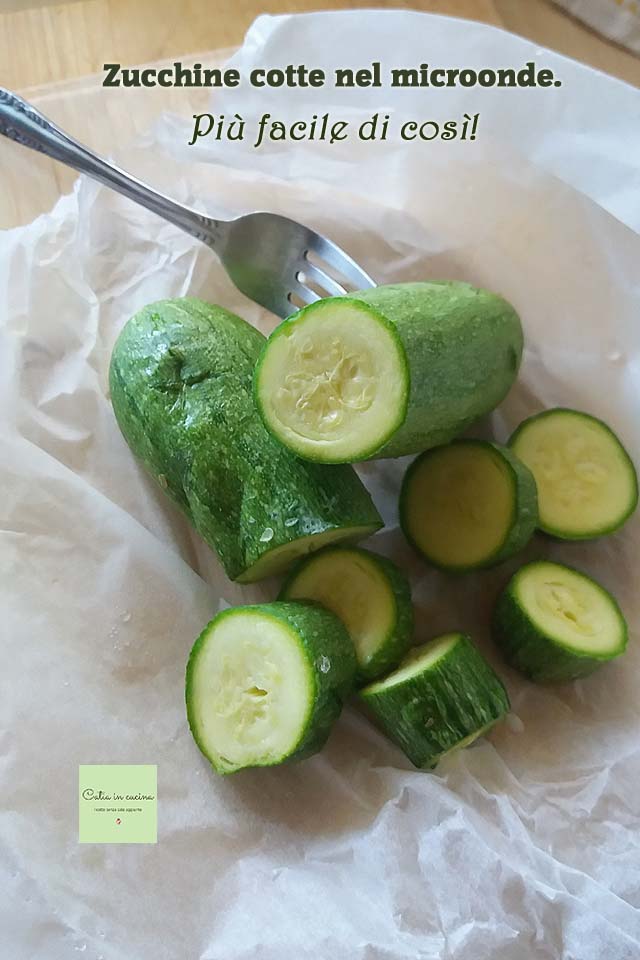
- Difficulty: Easy
- Cost: Economical
- Rest time: 5 Minutes
- Preparation time: 1 Minute
- Portions: 2
- Cooking methods: Microwave
- Cuisine: Italian
- Seasonality: All seasons
- Energy 28.70 (Kcal)
- Carbohydrates 4.25 (g) of which sugars 0.00 (g)
- Proteins 3.70 (g)
- Fat 0.55 (g) of which saturated 0.11 (g)of which unsaturated 0.27 (g)
- Fibers 1.50 (g)
- Sodium 4.10 (mg)
Indicative values for a portion of 100 g processed in an automated way starting from the nutritional information available on the CREA* and FoodData Central** databases. It is not food and / or nutritional advice.
* CREATES Food and Nutrition Research Center: https://www.crea.gov.it/alimenti-e-nutrizione https://www.alimentinutrizione.it ** U.S. Department of Agriculture, Agricultural Research Service. FoodData Central, 2019. https://fdc.nal.usda.gov
Ingredients
The weight of the zucchini I indicate here refers to the last zucchini I cooked and used. I will go into more detail with other weights and considerations in the procedure.
- 7 oz zucchini
Tools
To introduce the list of tools, I’ll quote a phrase I wrote in the article on cooking potatoes in the microwave, which is valid for all foods cooked with this appliance: “the important thing to always remember when using the microwave is to use suitable containers with lids”. It may seem trivial, but it is not. 🙂
- Microwave Oven
- Container for microwave Tupperware
- Lid universal for microwave
- Parchment paper
How to cook zucchini in the microwave
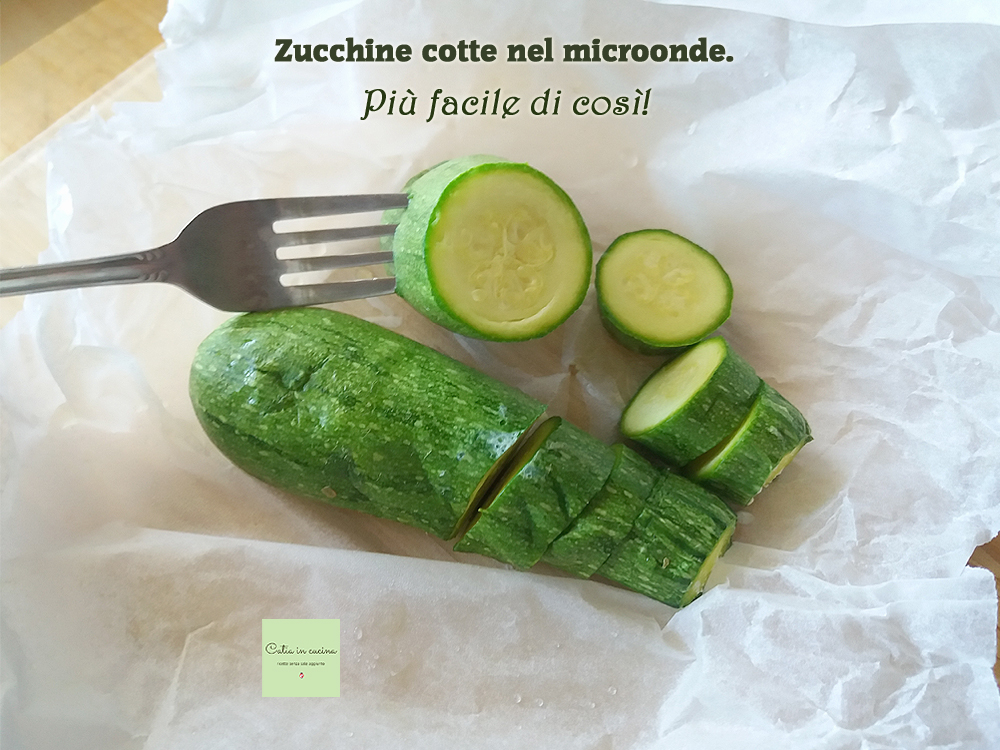
As with all vegetables, and as I mentioned in the article on potatoes (I mention it again because it’s a comprehensive article not only on cooking potatoes but on using the microwave in general, and I encourage you to read it for completeness of information), you can also proceed with cooking zucchini in the microwave either whole or cut into pieces.
Personally, I have a slight preference for cooking zucchini in pieces because it allows for more even cooking, provided, of course, that they are cut into as uniform pieces as possible.
For cooking whole zucchini, I usually proceed one at a time to avoid issues due to differences in size: it often happens that at my home we deal with farm-sourced zucchini, which are rarely the same size, and indeed they are often quite large.
In the case of similar-sized zucchini, you can proceed with simultaneous cooking, as I will explain further down in the section ‘How to cook whole zucchini,’ showing you the photos.
Wash and trim the ends of the zucchini.
Cut them into as even pieces as possible.
Place the pieces in a microwave-safe container and cover with a lid.
Since zucchini are very watery, it’s usually not necessary to add water, as the moisture is ensured by the water released during cooking. However, if the zucchini are small and thin, meaning they have little flesh, it might be useful to add a tiny amount of water (even just a tablespoon, depending on the amount of zucchini being used).
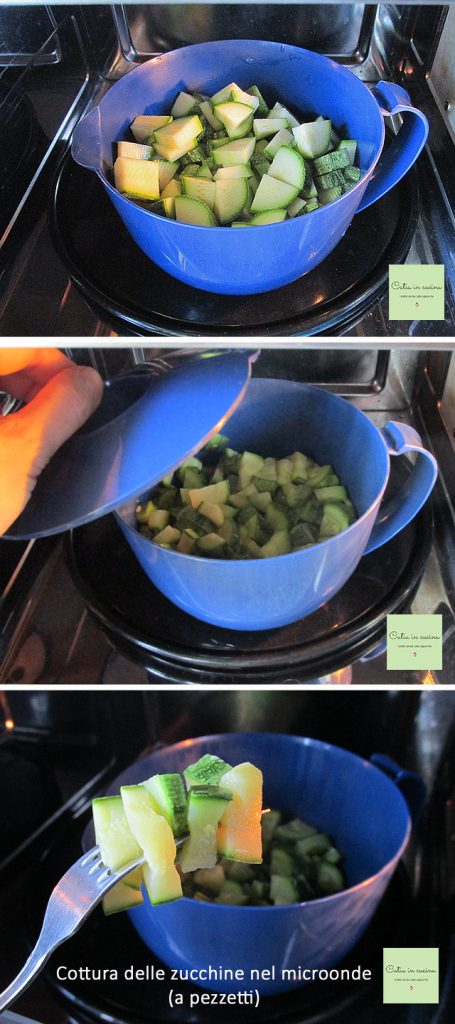
Examples of cooking times for zucchini cut into pieces:
7 oz : 5 minutes.
17.6 oz : 7 or 8 minutes.
Times vary, as always, depending on various circumstances, such as temperature (fridge or room temperature), piece size, zucchini variety, or even the microwave’s output and the power level chosen (I always use the highest power).
Two examples: in one case, I cooked 17.6 oz of zucchini cut into pieces in 3+3+2 minutes, with two breaks to stir the pieces. In another case, I went for 7 minutes with one break halfway through.
A minute more or less, my advice is to stop the microwave at least once to stir the pieces.
A minimum of flexibility is needed, and cooking times should not be considered absolute. The microwave should not be seen as an appliance that ‘just does everything’ because it doesn’t, like any other appliance.
Due to the delicacy of zucchini, when stopping to stir, I prefer not to use a tool, like a spoon or fork, to avoid damaging the pieces – especially during the second pause when they are partially cooked – but I flip them by tossing them in the container 😉
Important: at the end of cooking time, always plan for resting time (resting time is an important feature of microwave cooking): leave the container with the lid closed inside the microwave for a few minutes to allow the residual heat to even out the cooking.
Note: If the zucchini are large and the inner part (with seeds) is not to your liking – because being soft, it cooks more – it might be useful to remove it while cutting the zucchini. This way, the pieces cook more uniformly.
I like soft zucchini, so I never remove the inner part, and for this reason, I hadn’t thought that for some, microwave cooking might require this adjustment. A heartfelt thanks to my friend Lina for this suggestion. 🥰
Then… oh, please don’t throw away the removed part! It can be used in various recipes! (I will update you on this 😉).
Wash and trim the ends of the zucchini.
Optional: pierce the zucchini with a fork.
Having trimmed the two ends, it’s not essential to pierce them. Sometimes I do, sometimes I don’t, but in my opinion, they yield better results if pierced.
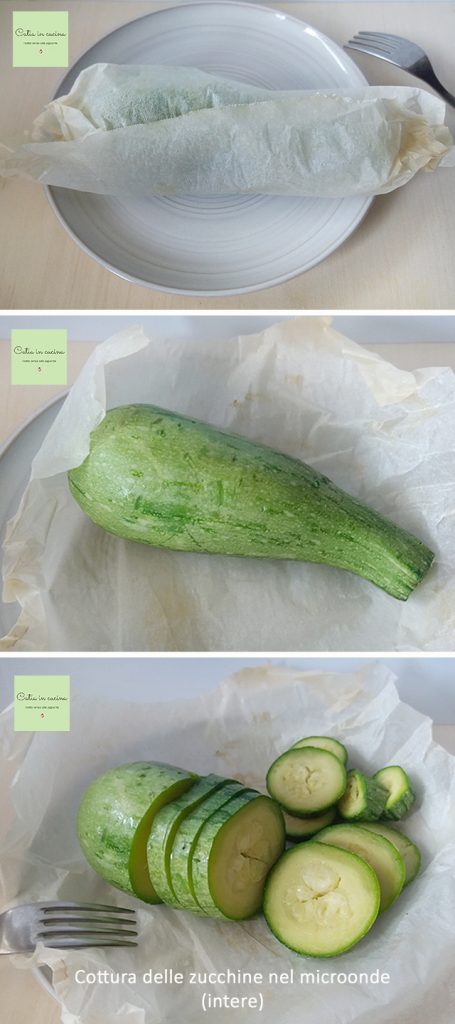
Wrap the zucchini in parchment paper.
If the zucchini are large, I wrap and cook them separately. If they are small, and especially if they are the same size, I cook them together.
Below, I leave you a sequence of photos of cooking a rather large zucchini (and not perfectly shaped):
And below, pictures of two zucchini of similar sizes and weights, cooked with the same parchment paper method but wrapped together instead of one by one:
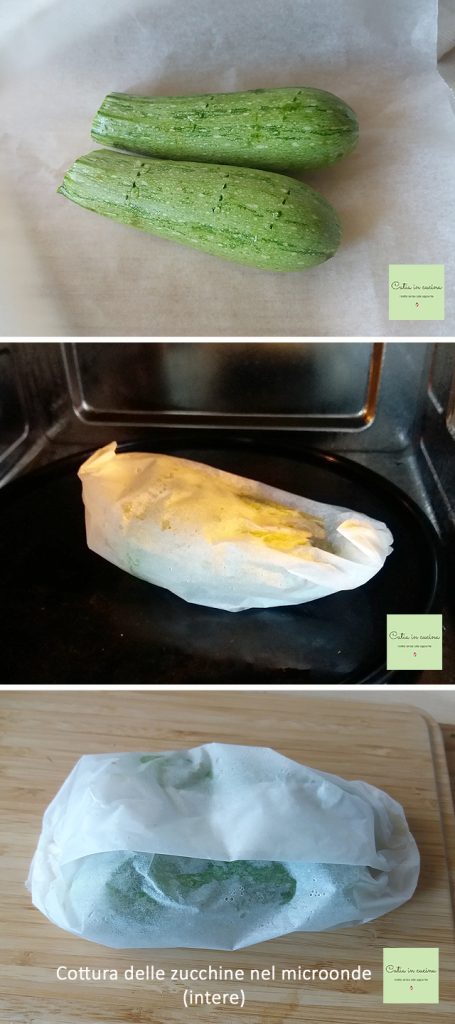
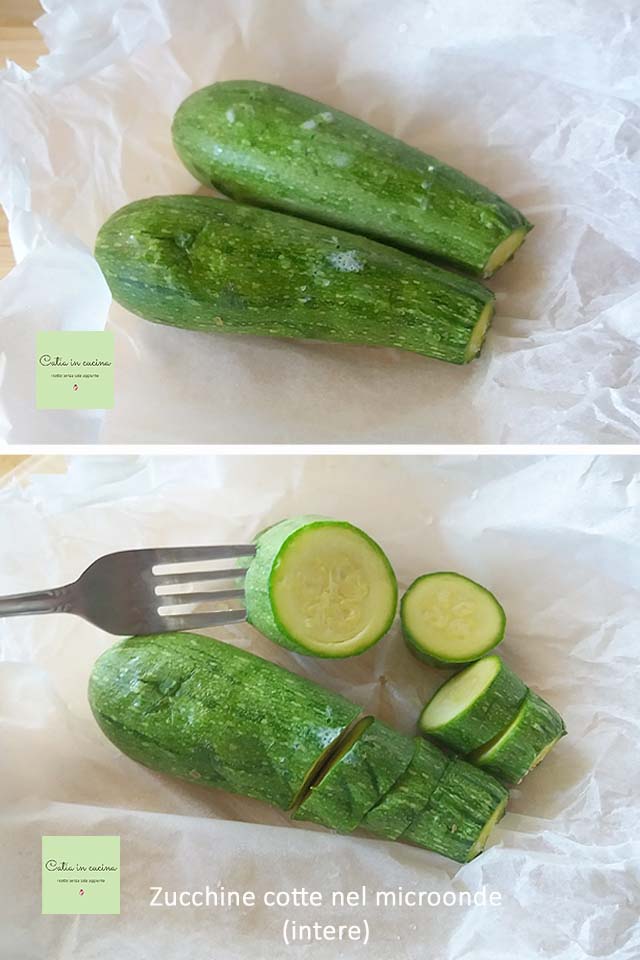
As clearly seen from the third photo in this sequence, moisture accumulates inside the parchment paper, helping the cooking process and preventing the zucchini ends from drying out.
Cooking time (also in this case at the microwave’s highest power) for these two small zucchini (6.9 oz): 4 minutes (3+1) + 3 minutes rest.
After 3 minutes of operation, stop the microwave and turn the zucchini (flip the whole package upside down).
At the bottom, where it contacts the plate, it cooks more (this can be easily felt by touch), so flipping them is helpful for uniform cooking.
Naturally, more zucchini can be cooked this way, adjusting the cooking time proportionally to their total weight (something that applies to any food cooked in the microwave, not just zucchini).
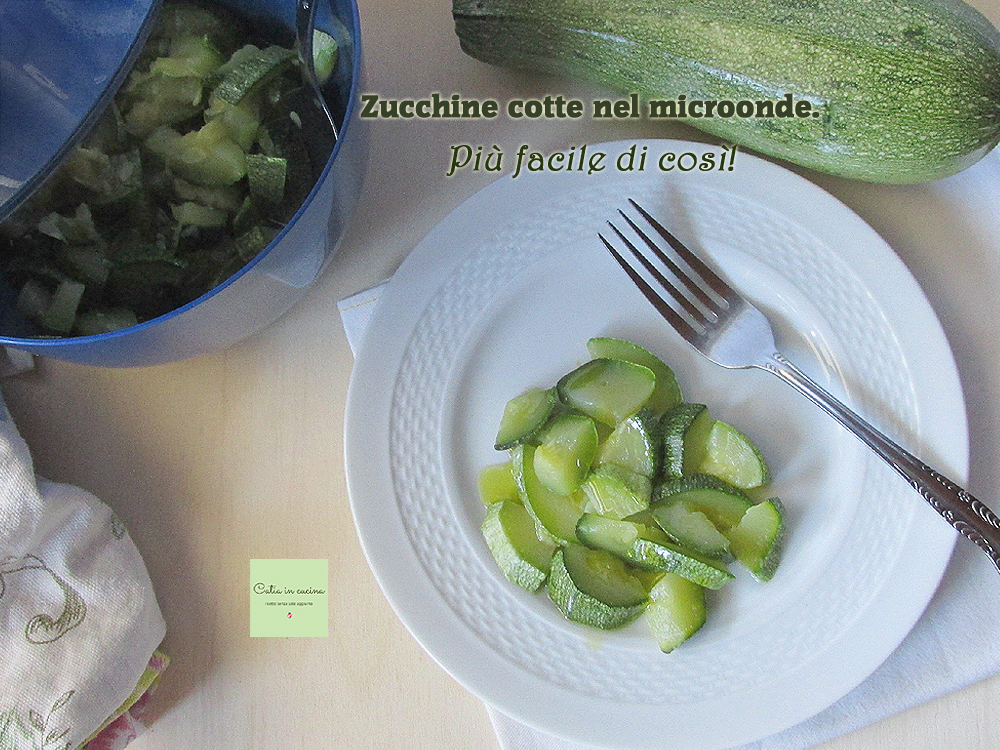
Serve the zucchini as a simple side dish seasoned with olive oil and lemon or aromatic herbs. Or as your imagination suggests… for example, along with potatoes (also cooked in the microwave), or perhaps turned into a puree (recipe to follow!). 😉
Enjoy your meal!!
Which method do you want to try first?
Whole?
Or in pieces? 🙂
Salt-Free Tips
 Microwave cooking is a precious ally for us low-sodium folks, as it retains the flavor and aroma of our vegetables. Additionally, it minimizes – compared to traditional water cooking – the loss of minerals and vitamins. 🙂
If you’re interested in reducing or eliminating salt, always remember to:
▪ Reduce salt gradually, the palate needs to get used to it slowly and shouldn’t notice the progressive reduction.
▪ Use spices. Chili, pepper, curry, nutmeg, cinnamon, cloves, cumin…
▪ Use aromatic herbs. Basil, parsley, oregano, thyme, sage, marjoram, rosemary, mint…
▪ Use seeds. Sesame, pine nuts, almonds, walnuts…
▪ Use spicy vegetables or fruit. Garlic, onion, lemon, orange…
▪ Use my salt-free vegetable granules and gomasio.
▪ Prefer fresh foods.
▪ Avoid cooking in water, prefer cooking methods that do not disperse flavors (grilling, baking, steaming, microwave)
▪ Avoid bringing the salt shaker to the table!
▪ Occasionally break the rule. It’s good for the mood and helps to persevere.
If you cannot, or do not wish to, give up salt:
▪ You can still try my recipes by salting according to your habits.
Follow Me!
In the WhatsApp channel and on Instagram, on the Facebook page, in Pinterest, in my two groups: Catia’s Group, in the kitchen and beyond and Just what I was looking for! and if you like… subscribe to my Newsletter
