
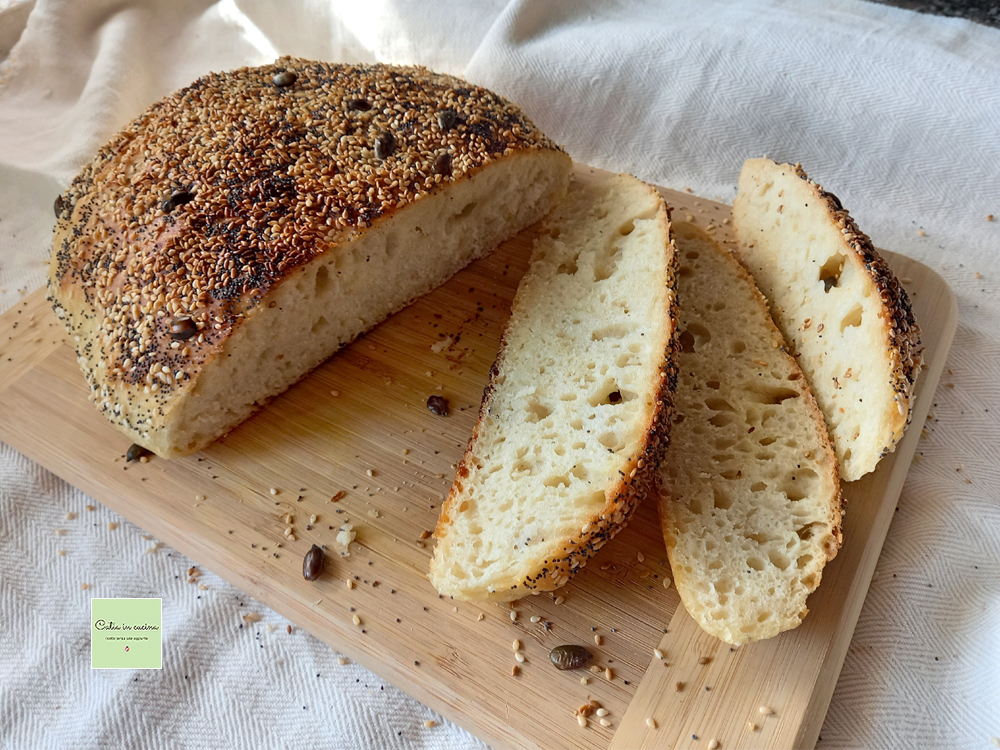
Today I brought to the table the least demanding bread I know: the no-knead bread, poured and baked in a casserole dish (and then covered with seeds).
The choice of a casserole dish (glass) instead of the classic pot (yes, all bread enthusiasts eventually try baking bread in a pot) has a long history: it dates back to the very early days of my sourdough adventure, a time of great experimentation for me. Back then, not owning a clay pot or another type of oven-safe pot, and…
well, to be honest… for some years, not even owning an oven!, but just a small oven (I had told you this story in the recipe for bread with autolysis)…
in short, during that time, using a pot was not for me, for obvious size reasons of my oven, so not wanting to give up trying bread in a pot, I tried with an old Arcopal casserole dish, the only one small enough and shaped like a pot, that could fit inside my legendary and irreplaceable small oven, which no one but me would have dared to use for baking bread. 😃💪
The successful attempt then prompted me to test all the Pyrex dishes and pans I have at home, all tests passed excellently.
The low-edged casseroles (one round and one oval) turned out to be perfect for use in the small oven.
Then, when I finally decided to get a ‘large’ oven, I put to work also the soufflé mold (also glass), a mold that I have never used to make even half a soufflé, but for bread and similar things (like the Easter loaf) it works perfectly.
So far, the story of my bread in a pot/casserole dish. But what I should talk to you about today shouldn’t be this, nor should it be no-knead bread. The real star of today’s recipe should be the seed bread. 😊
From the folder of seed bread photos in my archive, I had chosen this week’s recipe for Light and Tasty (today’s topic is precisely: seeds), discovering then upon closer examination that the seed photos were all of various types of no-knead bread, all baked in glass casseroles. 😊
If you know my recipes, you know that seeds are a usual ingredient for me. But they are also a recurring ingredient for Light and Tasty. In fact, we propose them to you practically every year, because all of us on the Team use them widely, and because they are a valuable ingredient: they give us energy, contain proteins and vitamins, minerals, fibers, omega3 and omega6, calcium, help lower triglycerides and cholesterol, and aid bowel function… in short, they are a food that must not be missing, a little every day, in our diet.
Seed bread, especially mixed, is the bread I make most often. At least eight or nine of my breads, rolls, loaves, loaves, out of ten – and perhaps even eight or nine focaccias out of ten – I cover with seeds, or sometimes I put them inside the dough, because bread is one of the best places to add seeds, they fit wonderfully.
And so… are you ready? What seeds do you have at home today?
For this no-knead bread, baked in a casserole dish, with mixed seeds, you can use any seeds you like: sesame, chia, pumpkin, flax, sunflower, hemp, poppy, and you can also add fennel seeds, cumin, caraway, and cardamom. 😊
〰 〰 〰
🍞🥖 Other ideas for other types of seed bread:
- Difficulty: Easy
- Cost: Very cheap
- Rest time: 7 Hours
- Preparation time: 10 Minutes
- Portions: about 20 slices
- Cooking methods: Oven
- Cuisine: Italian
- Seasonality: All seasons
Ingredients
- 250 g remilled durum wheat semolina
- 250 g Manitoba flour
- 150 g liquid sourdough starter (well active, refreshed 4 hours earlier)
- 260 g water
- 20 g extra virgin olive oil (10 g + 10 g)
- 3 tablespoons mixed seeds (as desired)
Tools
- Casserole Dish round glass
- Casserole glass
Steps
The procedure for preparing the leavened dough is very simple.
The only extra thing I did this time (compared to the habit of using the discard I have lately) was: refreshing the liquid sourdough. That is, I specifically refreshed the liquid sourdough to use it in this recipe (something that, believe me, is not always a given here 🤭) and therefore, I wrote in the ingredients the precise specification to use an active liquid sourdough.
☝ Even though, I must say, I did not find differences in rising times. But that’s how it is, it went exactly that way. It’s really true that sourdough is alive and the variables in leavening are always to be considered.
That being said, and the liquid sourdough refreshed (if it suits you), arm yourself with a spoon and proceed as follows:
Pour the liquid sourdough, flours, water, and 10 g of oil into a large bowl (where the dough will then rise, so make sure it’s a high-edged bowl) and mix with the spoon until you get a soft and sticky mixture.
👉 Compared to the recipes I make with the stand mixer, here I used more water; otherwise, the mixture becomes too compact to mix well using just the spoon.
Mix quickly. The final appearance is more or less like this:
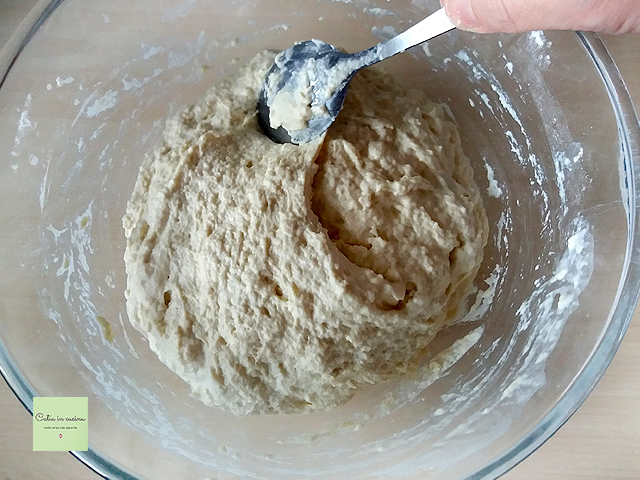
Let the mixture rise in a sheltered place; I always put it inside the microwave.
👉 Being closed in the microwave, which acts as a proofing chamber, there’s no need to cover the bowl, the surface doesn’t dry out. Optionally grease the surface with the other 10 g of oil, sometimes I do it and sometimes I don’t.
Let it rise until it doubles (or even a little more than just doubling).
☝ The rising time depends on the ambient temperature; the last one I made took 9 and a half hours, from the evening at 9:30 PM to the next morning at 7 AM, to be precise, at 6:54 AM, which is the exact time when I poured it into the casserole dish (this photo):
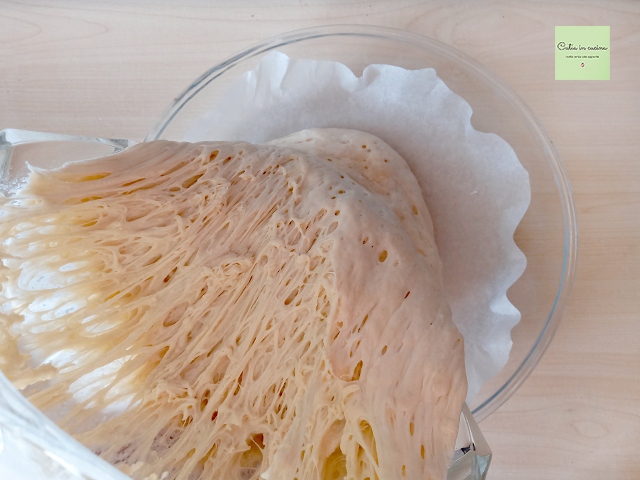
In this case, I decided to cover the bottom of the casserole dish with parchment paper; other times, I grease and flour it (this is the case with the oval bread you’ll see further down). Both methods work well.
☝ For precision, I know there are those who preheat the casseroles before pouring the dough, directly on the casserole without paper or anything else. I haven’t tried it because I don’t like preheating (but it’s a personal thing, not technically supported).
If necessary, after pouring the dough, level it with the back of the spoon or slightly shake the pan.
👉 Which pan to use: in the Tools section, I indicated 4 different glass casserole dishes, of different shapes and sizes, all glass, including the soufflé one (take a look at the links so you can better see what it’s about). I had optimal results with all, the difference lies only in the final shape you want to achieve and in the height of the bread, which obviously comes smaller and taller in the soufflé mold. To better test the differences, albeit predictable, I also tried baking the same recipe without casseroles or molds, pouring the dough onto the baking sheet: in this case, being very soft, the dough tends to spread out, so it widens and the bread comes out lower.
Grease the surface slightly with a bit of oil (but it’s optional) and sprinkle the seeds as desired.
Bake in the oven at 392°F (200°C) for 35 minutes. Halfway through cooking, you can lower it to 356°F (180°C), or protect the surface with a sheet of aluminum foil to prevent the seeds from burning.
👉 With the casserole, which has a lid, you can use the lid in the first 10-15 minutes of baking. Usually, I do the opposite: I bake uncovered and then protect, if necessary, after halfway through cooking.
Place the bread to cool on a rack and slice it only when it’s cold or at least warm.
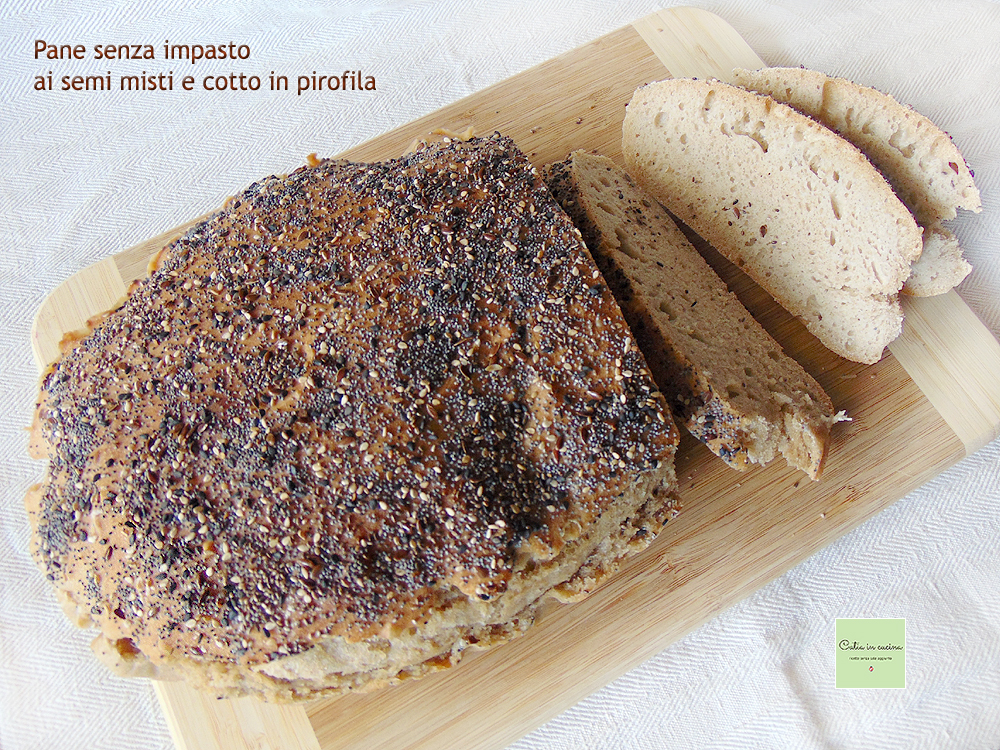
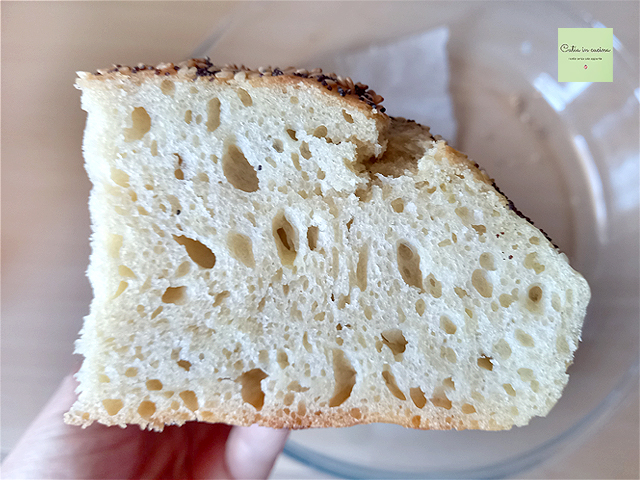
It’s an excellent bread. Soft, slightly moist if eaten within the first few hours.
The next day it is drier, but still delicious, both at meals and for breakfast (great with butter and jam!).
It’s also perfect as bread for dipping (try it with eggs in sauce 😋).
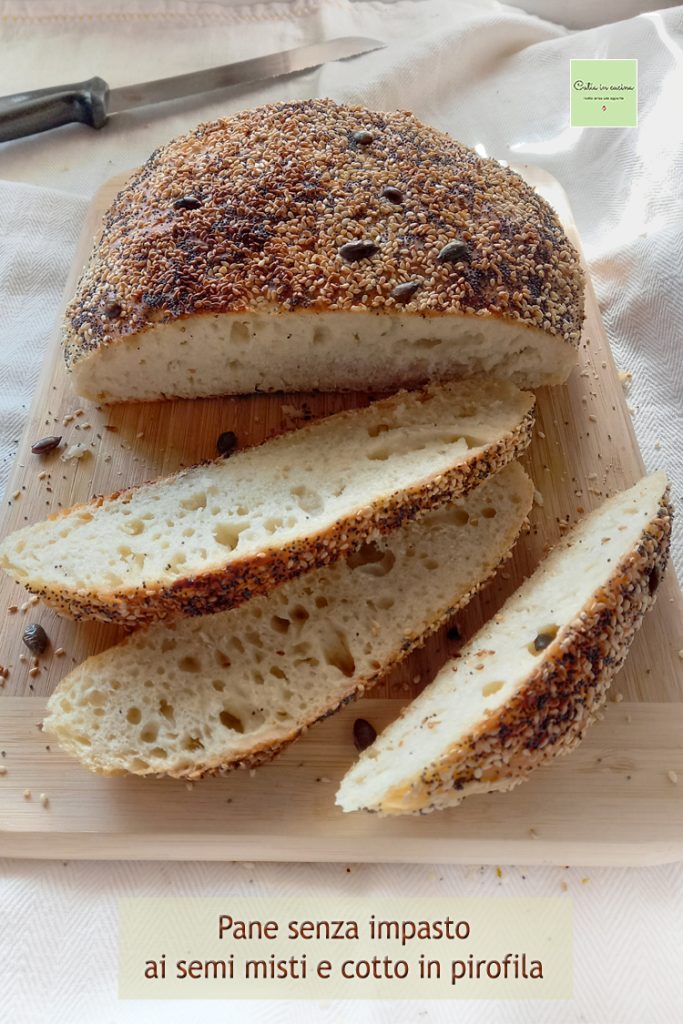
And the crispy seed crust is a delight. 😉
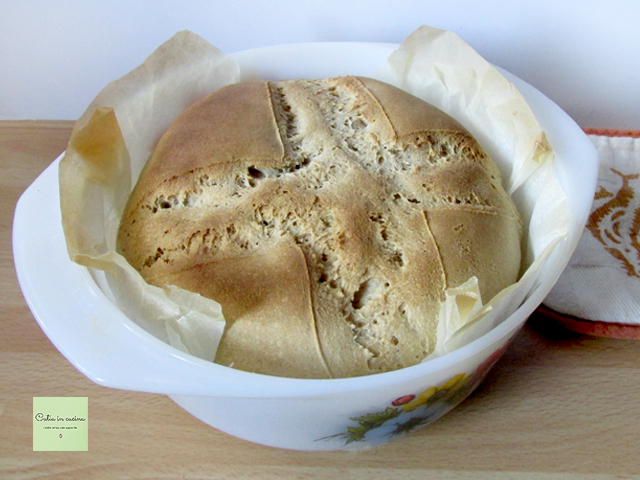
Ah, I forgot to show you the founding casserole bread!
The first one, baked in the Arcopal bowl. 😊
It was a bread without seeds (and leavened with solid sourdough instead of the liquid one I prefer now), but it deserves a place in this recipe!
Salt-free advice
 I will never stop recommending making bread without salt! If I were to make a comparison, it’s a bit like getting used to sugar-free coffee 😄 you never go back! 😃😁
If you are interested in reducing or eliminating salt, always remember to:
▫ Gradually decrease the salt, your palate needs to gradually adjust and shouldn’t notice the progressive reduction.
▫ Use spices. Chili, pepper, curry, nutmeg, cinnamon, cloves, cumin…
▫ Use aromatic herbs. Basil, parsley, oregano, thyme, sage, marjoram, rosemary, mint…
▫ Use seeds. Sesame, pine nuts, almonds, walnuts…
▫ Use spicy vegetables or fruit. Garlic, onion, lemon, orange…
▫ Use my salt-free vegetable granules
▫ Prefer fresh foods.
▫ Avoid cooking in water, prefer methods that do not disperse flavors (grill, foil, steam, microwave)
▫ Avoid bringing the salt shaker to the table!
▫ Occasionally allow yourself a cheat day. It’s good for the mood and helps you persevere.
If you don’t want, or can’t, give up salt:
▫ You can still try my recipes, salting according to your habits.
Follow me!
In my new WhatsApp channel, and, listen up! I am now also on Instagram! 😀 And as always, on the Facebook page, on my Pinterest boards, in my group Il gruppo di Catia, in cucina e oltre, and if you want… subscribe to my Newsletter
In my new WhatsApp channel, and, listen up! I am now also on Instagram! 😀 And as always, on the Facebook page, on my Pinterest boards, in my group Il gruppo di Catia, in cucina e oltre, and if you want… subscribe to my Newsletter
And now here are today’s other proposals from the Light and Tasty Team. 🙂
Carla Emilia: Black bread with seeds
Daniela: Granola with dried fruit and mixed seeds
Elena: Cream of purple cabbage with hemp seeds
Milena: Carrot, onion, and seed flatbreads with robiola
Serena: Sesame seed bread braid
