
Years ago, when I saw certain ‘strange’ recipes on the web with the mythical name of overnight oats, I was almost intimidated. I imagined them as concoctions of Northern European or American ingredients, unknown and unappealing to me. Just to give two examples, that peanut butter which was one of the great mysteries of my childhood, or more recently, buttermilk. Mysterious things.
Then over time, many doubts dissipated. Peanut butter arrived on our shelves, I discovered it’s almost addictive 😅 and even made it at home. And buttermilk is nothing more than the residual liquid from the production of cream butter (and which was once fermented, but it was a typical practice of Anglo-Saxon countries). Now, buttermilk has also spread a bit everywhere, although usually replaced with kefir or yogurt.
Instead, for overnight oats, it took me a few more years to shake off my skepticism. And to really understand what it was, I first had to get to know porridge.
Researching porridge, I had the chance to see many variants of overnight oats and overnight porridge and to understand that, despite the English name which always sounds very grandiose, it’s actually a disarmingly simple preparation that shouldn’t even be called a recipe if we’re being picky, since there’s nothing to cook, just assemble and put in the fridge, and that’s it.
After much procrastination, today, or rather last night, it was its turn. I tried to prepare an overnight oats with kefir, and this morning it was my breakfast. 😋
Kefir never misses in my home, so the choice was easy, but it can also be prepared with yogurt or milk (cow’s or plant-based) or even just with water, then you play with additions of fresh and dried fruit, seeds, or other ingredients to taste, there’s only room to be creative. The only thing that cannot be missed, because it’s the base of overnight oats, is… the oats. I.e., oatmeal, specifically the oat flakes (oat, usually used in the plural, oats, translates both: the cultivated plant and the cereal, even when it’s in flakes).
So, this my first overnight, truly the very first made by myself, today is my proposal for the Light and Tasty column. Today’s theme: the flakes, what else? 😀
〰 〰 〰
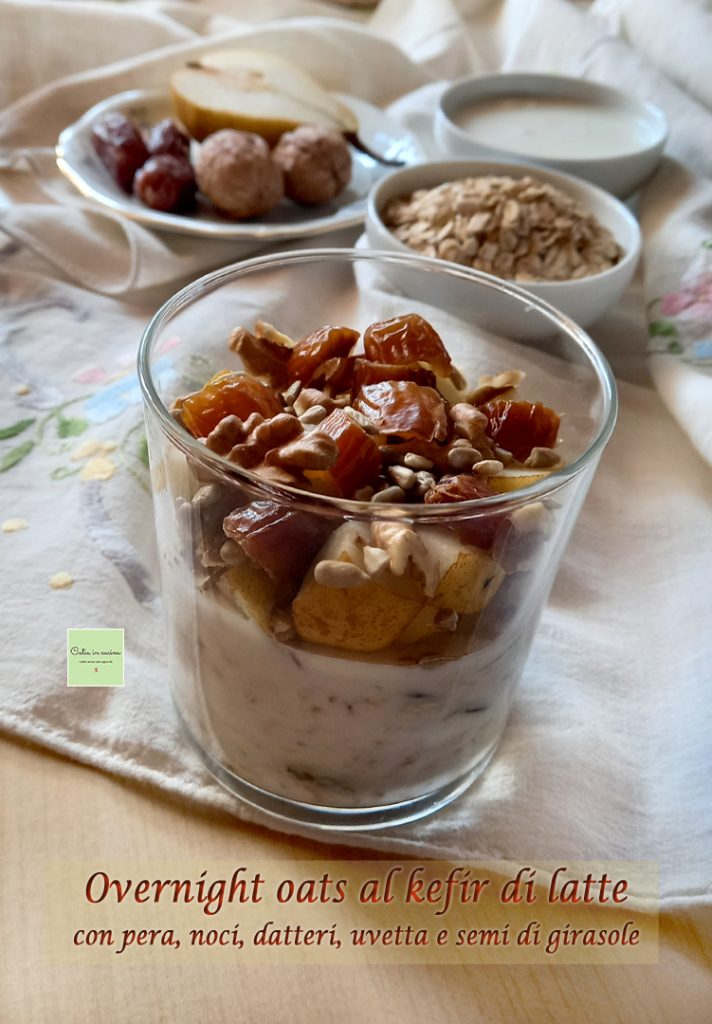
- Difficulty: Very Easy
- Cost: Cheap
- Rest time: 8 Hours
- Preparation time: 5 Minutes
- Portions: 1
- Cooking methods: No-cook
- Cuisine: American
- Seasonality: All Seasons
Ingredients
- 1/3 cup rolled oats
- 1/2 cup milk kefir
- 1 1/2 tbsp milk (or water)
- Half pear (or other fruit to taste)
- 1 tbsp raisins
- 3 dates
- 2 walnuts
- 1 teaspoon toasted sunflower seeds
Tools
- Glass
- Jar with lid and spoon
Steps
First, wash the raisins by rinsing them with water.
☝ This step should always be done before using raisins, to remove impurities (inevitable due to the drying and processing of grapes) and any oil present as a coating agent (if used, it’s indicated on the package).
Pour the rolled oats into a glass.
Add the kefir.
👉 If the kefir is very thick, or if you’re using yogurt, also add 1-2 tbsps of milk or water. If the kefir is liquid, use 1/2 cup instead of 1/3 cup. You can adjust according to the final thickness you want to achieve.
Add the raisins (and possibly the chopped dates).
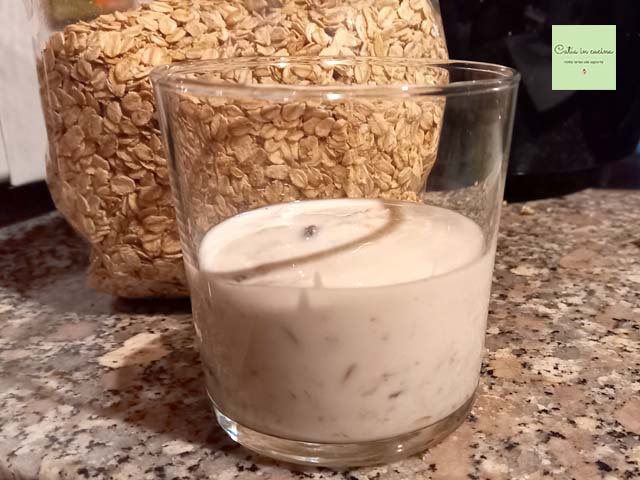
Cover the glass with a lid or plastic wrap and place in the fridge.
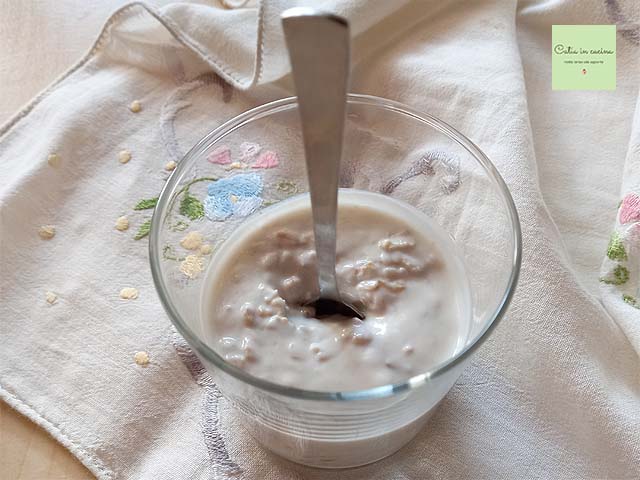
The next morning, the overnight oats are ready.
It will have set, more or less depending on the ratio between oats and liquid, but will still be thick enough to leave a spoon standing. 😀
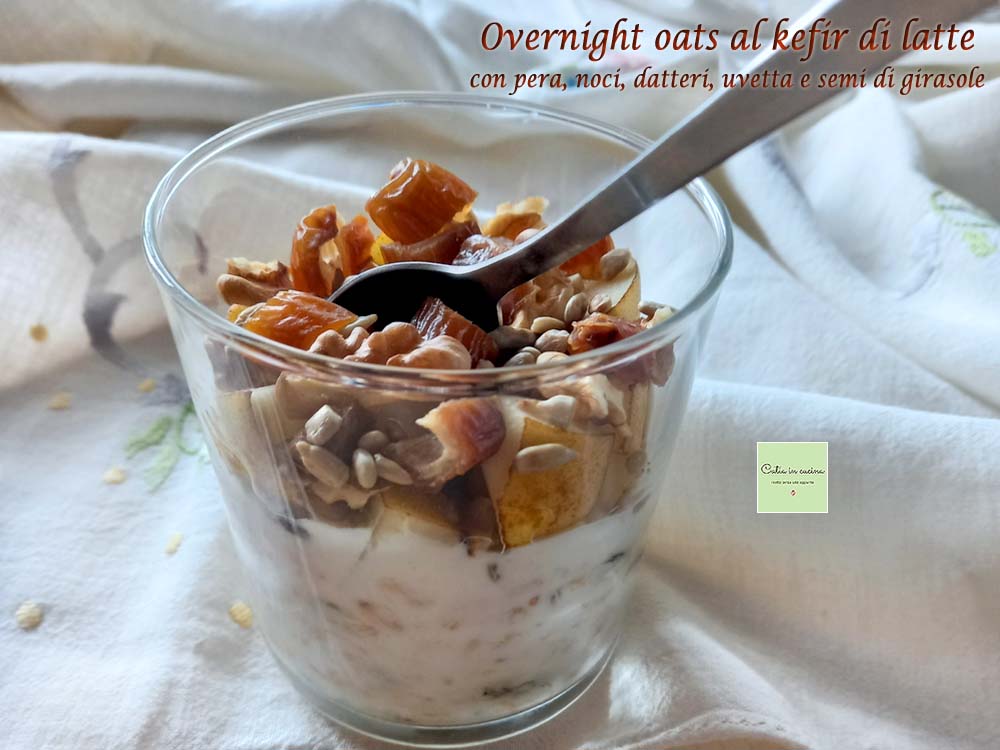
Add the fresh fruit, even mixed, dried fruit, and everything you prefer: walnuts, almonds, seeds (better if toasted) like sunflower, flax, pumpkin.
Then you can sweeten it with sugar or maple or agave syrup.
👉 I intentionally avoided any added sugar, replacing it with dates which, along with the raisins, were my natural sweetener.
☝ Optionally, dates can be put in kefir the night before, so they soften with the raisins and release their flavor even more.
👉 A final note regarding honey, often used in overnights: those who make milk kefir at home already know that honey is not recommended in second fermentation because, being a natural antibacterial, it can alter the bacterial colony of kefir. Therefore, in overnights made with kefir, I recommend adding it as a topping at the time of consumption (i.e., to be precise: not inside the kefir from the night before but only at the last moment).
I wish you a great breakfast. You’ll see it will be tasty and filling!
Needless to say, I love it 😋 and that this overnight will just be the first of a long series! 😉💪
Follow me!
In my new WhatsApp channel and, drumroll! I’m also on Instagram now! 😀
As always, you can find me on my Facebook page, on my Pinterest boards, in my two groups: Catia’s group, in the kitchen and beyond and Just what I was looking for! and if you like… subscribe to my Newsletter.
Light and Tasty:
And now here are all the recipes with flakes from my colleagues in the Team. Who knows what flakes they used!
Carla Emilia: Salad with Cottage Cheese and Black Lentils
Cinzia: Apple and Cinnamon Porridge with Instant Pot
Claudia: Dessert with Cottage Cheese and Fruit
Daniela: Whole Wheat Crackers with Oat Flakes and Seeds
Elena: Porridge with Oat Flakes
Milena: Pancakes with Whole Oat Flakes and Egg Whites
