
The recipe for panzanella does not belong to my family’s tradition. I grew up with piada and tagliatelle and didn’t learn about the existence of panzanella until I was an adult (a very adult, I would say).
It is thanks to my husband, who is crazy about simple dishes, and who could live on bread and tomatoes for biblical times, that I discovered the existence of so many tasty dishes like this.
I will not go on about the origins of this dish, nor will I list the many versions I have read about, on various occasions, both in cookbooks and on the web; I will just refer you to this link, where many versions are listed and where the comments explain well how heated the “debate” on the real panzanella and the real original ingredients is (as always happens for every traditional recipe).
As for me, I can only say that the only thing I know for sure is that panzanella is always good, both in its original form and in the “as I like it” version.
At my house, panzanella is never the same, because I make it with the ingredients I have or that inspire me.
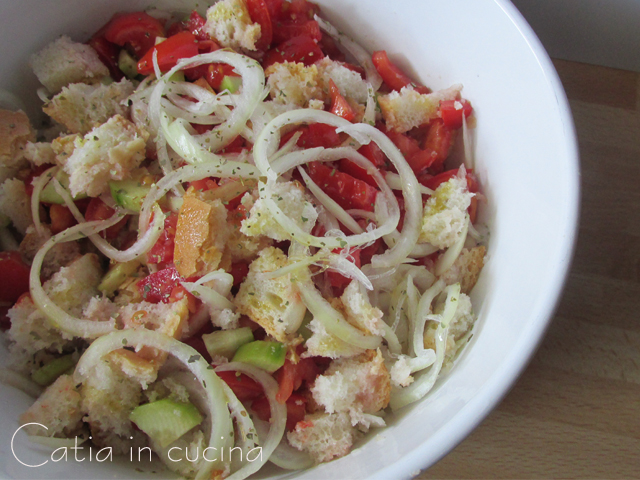
Today I made it like this: with oregano because I ran out of basil, with yellow onion because I didn’t have red, and without celery which I will certainly add next time because I think it suits it.
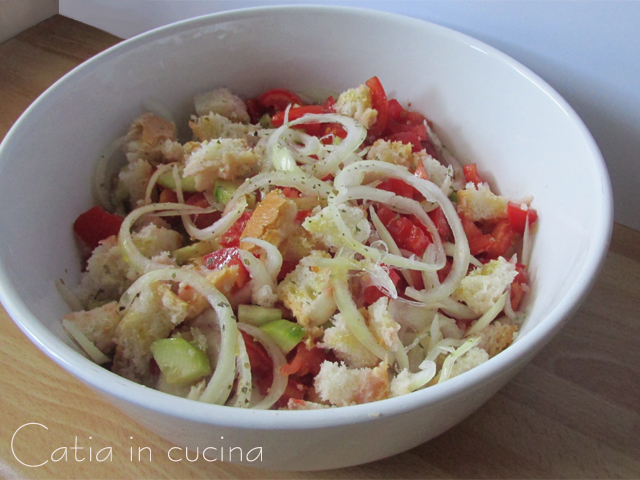
- Difficulty: Very easy
- Cost: Inexpensive
- Preparation time: 15 Minutes
- Portions: 2
- Cooking methods: No cooking
- Cuisine: Regional Italian
- Seasonality: Summer
Ingredients
- 5 slices Tuscan bread (stale)
- 3 tomatoes (ripe)
- 1 cucumber
- 1 onion (small)
- oregano
- red wine vinegar
- extra virgin olive oil
Tools
- Salad bowl
Steps
Slice the onion and soak it in cold water with vinegar added to taste. Leave to soak for 15-20 minutes.
Meanwhile, place the slices of bread on a plate and wet them lightly with cold water and a little vinegar.
Put in the fridge.
Peel the cucumber and cut it into chunks (or slices, as you prefer), wash the tomatoes and cut them into rather small pieces, keeping the seeds and liquid part.
After the onion soaking time, rinse it with cold water, drain it, optionally pat it gently with a cloth or kitchen paper, and add it to the bowl with cucumbers and tomatoes.
Take the soaked bread slices. If they are too wet, squeeze them to remove excess water. I avoid wetting them with too much water because I don’t like this “squeezing” of the bread; I prefer to use little water and keep the bread a bit dry, as it will further soak with the tomato juice, and with the oil and vinegar from the dressing.
Cut the soaked bread slices into irregular pieces, add them to the vegetables, season with oil, vinegar, and oregano (or basil, if you prefer), mix and place in the fridge for at least half an hour, but a couple of hours would be better.
Salt-free tips
 If you don’t have time to wait for the rest in the fridge (which is meant to flavor the bread) and want to eat it immediately, adding two or three pinches of gomasio can help flavor the soaked bread.
If you are interested in reducing or eliminating salt, always remember to:
▪ Gradually reduce the salt, the palate must gradually get used without noticing the progressive reduction.
▪ Use spices. Chili, pepper, curry, nutmeg, cinnamon, cloves, cumin…
▪ Use aromatic herbs. Basil, parsley, oregano, thyme, sage, marjoram, rosemary, mint…
▪ Use seeds. Sesame, pine nuts, almonds, walnuts…
▪ Use spicy vegetables or fruits. Garlic, onion, lemon, orange…
▪ Use my salt-free vegetable granules
▪ Prefer fresh foods.
▪ Avoid cooking in water, prefer cooking methods that do not disperse flavors (grill, foil, steam, microwave)
▪ Avoid bringing the salt shaker to the table!
▪ Sometimes allow yourself a break from the rule. It is good for the mood and helps to persevere.
If you cannot or do not want to give up salt:
▪ You can still try my recipes, salting according to your habits.
Follow me!
on my Facebook page
on my Pinterest boards
in my two groups:
Catia’s group, in the kitchen and beyond
and Just what I was looking for!
and if you want… subscribe to my Newsletter
and if you want… subscribe to my Newsletter
