
A basic recipe is needed from time to time, right? Here is a new shortcrust pastry, shortcrust pastry with coconut oil, a recipe that is almost exotic to me since coconut oil is an ingredient I’ve only recently become familiar with. So far, I’ve only tried it in pastries, replacing coconut oil with butter or in vegan versions.
Today I present to you the ‘normal’ version with egg, and I’ll tell you about the vegan version in a dedicated recipe as I have some details to clarify.
Today’s version – similar to a classic shortcrust pastry but with coconut oil instead of butter – I tried it in two ways: with solid coconut oil (in winter) and with liquid coconut oil (in summer).
Indeed, it’s a characteristic of coconut oil to change from solid (buttery, dense and soft like butter or lard) to liquid (oily and transparent) depending on room temperature: it starts to liquefy above 73-75°F.
The first time I noticed this, I thought it had gone bad (!), I had bought and used a couple of jars but always in winter, and I had always seen (and used) it in solid form. I had made pies and cookies and didn’t know it could also be used in liquid form.
Then, during this scorching summer, after discovering it transformed into oil (which, upon reflection, seemed logical, but I hadn’t thought of it!), I better informed myself about its properties and characteristics and learned to manage and use it better.
One thing I learned from my research is that coconut oil contains saturated fats (similar to those in butter and lard) despite being a vegetable fat. This is the main reason why many consider it a food to avoid.
I won’t delve into the technical details about the difference between long-chain or short-chain saturated fats, what struck me is that opinions among supporters and detractors of coconut oil sometimes differ because, alongside those who consider it harmful, there are also those who claim that it not only isn’t harmful but that it has positive characteristics: it would increase HDL cholesterol (that’s the good cholesterol), help burn fat and thus lose weight, be antibacterial and antioxidant, even beneficial for people with Alzheimer’s.
I don’t know who is right, but as always, I read all information with great interest because I like to stay informed, to then arrive at the usual conclusion: that what is eaten in small quantities and occasionally ultimately does not do much harm (if there are no specific disorders or diseases, of course), and therefore the best thing to do, in my opinion, is to vary the diet as much as possible. Occasionally indulging in some saturated fat, whether animal or vegetable.
At this point… how to use this coconut oil?
In many ways, as we have always done with oil and butter. So far, I’ve used it to make pies and cookies, and I won’t fail to write the recipes (the first one in just a few days). But let’s take it step by step, and today we start with this basic recipe.
Are you ready? 😊
〰〰〰
👇 If you like alternative recipes, here are links to three other non-traditional shortcrust pastries: 👇
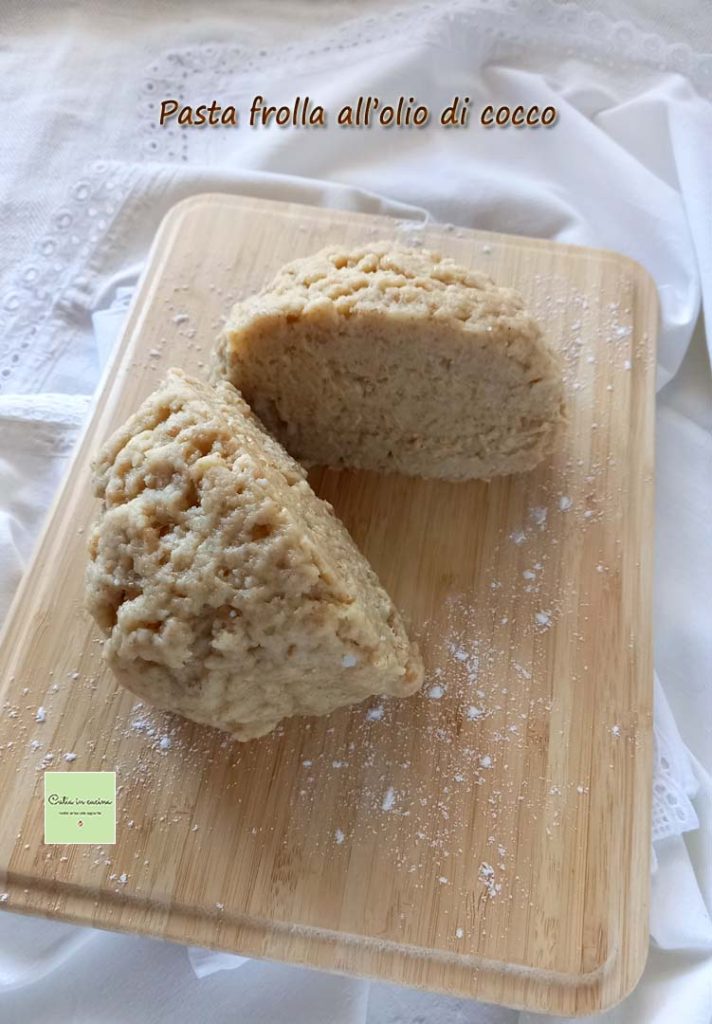
- Difficulty: Easy
- Cost: Economical
- Rest time: 15 Minutes
- Preparation time: 10 Minutes
- Cooking methods: No Cooking
- Cuisine: International
- Seasonality: All Seasons
Ingredients
☝ NOTE: At the end of the recipe (in the FAQ), you will find a short explanation of the difference between native and deodorized coconut oil (i.e., neutral, without coconut aroma).
- 2 1/2 cups flour (all-purpose or cake flour)
- 1/4 cup coconut oil (native or deodorized, both are fine)
- 2/5 cup sugar
- 1 egg
- lemon zest (grated)
- 1 teaspoon baking powder (level)
- 1 tablespoon water (if necessary)
Tools
- Bowl
Steps
As with every shortcrust pastry, start by pouring the flour into a bowl, then add all the ingredients.
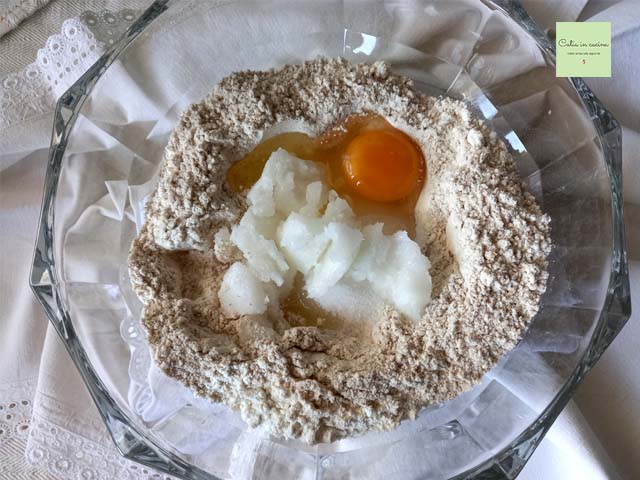
Work by hand, first making sure the sugar is well dissolved, then knead to obtain a mixture (crumbly or amalgamated as needed).
Initially, the mixture remains crumbly, so it may be useful to moisten it by adding, at discretion, one or two tablespoons of water (for those without lactose issues, milk, yogurt, or kefir is also fine).
👉 The quantity can vary because it depends on the type of flour used and/or the consistency desired: to make a crumbly pie, you don’t need to moisten the mixture too much (this makes it easier to obtain crumbs).
Great, the basic version of shortcrust pastry with coconut oil is ready.
It can be put in the fridge to rest, as usually with all shortcrust pastries, but it can also be used immediately.
👉 Usually, I proceed to use it immediately when the coconut oil is solid, while I put it in the fridge (but briefly) when it’s liquid. This is a personal preference, which doesn’t particularly affect the final result.
☝ A characteristic of coconut oil is the change from liquid to solid state and vice versa depending on room temperature.
If it’s solid and you want to liquefy it, just heat it. Conversely, you can put it in the fridge.
From my personal experience, perhaps the fridge temperature is a bit too low: when I’ve tried, I’ve had some difficulty scooping it out with a spoon because it became too hard, so you need to anticipate its use and remove it from the fridge in time.
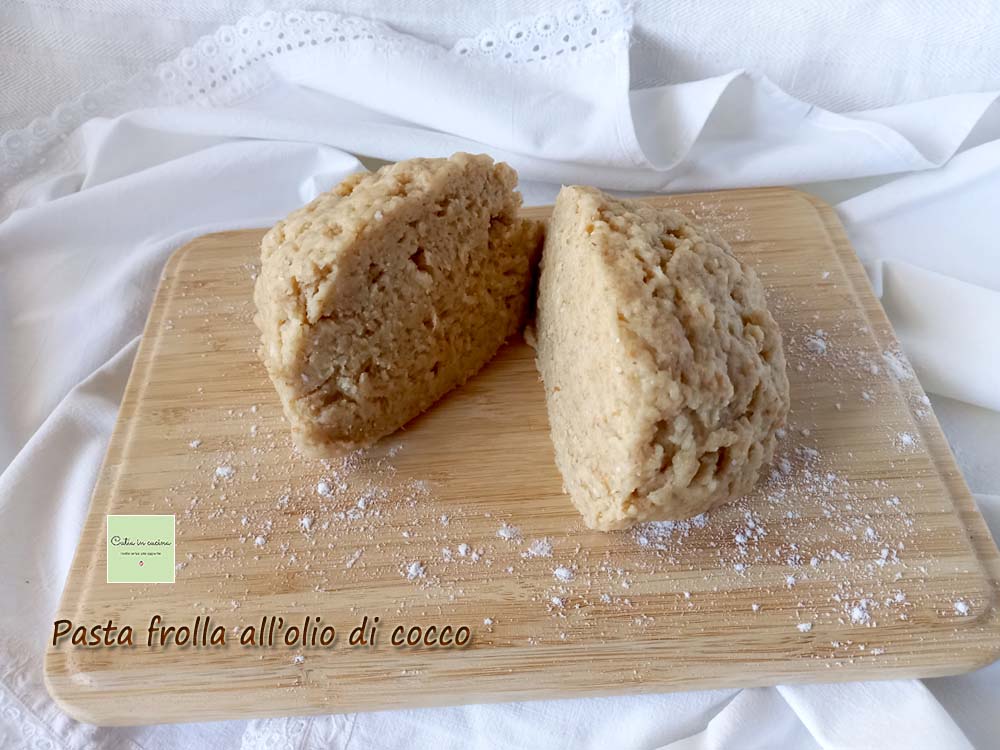
The photos of this recipe refer to a shortcrust pastry I made a few months ago when temperatures were below the liquefaction temperature (between 73 and 79°F, it’s usually written on the label). The consistency of the coconut oil on that occasion was compact and quite soft. Instead, now, since the beginning of summer, the permanent state in the jar is this:
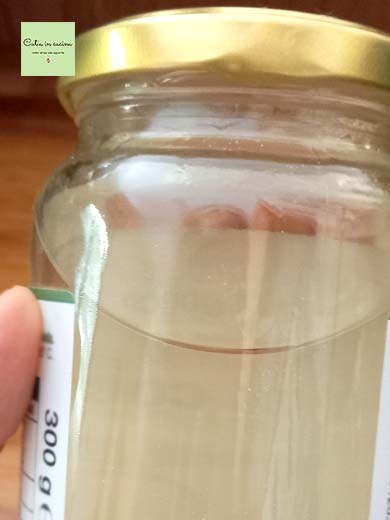
Since it’s not necessary to keep it in the fridge for preservation purposes, I now store it simply in the kitchen cabinet and use it in liquid form, the shortcrust pastry comes out just as good. Always shortcrust pastry with coconut oil it is. 😀
If you try my shortcrust pastry with coconut oil… send me a photo!!!
Come visit me!
In my new WhatsApp channel and on Instagram, on Facebook page, on Pinterest boards, in my two groups: Catia’s group, in the kitchen and beyond and Just what I was looking for! And subscribe to the Newsletter!
In my new WhatsApp channel and on Instagram, on Facebook page, on Pinterest boards, in my two groups: Catia’s group, in the kitchen and beyond and Just what I was looking for! And subscribe to the Newsletter!
FAQ (Questions and Answers)
What is the difference between native and deodorized coconut oil?
The difference lies in the term ‘deodorized’: deodorized coconut oil is neutral, tasteless, while native retains the aroma and flavor of coconut.
Both are suitable for shortcrust pastry, it’s just a matter of taste. For cooking or preparations where the coconut aroma is not desired, or where it might overpower or alter the flavor of the dish, deodorized is more suitable.
Both types come from organic farming.What can be used as a substitute for coconut oil?
If the choice has to be made among vegetable origin foods, simply seed oil (like corn or sunflower) or even margarine can be used.
For those looking for a particular alternative different from the usual, I suggest trying avocado (find here my well-tested recipe 😊).
