
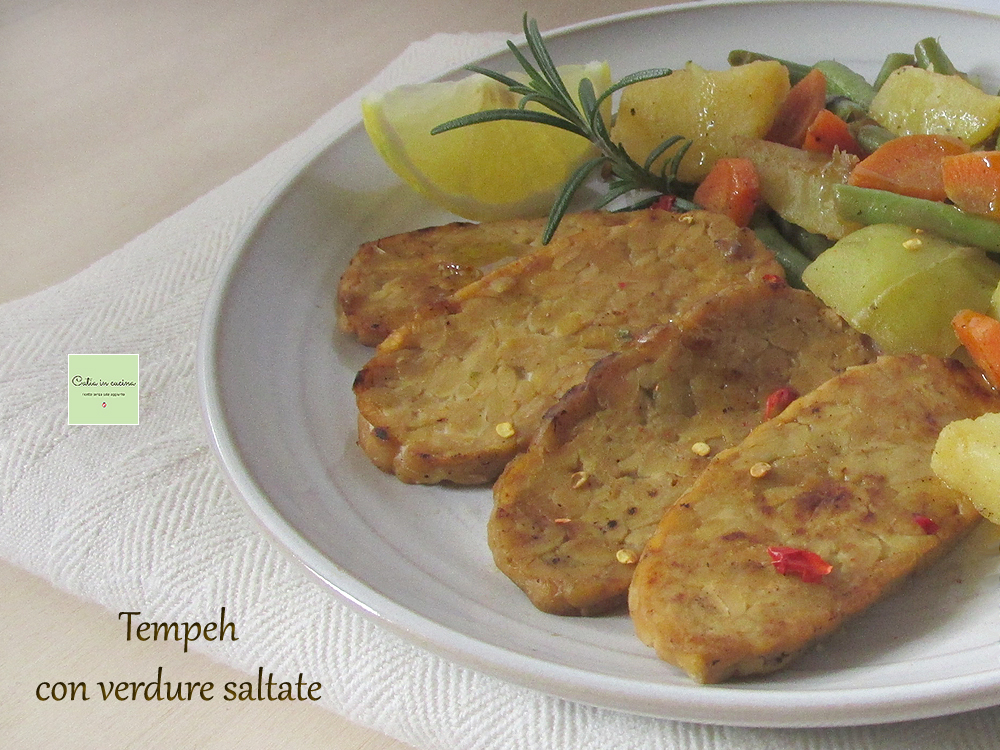
Let me introduce you to my tempeh with mixed stir-fried vegetables. I did it! I finally cooked tempeh! Do you know it?
I mentioned tempeh some time ago in the article dedicated to the third lesson of the cooking course, in which I explained that I was not an expert in tempeh.
I still am not, an expert, but now I’ve cooked it! And with excellent results, I’ll tell you. 😀
This debut recipe of mine is tempeh with vegetables, a recipe that’s simple to make. Yes, because… you need to start with simple recipes.
And now my impressions are urgently needed.
First of all, as I was saying, having made one recipe doesn’t make me an expert. 😀 So, if among you readers there is someone more experienced than I am, I gladly welcome suggestions and advice to improve my skills and to be able to propose in the future, to you and to me (and to the family jury!) other and always better recipes with tempeh.
Indeed, beyond personal skills, it should be noted that tempeh has a somewhat particular taste. Well, alternative meat products are a bit particular at first taste. They all have a taste that might seem foreign to us, if only because they do not belong to our traditional culinary culture and because we all necessarily have taste buds accustomed to other flavors. And, in terms of peculiarity, tempeh has an even more ‘particular’ taste than tofu or seitan, that should be said.
I think everyone should find the recipes suitable for themselves, and find the best way to cook tempeh, which is the best for themselves and their own palate.
With tofu and seitan, which are the meat substitutes I know better for now, that’s exactly what happened. The first few times I cooked them I was afraid I wouldn’t be able to make them tasty, then I found some clever recipes, suitable for me (for example this tofu pâté and this seitan with green pepper), and from then on… it was all downhill. 😉
What is tempeh:
Tempeh is a soybean derivative, practically a cousin of tofu. It differs from tofu because it is made with fermented soy, with the pros and cons that this entails. Fermented products are, as you certainly know, more nutritious, more digestible, and have a more intense flavor than the same product that is not fermented.
And it is precisely this more intense flavor that makes tempeh peculiar, and that can make it ‘difficult’ at first impact.
That famous aftertaste of nuts and mushrooms that you read about everywhere, I frankly don’t feel confident to confirm, in my opinion, tempeh has simply its own flavor and that’s it. It has a strong, slightly bitter taste, which is not easy to explain to someone who has never tasted it.
So… taste it, won’t you? What are you waiting for? 😀
〰 〰 〰
- Difficulty: Easy
- Cost: Economical
- Preparation time: 10 Minutes
- Portions: 2
- Cooking methods: Stovetop
- Cuisine: Italian
- Seasonality: All Seasons
Ingredients
- 8.8 oz tempeh
- 2 potatoes
- 2 carrots
- 1 red onion
- green beans (amount to taste)
- 1 sprig rosemary
- 2 tablespoons extra virgin olive oil
- extra virgin olive oil
- lemon (juice and zest)
- rosemary
- dill
- marjoram
- chili pepper
Tools
- Pan
Steps
Slice the tempeh thinly and fry it in a pan with the oil, a whole sprig of rosemary (and a piece of chili pepper), until golden brown.
Meanwhile wash and cut all the vegetables into pieces.
Peel and cut the potatoes into pieces and cook them separately (I use the microwave as always). For the microwave cooking of the potatoes see here.
👉 Naturally, if you prefer, you can cook the potatoes together with the vegetables, I didn’t because I wanted a short cooking for the vegetables so they would remain crunchy.Remove the tempeh and sauté the vegetables in the same pan.
When the vegetables are cooked, add the already cooked potatoes and let them absorb the flavors.
At this point I wanted to try transferring everything to the oven for a brief gratin. I sprinkled a little breadcrumbs on vegetables and tempeh and baked for 10-15 minutes.
🌸 From the photos it doesn’t look like, um… because… this portion I photographed is not gratin 😀 (I couldn’t photograph the gratin version). But my judgment in the comparison between the gratin version and the version just browned in the pan is that: I didn’t notice a great difference. The tempeh was similar in taste and texture, in short, the breadcrumbs didn’t make a big difference, to my taste. However, the important thing is that the tempeh is golden on the surface, in the pan or in the oven.
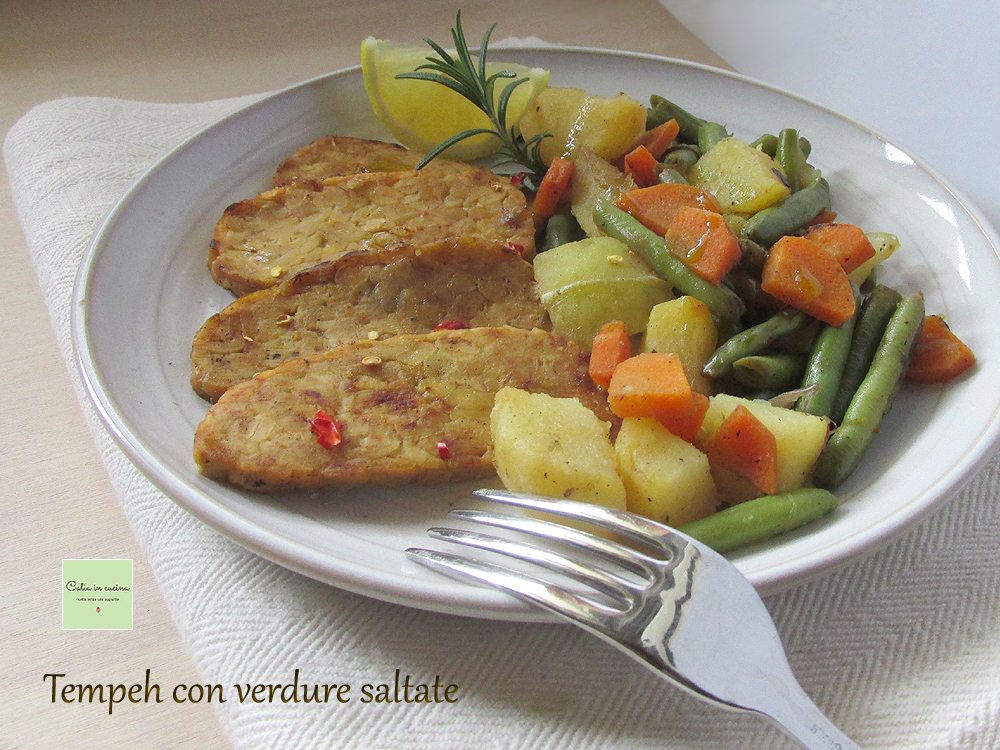
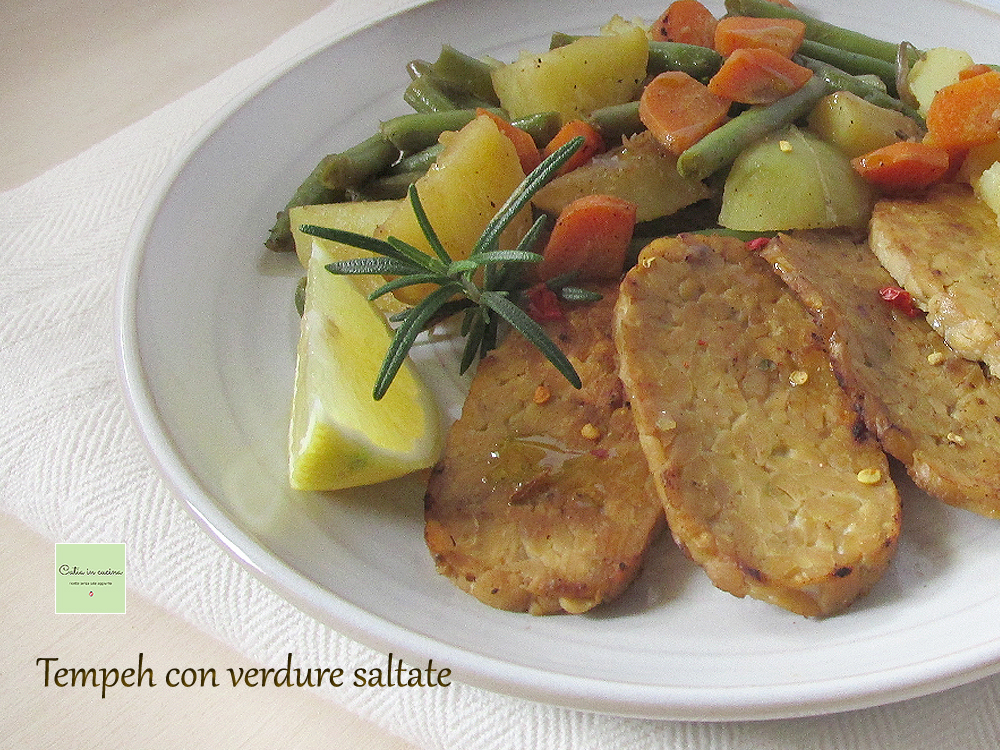
A detail that fits well with this tempeh with vegetables is the herb vinaigrette, a simple emulsion of oil and lemon enriched with aromatic herbs, suitable for both the pan and oven version.
Try it, taste it, decide what in your opinion seems to adapt best to your tempeh. For my part, I didn’t miss anything and tried to use the vinaigrette both plain and spicy (by adding some chili pepper).
How to prepare the vinaigrette: in a small bowl, whisk together oil and lemon (juice and zest), add a mince of rosemary, dill, and marjoram (or other herbs to your liking, in my case the rosemary was fresh, dill and marjoram were dried) and chili pepper (optional) and pour over the tempeh and vegetables just before serving.
Enjoy!
No Salt Advice
 In the restaurants where I’ve had the chance to eat tempeh, I’ve noticed that it’s always cooked very flavorful. I have to say that most of the vegan and especially macrobiotic cuisine I’ve tried in restaurants tends to be very flavorful. I don’t frankly know if it’s a typical characteristic, or if I’ve just happened to end up in restaurants that prefer strong flavors, for sure there’s this: in this recipe, I didn’t use salt, but I found the use of chili pepper useful. Additionally, the final touch given by the vinaigrette, the use of lemon is always useful in low-sodium cooking. 😉
If you’re interested in reducing or eliminating salt, always remember to:
▫ Gradually decrease salt, the palate must get used to it little by little without noticing the progressive reduction.
▫ Use spices. Chili, pepper, curry, nutmeg, cinnamon, cloves, cumin…
▫ Use aromatic herbs. Basil, parsley, oregano, thyme, sage, marjoram, rosemary, mint…
▫ Use seeds. Sesame, pine nuts, almonds, walnuts…
▫ Use spicy vegetables or fruit. Garlic, onion, lemon, orange…
▫ Use my salt-free vegetable granules and gomasio.
▫ Prefer fresh foods.
▫ Avoid cooking in water, prefer cooking that doesn’t disperse flavors (grill, foil, steam, microwave)
▫ Avoid bringing the salt shaker to the table!
▫ Allow yourself sometimes a break from the rule. It is good for your mood and helps to persevere.
If you don’t want to, or can’t, give up salt:
▫ You can still try my recipes by salting according to your habits.
Follow Me!
In my new WhatsApp channel and on Instagram, on the Facebook page and Pinterest, in my two groups: Catia’s group, in the kitchen and beyond and Just what I was looking for! and if you like… subscribe to my Newsletter
In my new WhatsApp channel and on Instagram, on the Facebook page and Pinterest, in my two groups: Catia’s group, in the kitchen and beyond and Just what I was looking for! and if you like… subscribe to my Newsletter
