
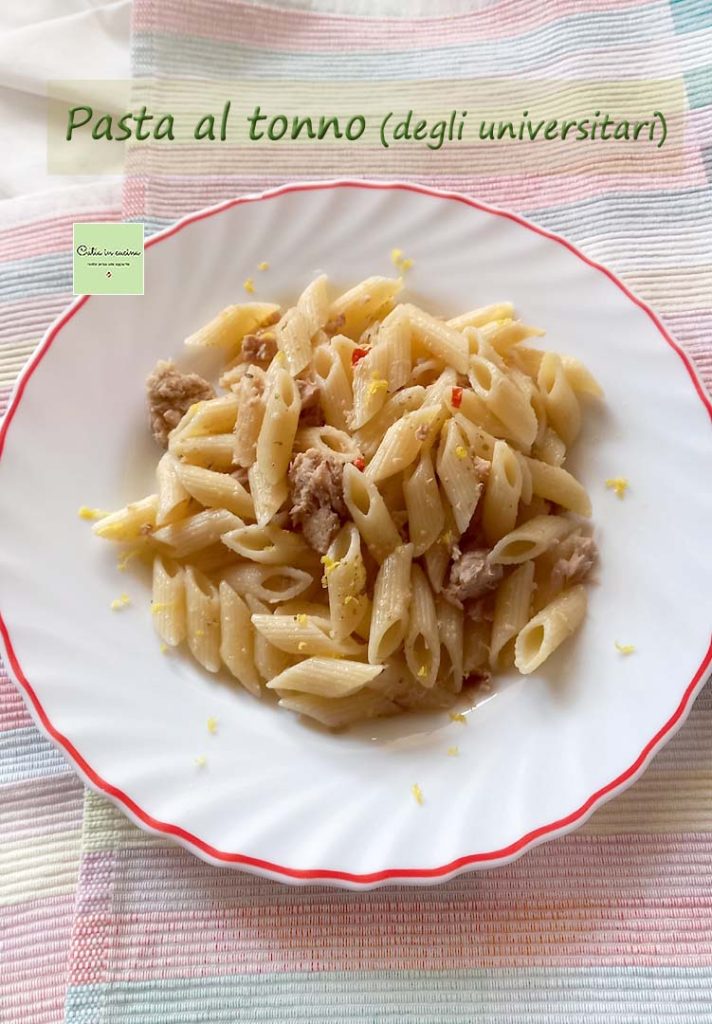
Since my children started university, I’ve discovered something I didn’t know: that tuna pasta and pesto pasta are the two most cooked dishes by students.
I mean ‘cooked’… 😃
Yes, according to what my children told me, the ‘raw’ reality of the university students’ tuna pasta consists of pouring the can of tuna directly onto the pasta or, in more elaborate cases, in: ‘put the tuna in the pan with (almost) all its oil, add a few tablespoons of pasta water, pour the pasta into the pan, done.’ (quoted because it’s a citation).
Ahhh how things have changed since I was a university student! My roommates and I had cutting boards and rolling pins and made our own flatbreads (well, pre-cooked ones didn’t exist yet), and I remember certain chickpea soups and how much I loved cooking risottos, and now – right now while I’m writing – my friend Milena is telling me on the phone that she remembers the day we cooked eggplant sauce together (my beloved eggplants, ever since!). But neither she nor I have any memory of ever eating a student’s tuna pasta like the one my children report.
And so… since our Light and Tasty column today covers a beautiful and perfectly fitting topic – that is, first courses prepared during the pasta cooking – yesterday I deliberately and specially cooked a student’s tuna pasta (in the presence of my son 😃).
I dared a more elaborate version – but just slightly so as not to scare my son 🤭 – with only three more easy ingredients.
Did I manage to convince him that keeping a lemon, a garlic clove, and a jar of aromatic herbs at home is not a complicated thing? And that adding just three small ingredients can improve the result (in the same time and with the same effort as the ‘nothing added’ version he told me about)? I hope so!!
So then at the next step, I could try to advocate for tuna sauce, or for a gratin pesto pasta, or a minimal couscous salad. And who knows, maybe in the end even my son will become passionate about cooking! (I doubt it… but never say never! 😄).
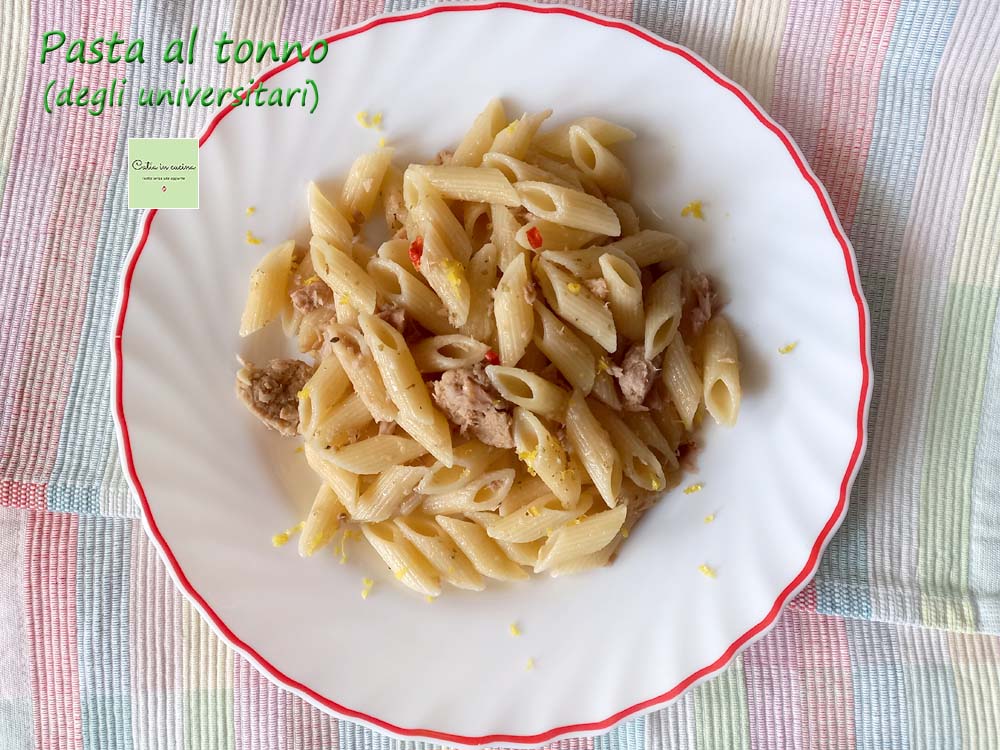
- Difficulty: Very Easy
- Cost: Economical
- Preparation time: 5 Minutes
- Portions: 2
- Cooking methods: Stovetop
- Cuisine: Italian
- Seasonality: All Seasons
Ingredients
- 7 oz pasta (I used penne)
- 4.5 oz canned tuna in oil (2 small cans)
- 1 clove garlic
- Half lemon (juice and zest)
- marjoram (or other aromatic herbs to taste)
- chili pepper (optional)
Tools
- Pasta Pot
- Frying Pan
- Lemon Grater
Steps
First, bring water to a boil and cook the pasta when it’s boiling.
While the pasta is cooking, prepare the tuna sauce:
Pour the tuna into a non-stick pan, oil included.
☝ For some people, the oil from both cans might be too much (for me, for example), so consider using only the oil from the first can and draining the second, depending on your taste.
Let the tuna briefly flavor with a coarsely chopped garlic clove.
Add chili pepper if desired.
👉 I added the chili pepper at the end while sautéing the pasta, but maybe it’s better to add it now.
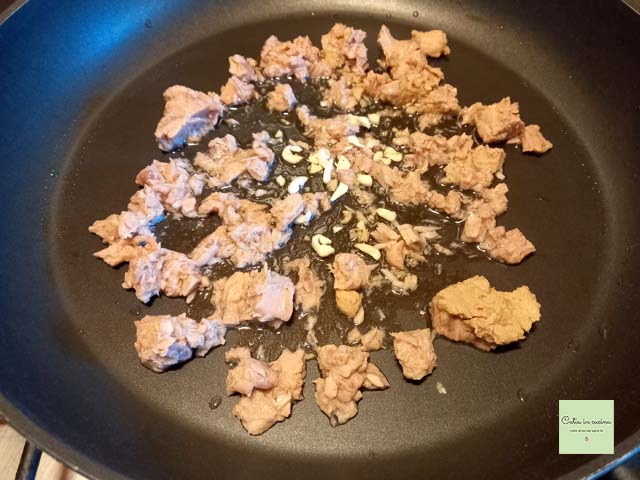
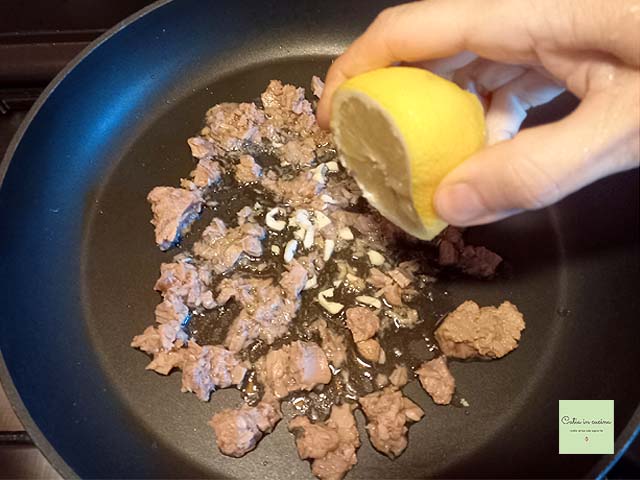
Drizzle the tuna with the juice of half a lemon.
Grate the zest as well.
Let it flavor for a few minutes, then lower the heat to a minimum (or turn it off if the pasta has a very long cooking time) while waiting for the pasta to cook (for our penne, 10 minutes).
Drain the pasta and sauté it in the pan with the tuna, adding a sprinkle of marjoram (or parsley, or oregano) and more grated lemon zest.
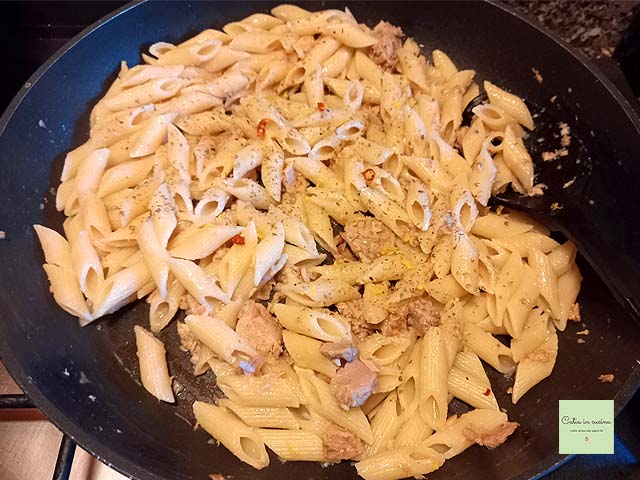
As an alternative to chili pepper, sprinkle some pepper during the sauté.
Serve hot. But it’s also excellent as cold pasta.
Sure, the appearance is minimalist 😃, but a touch of color can always be added, for example with some green or black olives, or with some capers, or using freshly chopped parsley.
Let me know which variant you like best!
Salt-Free Tips
 I recently learned that there is a low-salt canned tuna (a whopping 80% less). It’s surely been on the market for a while, but unfortunately, it’s not found in all supermarkets, so I missed it. For those who have trouble finding it, it is available online (–> here the Nostromo with 3 cans).
It has a declared salt content of 0.16 g (per 100 g of product), against values (both for tuna in oil and natural) that usually range from 1.1 to 1.7 g.
It’s likely that students aren’t very interested in low-sodium cooking (but their parents probably are). 😅 But becoming aware of it can only be beneficial, so I encourage everyone to read my usual tips in pills:
If you’re interested in reducing or eliminating salt, always remember to:
▫ Gradually decrease salt, the palate needs to get used to the progressive reduction.
▫ Use spices. Chili, pepper, curry, nutmeg, cinnamon, cloves, cumin…
▫ Use aromatic herbs. Basil, parsley, oregano, thyme, sage, marjoram, rosemary, mint…
▫ Use seeds. Sesame, pine nuts, almonds, walnuts…
▫ Use spicy vegetables or fruits. Garlic, onion, lemon, orange…
▫ Use my salt-free vegetable granular and gomasio.
▫ Prefer fresh foods.
▫ Avoid cooking in water, prefer cooking methods that don’t disperse flavors (grill, foil, steam, microwave)
▫ Avoid bringing the salt shaker to the table!
▫ Sometimes break the rule. It’s good for the mood and helps to persevere.
If you don’t want, or can’t, give up salt:
▫ You can still try my recipes by salting according to your habits.
Follow Me!
In the WhatsApp channel and on Instagram, on the Facebook page, on my Pinterest boards, in my two groups: Catia’s group, in the kitchen and beyond and Exactly what I was looking for! and if you like… sign up for my Newsletter
Light and Tasty:
I greet you with my colleagues’ ultra-fast first courses from the Light and Tasty Team:
Carla Emilia: Potato gnocchi with tuna bottarga
Daniela: Corn spaghetti with anchovies and almond pesto
Elena: Pasta with zucchini, speck, and ricotta
Milena: Whole wheat spaghetti with lemon pesto and pecan nuts
Serena: Pasta with cherry tomatoes and breadcrumbs
Carla Emilia: Potato gnocchi with tuna bottarga
Daniela: Corn spaghetti with anchovies and almond pesto
Elena: Pasta with zucchini, speck, and ricotta
Milena: Whole wheat spaghetti with lemon pesto and pecan nuts
Serena: Pasta with cherry tomatoes and breadcrumbs
