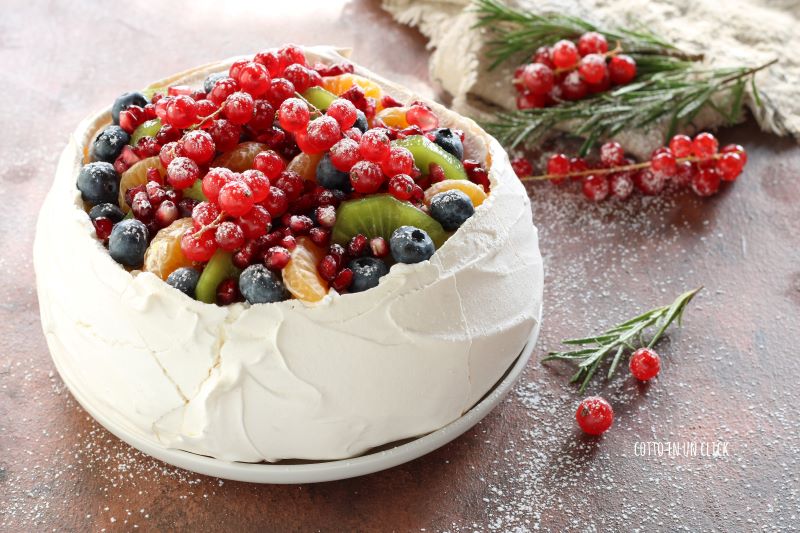
The Christmas Pavlova is a spectacular dessert, perfect to serve as a dessert on New Year’s Eve, or during the Christmas holidays. You are probably wondering if I’ve gone crazy suggesting such a unique and seemingly complicated dessert. I assure you that you’ll be able to make the pavlova easily by following a few simple tips on how to prepare the meringue.
Originating from New Zealand and Australia, the Pavlova is said to have been created by a hotel chef in Wellington and named in honor of the ballerina Anna Pavlova. The shape and whiteness of this dessert indeed pay homage to the gracefulness of the dancer, who had captivated audiences worldwide.
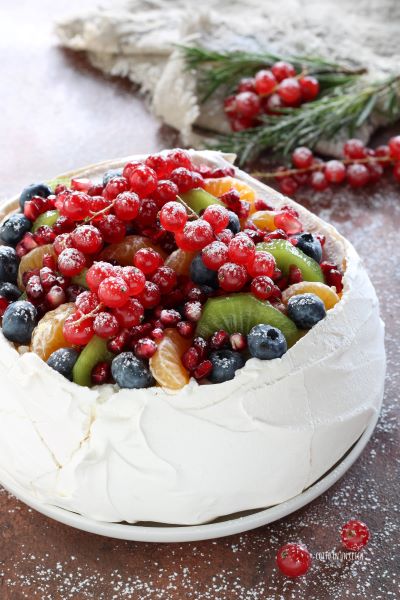
Pavlova is a cake with a crisp meringue shell on the outside and soft on the inside, filled with whipped cream and fresh, colorful fruit. Typically, berries, kiwi, passion fruit, and strawberries are used, but the choice of fruit is quite free and personal. In my version, considering the season, I used tangerines, currant, pomegranate, kiwi, and blueberries.
I confess that before understanding how to correctly make the meringue, I had to discard 2 preparations. After making the meringue for the third time, I finally understood what mistakes I initially made and what tricks to adopt to achieve a perfect meringue. I won’t bore you here with my tips on making a perfect meringue. Also, because these steps are very important, and I prefer to explain them in the recipe. This Christmas dessert is uniquely delightful! And now, enough talking, let’s get into the kitchen together, because the Christmas Pavlova will be ready in a click!
If you are interested in other Christmas dessert recipes, also read:
- Difficulty: Medium
- Cost: Very cheap
- Preparation time: 30 Minutes
- Portions: 8People
- Cooking methods: Oven
- Cuisine: New Zealand
- Seasonality: New Year's Eve, Christmas
- Energy 238.69 (Kcal)
- Carbohydrates 37.23 (g) of which sugars 35.46 (g)
- Proteins 2.39 (g)
- Fat 9.60 (g) of which saturated 0.01 (g)of which unsaturated 0.06 (g)
- Fibers 0.84 (g)
- Sodium 27.81 (mg)
Indicative values for a portion of 89 g processed in an automated way starting from the nutritional information available on the CREA* and FoodData Central** databases. It is not food and / or nutritional advice.
* CREATES Food and Nutrition Research Center: https://www.crea.gov.it/alimenti-e-nutrizione https://www.alimentinutrizione.it ** U.S. Department of Agriculture, Agricultural Research Service. FoodData Central, 2019. https://fdc.nal.usda.gov
Ingredients
- 4 oz egg whites
- 4 oz granulated sugar
- 1 cup powdered sugar
- 2 tsp lemon juice
- 1 cup heavy cream (fresh)
- 1.5 tbsps powdered sugar
- kiwi (to taste)
- tangerines (to taste)
- pomegranate (to taste)
- blueberries (to taste)
- red currants (to taste)
Tools
- Mixer
- Bowl
- Stand Mixer
- Cutting Board
- Knife
- Baking Sheet
- Parchment Paper
Steps
For this recipe, we will prepare a French meringue, where the egg whites are whipped cold. As a main rule, forget to add salt. It’s said that “a pinch of salt helps the egg whites whip better.” This is completely false! I used to do it, and the whites always collapsed without understanding why until I made this dessert.
That said, now I’ll leave you the steps to make the base. However, one last recommendation before proceeding! Follow the steps, adding the ingredients in the order I’ll write. There’s a very valid reason, but I won’t explain it now. I’ll definitely do it in a future recipe dedicated solely to meringues.
Remove the eggs from the refrigerator at least a couple of hours before (even more if possible) making the recipe because they need to be at room temperature. Then separate the yolks from the whites and weigh the latter, which should correspond to the weight indicated in the ingredients above. Obviously, eggs aren’t all the same size, so if the weight doesn’t match, know that the sugar should be double the weight of the egg whites. Do not throw away the yolks; you can use them to make a carbonara.
Please be careful not to let any yolk drop into the whites when separating them. The yolks contain fat, which could compromise the recipe’s success.
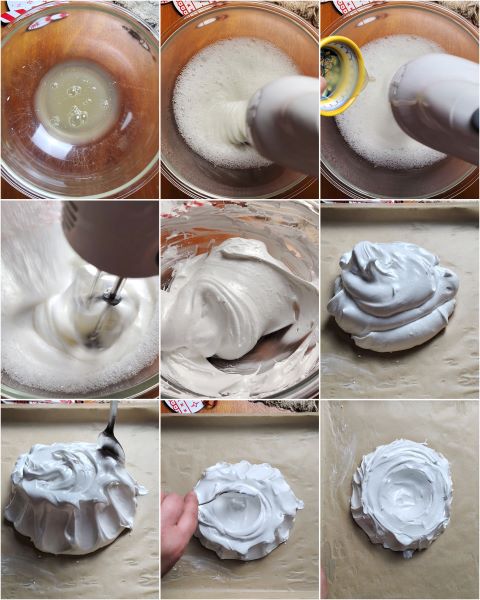
Start working the egg whites with electric whisks or a stand mixer until they start to foam. Now add the lemon juice, still with the electric whisks on, and continue working the whites for a couple of minutes. Then add the granulated sugar, always whipping with the whisks, little by little. Do this operation in 3 or 4 stages, waiting a couple of minutes before adding the next. Granulated sugar takes a while to dissolve.
After adding all the granulated sugar, add the powdered sugar in the same way as you added the granulated sugar. It is a process that takes time, and it’s essential to respect the time to avoid compromising the recipe’s outcome. You’ll see that in the end, it will be worth it, as the result will be uniquely satisfying and delicious.
The egg whites will be well-whipped when you obtain a frothy and glossy mass. To verify the perfect result, you can detach the whisks from the mixture. When lifted, they should form a peak with a tip. Then set aside the bowl with the whipped whites and draw a circle with a diameter of 8-9 inches on a sheet of parchment paper. Flip it over and transfer it onto a baking sheet. The circle will be the template for making the Pavlova.
Now transfer the whipped egg whites to the center of this circle, trying to cover its entire surface. With a spatula or a spoon, very gently, start shaping it into a mound. Shape the sides with the back of a spoon, and with the same spoon, slightly hollow the center to create a cavity.
Bake the meringue in a preheated oven at 230°F with static mode for 2 hours. After the baking time, open the door and let the meringue cool completely. It will be well-cooked if it easily detaches from the parchment paper and feels light.
Meanwhile, as the meringue cools, put the cold cream from the fridge in a bowl with the powdered sugar and whip it with electric whisks until you get a smooth and frothy mixture. Take the meringue and fill the center with the previously whipped cream. If the cavity you made before baking isn’t deep enough, you can gently tap the inside of the meringue as I did to create more space.
Now focus on preparing the fruit for garnishing. Peel the kiwis and cut them in half, then into slices. Also, peel the tangerine and divide it into segments. Seed the pomegranate and rinse the currants and blueberries under water, then pat them dry with kitchen paper.
Now go wild with the cake decoration! Distribute the blueberries, kiwi slices, and tangerine segments randomly as you prefer. Then add the pomegranate seeds and finish with the currants.
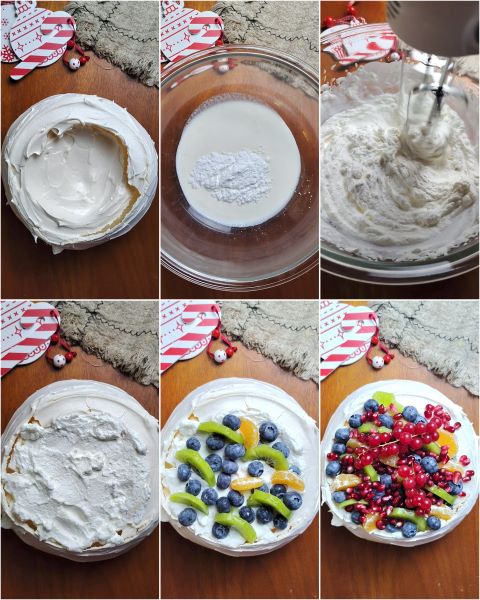
Dust with powdered sugar and serve your Pavlova.
Storage and Tips for Christmas Pavlova
The Christmas Pavlova, once filled, can be stored in the refrigerator for 1 or 2 days max. You can prepare the meringue the day before and keep it in a cool, dry place, covered by a glass dome. Shortly before serving, decorate it with cream and fruit.
This content also contains one or more affiliate links, on which I may earn a small commission without affecting the price.
FAQs Questions and Answers for Christmas Pavlova
Why do the egg whites stay too soft and not firm enough after being whipped?
Probably because you didn’t whip them correctly. First of all, do not add the pinch of salt because it isn’t necessary and could compromise the recipe’s success. Also, add the ingredients in the order as written above, with the required pauses to allow the sugar to incorporate perfectly.
Why is the meringue raw inside?
If it’s raw inside, you’ll need to extend the baking time. Keep in mind that ovens aren’t all the same. However, I recommend not exceeding 230°F, as the meringue might crack.
Why does the meringue crack and split?
This can be due to the oven temperature being too high or the baking time being too long.
Can I substitute powdered sugar with cornstarch?
Yes, you can use 240 g of granulated sugar and 20 g of cornstarch.