
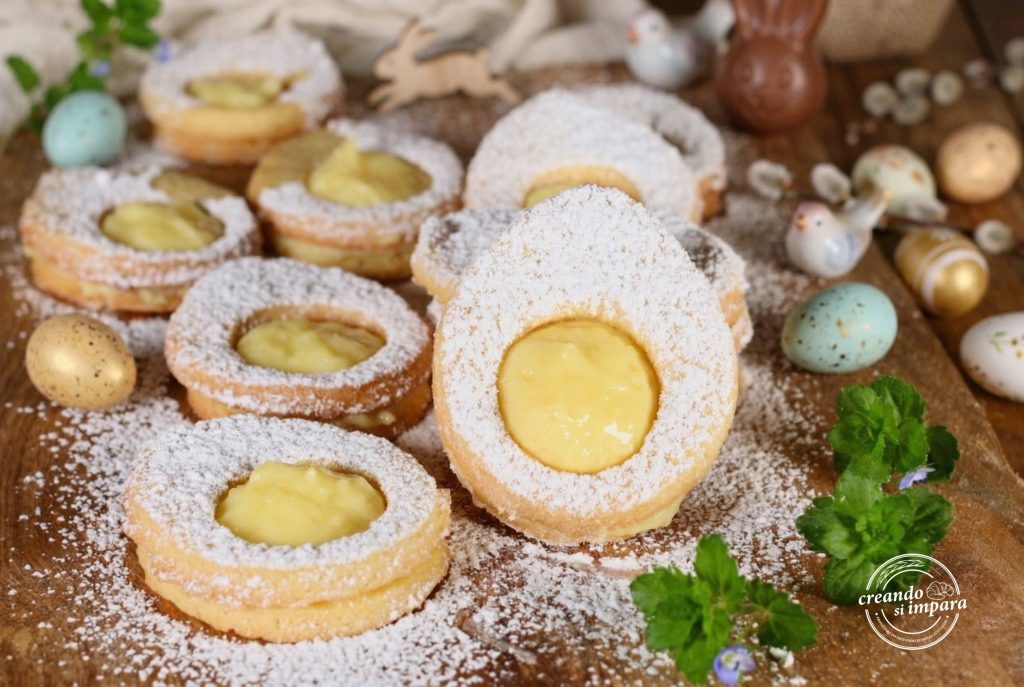
The Easter egg cookies with pastry cream are delightful filled shortbreads that enchant with their jammy-eye shape customized for the Easter period. The specialty of this preparation lies in the dough, enriched with rice flour, which gives superior crispness and a texture that literally melts in the mouth. The crunchy shell encloses a velvety heart of lemon pastry cream, visible thanks to the central hole, visually recalling the look of a sweet fried egg. Preparing these homemade cookies is a creative and fun activity, perfect to enhance the Easter breakfast table or to give as gifts in elegant transparent bags. Follow my technical steps to obtain an elastic shortcrust pastry and a velvety filling!
If you are looking for more cookie ideas try the 3-ingredient soft almond cookies, canestrelli, lemon shortcrust cookies or also jam-filled large cookies.
Find among all my DESSERTS the one that’s right for you!
Follow my page FACEBOOK for lots of kitchen ideas every day!
OTHER EASTER DESSERTS
- Difficulty: Easy
- Cost: Economical
- Preparation time: 20 Minutes
- Cooking time: 20 Minutes
- Portions: 15 Pieces
- Cooking methods: Stovetop, Oven
- Cuisine: Italian
- Seasonality: Easter
Ingredients for your Easter egg cookies
- 1 1/2 cups all-purpose flour (about 180 g)
- 2 1/2 tbsp rice flour (about 20 g)
- 7 tbsp butter (cold, about 3.5 oz / 100 g)
- 1/2 cup granulated sugar (about 3.5 oz / 100 g)
- Half vial lemon extract
- 1 egg
- 2 cups milk (about 16.9 fl oz / 500 ml)
- 4 egg yolks
- 4.2 oz granulated sugar (about 120 g)
- Zest of half lemon (zest of half a lemon)
- 6 tbsp cornstarch (about 50 g)
- 2 tbsp powdered sugar
Steps to prepare the Easter egg cookies with pastry cream
Start preparing the pastry cream by warming the milk with the lemon zest. In a separate bowl, whisk the egg yolks with the sugar and the cornstarch using a hand whisk until the mixture is smooth. Strain the hot milk to remove the zest and gradually pour it over the egg mixture, stirring continuously. Place everything back on the stove and cook over low heat until the cream thickens. Transfer immediately into a bowl, cover the surface with plastic wrap directly touching the cream to prevent a skin from forming, and let it cool completely. A cold cream is essential for the stability of your Easter egg cookies.
To make the shortcrust pastry, quickly work the all-purpose flour and the rice flour with the cold diced butter until you obtain a sandy texture. Add the egg, the sugar, the lemon extract and the salt. Quickly knead with your fingertips until you have a homogeneous dough; do not overwork the dough so as not to warm the butter and compromise the crumbly texture. Wrap the dough in plastic wrap and place it in the refrigerator for at least 30 minutes. This technical resting time is essential so the shortcrust pastry stabilizes, allowing you to roll and cut it without it losing shape during oven baking.
Roll the shortcrust pastry on a lightly floured surface to a thickness of about 4–5 mm (about 0.16–0.20 in). Using egg-shaped cookie cutters, cut out an even number of cookies. On half of the cookies, make a central hole using a small round cutter (which will represent the egg yolk). Place the cookies on a baking tray lined with parchment paper and bake in a conventional oven at 356°F for 20–25 minutes, or until the edges are just golden. Remove your homemade cookies from the oven and let them cool completely on a wire rack before filling.
Once the shells are cold, proceed to assemble the Easter egg cookies with pastry cream. Spread a generous tablespoon of cold pastry cream in the center of the whole cookie, creating a slight mound in the middle. Place the cookie with the hole on top, pressing lightly so the cream emerges from the central hole, perfectly simulating the yolk. Dust the surface with plenty of powdered sugar to give a snowy, finished look. The contrast between the white sugar and the yellow cream will make your cookies visually irresistible and ready to serve.
Tips for perfect results
Cold cookie shells: Make sure the cookies are completely cold before filling; otherwise the residual heat would melt the pastry cream, making the shortcrust soft and unstable.
Rice flour: Do not omit the rice flour; it is the technical ingredient that guarantees that dry, crumbly “bite” typical of high-quality dry pastry.
Plastic wrap: For a silky cream, the plastic wrap must touch the hot cream surface directly. This prevents the air from oxidizing the surface and forming lumps.
Tasty variations
Chocolate center: If you want a richer version, add a small square of melted dark chocolate in the center of the cream before closing the cookie.
Cocoa shortcrust: Replace 20 g of all-purpose flour with unsweetened cocoa powder to obtain dark cookies that will make the yellow pastry cream pop even more.
Orange extract: Replace the lemon with orange zest both in the pastry and in the cream for a fragrant, typically Mediterranean variation.
Storage
In the refrigerator: Because of the cream, keep the cookies in the fridge for a maximum of 2 days.
Tip for crunchiness: If you want a crisp shortcrust, store the cookies and the cream separately and assemble them only an hour before serving.
Freezing: You can freeze baked shortcrust pastry cookies (without cream) for about one month. When needed, thaw at room temperature and fill with fresh cream.
Now it’s your turn!
The Easter egg cookies with pastry cream are the perfect treat to celebrate with family. Their fun shape and the comforting flavor of pastry cream make them favorites with children.
Which flavor do you prefer for the shortcrust? Are you a fan of classic lemon or would you try a vanilla variation? Let me know in the comments if the egg shape came out perfect and if these cookies have become the new symbol of your Easter!
FAQ (Questions & Answers)
Can I use jam instead of pastry cream?
Certainly! If you use apricot jam, you’ll get the same visual yolk effect but you’ll be able to store the cookies at room temperature for longer.
Why did the cookies deform in the oven?
Most likely the shortcrust pastry didn’t rest long enough in the fridge or was overworked. The cold is essential to maintain the sharp edges of the cutter.
Can I make the cream the day before?
Yes, in fact it is recommended. The pastry cream that has rested in the fridge becomes denser and more stable, ideal for filling the cookies without running.
