
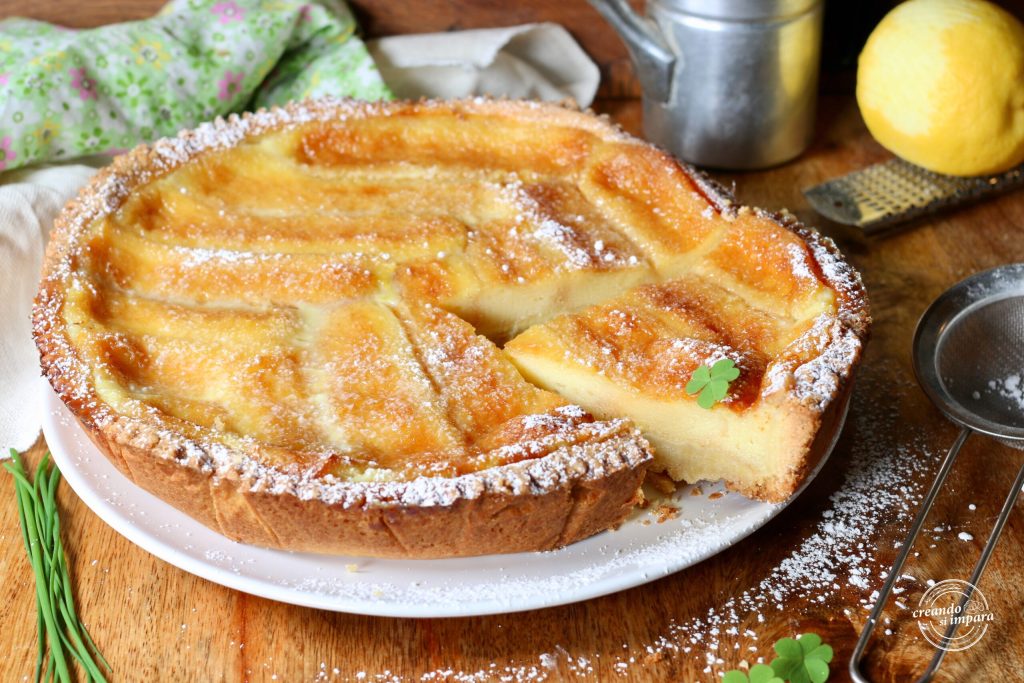
Today I bring you to the heart of tradition with a sweet that enchants with its uniqueness: the Portuguese Cake, known to many as the Benevento Tart. Do not be fooled by the name, this cake is very Italian and owes its unmistakable aroma to the famous Strega liqueur.
The magic happens in the oven: the savoiardi, immersed in a velvety milk cream, rise to the surface creating a soft layer that contrasts with the crispness of the pastry. It is an ancient, elegant dessert perfect for those who love old-time flavors. Let’s prepare it together! If you love tarts, try the jam tart, the lemon cream tart, the milk cream tart or the whipped pastry tart.
Find among all my DESSERTS the one that suits you!
Follow my page FACEBOOK HERE for daily kitchen inspiration!
OTHER TARTS
- Difficulty: Easy
- Cost: Low
- Preparation time: 20 Minutes
- Portions: 8 servings
- Cooking methods: Oven
- Cuisine: Italian
- Seasonality: All seasons
Ingredients for the preparation of the Portuguese cake or Benevento tart
- 2 1/2 cups all-purpose flour
- 1 cup powdered sugar
- 2/3 cup butter
- 3 1/2 oz egg yolks
- 1 tbsp vanilla extract
- 1 pinch salt
- 2 1/4 cups milk
- 3 eggs
- 3/4 cup sugar
- Half lemon peel
- 4 tbsp Strega liqueur
- 4 1/4 oz savoiardi
Steps for preparing the beneventana tart
In a bowl, put the cold butter into chunks with the sifted flour. Work quickly with your fingertips until you get a sandy mixture. Add the powdered sugar, the egg yolks, the pinch of salt, and the vanilla. Knead quickly until you get a smooth and homogeneous dough. Wrap it in plastic wrap and let it rest in the refrigerator for 30 minutes.
This cream is very simple: heat the milk without bringing it to a boil (you can easily use the microwave). In a separate bowl, beat the eggs with the sugar using a hand whisk. Combine the warm milk, the Strega liqueur, and the grated lemon peel. Mix well and let it cool down.
Roll out the pastry on a sheet of parchment paper with the help of a rolling pin. Line a tart pan, trim the excess from the edges, and prick the bottom with a fork. Arrange the savoiardi on the bottom in a fishbone pattern (or radial). Gently pour the cream over the biscuits. Don’t worry if the savoiardi start to float: that’s exactly what should happen!
Bake in a static oven at 350°F for about 45 minutes. The cream will thicken and the savoiardi will turn golden. Once baked, let the cake cool completely in the pan before removing: this is a crucial step to prevent breakage.
Tips
The pastry rest: Do not skip the 30 minutes in the fridge. The butter must get cold again so that the pastry does not crumble and maintains the perfect shape during baking.
The temperature of the milk: Heat the milk in the microwave until it’s warm to the touch but not boiling. If it is too hot, it risks cooking the eggs instantly, creating lumps in the liquid mixture.
The cooling trick: This cake is very delicate just out of the oven. Let it cool completely in the pan before trying to move it to the serving plate, otherwise the moist base might give way.
Tasty Variants
Chocolate chips: For a more indulgent version, you can sprinkle dark chocolate chips over the savoiardi before pouring the cream.
Alternative to the liqueur: If you don’t have Strega, you can use anise liqueur or Maraschino, but keep in mind that Strega gives the typical yellow color and Benevento aroma.
Orange scent: If you prefer a more winter flavor, replace the lemon peel with organic orange peel.
Storage
In the refrigerator: Being an egg and milk-based cake, it should be stored in the fridge. It keeps perfectly for 3 days, covered with a glass dome or under plastic wrap.
Serving: I recommend taking it out of the refrigerator about 20 minutes before serving. This way the pastry becomes crumbly again and the liqueur aromas are released at their best.
Freezing: I don’t recommend freezing this cake due to the consistency of the cream and soaked savoiardi, which would lose its typical structure.
Now it’s your turn
I hope this Portuguese Cake wins you over at the first bite as it did for me! It’s a dessert that smells of home, traditions, and things made with care.
If you make it, don’t forget to snap a photo and tag me on social media: I love seeing your golden tarts! And you, did you already know about this Benevento ‘mess’ or is it your first time? Write it in the comments, let’s talk about it together!
Frequently Asked Questions
Why do savoiardi float?
It is completely normal! Savoiardi are light and full of air; when you pour the liquid cream, they will rise to the surface. In the oven, they will become a kind of soft sponge cake integrated into the cream.
Can I use Sardinian savoiardi (the soft ones)?
For this recipe, classic dry savoiardi are preferable because they absorb the liquid better without completely disintegrating during the 45 minutes of baking.
Is the cream too runny?
If at the end of the 45 minutes the cream still seems very wobbly, don’t worry: it will firm up as it cools thanks to the eggs, taking on the consistency of a solid pudding.
Do I need to soak the savoiardi beforehand?
No, it is not necessary. The cream itself will soak them perfectly during the baking in the oven.
