
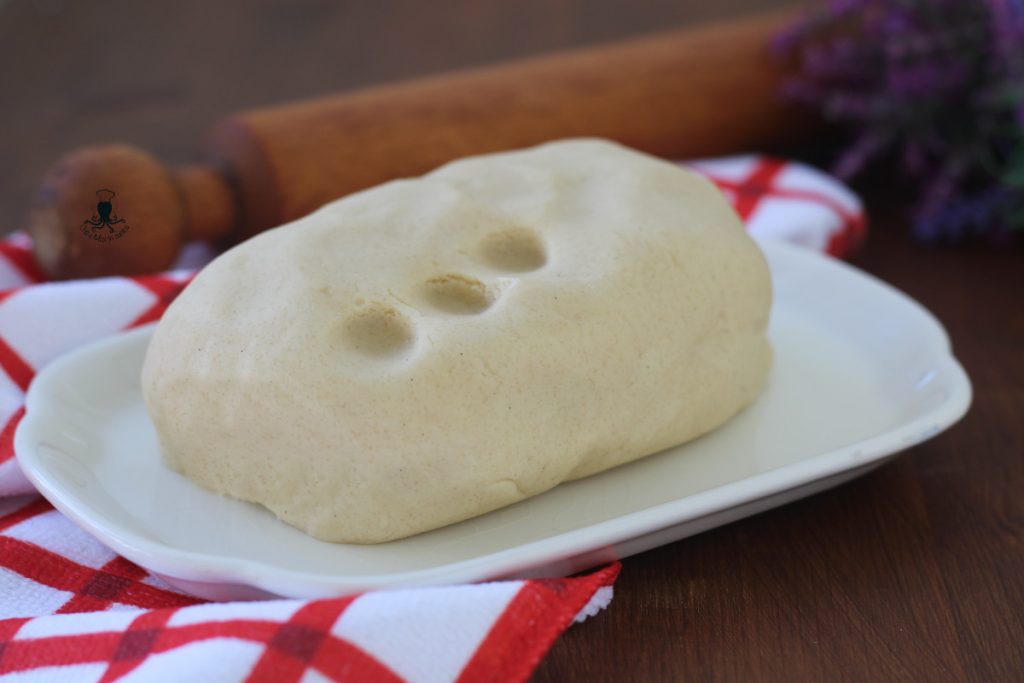
The 1-2-3 shortcrust pastry without eggs is one of the simplest, most versatile, and beloved basic recipes in pastry making. The name comes from the perfect and easy-to-remember ratio of ingredients: 1 part sugar, 2 parts butter, and 3 parts flour. In this version, there are no eggs, which gives the dough a different consistency compared to classic shortcrust: lighter, more delicate, more crumbly, and literally melts in your mouth.
This recipe is ideal for those who cannot or do not want to consume eggs, but also for those who love fine pastry cookies, the small and crumbly ones that accompany tea or coffee and are often found in the windows of the best pastry shops. It is also perfect for light tarts and filled cookies with jam: the contrast between the buttery shortcrust and the sweetness of the jam is truly irresistible.
Compared to traditional shortcrust with yolks, the 1-2-3 without eggs is more neutral and versatile. Lacking the protein component of eggs, it does not develop elasticity: this means it is more delicate to work with, but once baked, offers that “sablée” texture typical of French pastry. It is less suitable for large tarts with heavy fillings, which require a sturdy base, but unbeatable for crumbly cookies, thumbprint cookies, and tea treats.
Another advantage of the eggless shortcrust is its versatility with flavors: it pairs beautifully with citrus zest (lemon, orange, mandarin), vanilla, or Christmas spices like cinnamon, ginger, and cardamom. When used with orange marmalade, for example, it becomes a perfect base for elegant and fragrant Christmas cookies. With just a splash of orange liqueur (Grand Marnier or Cointreau), you can transform a simple dough into a refined recipe to serve during the holidays.
- Difficulty: Very easy
- Cost: Economical
- Preparation time: 5 Minutes
- Portions: About 1.3 lbs of dough
- Cooking methods: No baking
- Cuisine: Italian
Ingredients for 1-2-3 Shortcrust Pastry Without Eggs:
- 1/2 cup granulated sugar (or powdered sugar for finer, more crumbly cookies)
- 7 oz soft butter
- 2 1/2 cups all-purpose flour
- 1 pinch fine salt
- as needed vanilla extract (or lemon, orange zest, various spices)
Tools for 1-2-3 Shortcrust Pastry Without Eggs:
- 1 Bowl
- 1 Work Surface
Steps for Preparing 1-2-3 Shortcrust Pastry Without Eggs:
Place the soft butter in pieces (leave it at room temperature for 15 to 20 minutes depending on the season) and the granulated sugar in a large bowl, and use a fork to work the mixture until you obtain a uniform cream. Add the flour, a pinch of salt, and either vanilla essence or grated lemon or orange zest, or cinnamon or other spices.
Continue to work the mixture until it forms crumbs, then transfer the mixture to a work surface and quickly compact it with your hands until you form a smooth dough.
Wrap in plastic wrap and let rest in the refrigerator for 30 minutes.
For a fine and crumbly shortcrust version:
Use the same quantity of granulated sugar with powdered sugar and beat it with the mixer with the soft butter until you get a light and creamy mixture. Then add the flour and flavors, mix the ingredients together with your hands or a spatula, then transfer the mixture to a work surface, form a dough that you will cover with plastic wrap and put in the refrigerator for 30 minutes. With this method, you will get a smooth and melt-in-the-mouth shortcrust thanks to the air incorporated with the electric mixer and powdered sugar.
Tips:
Powdered sugar or granulated sugar?
You can prepare the 1-2-3 shortcrust pastry without eggs using either powdered sugar or granulated sugar. The difference is noticeable both in the working and the final result:
With powdered sugar, you will obtain a smooth, homogeneous, and very crumbly shortcrust, which melts in your mouth. It is perfect for tea cookies or to decorate, as the surface remains regular and elegant.
With granulated sugar, the shortcrust will be slightly more grainy during the kneading and the cookies, once baked, will be crunchier and more rustic.
FAQ (Questions and Answers)
Is it suitable for tarts?
Yes, but keep in mind that without eggs, the shortcrust is more delicate and tends to crumble. Perfect for light jam tarts or single-serving tarts.
How can I flavor it?
You can use citrus zest (orange, lemon, mandarin), vanilla, cinnamon, ginger, or a splash of orange liqueur (like Cointreau or Grand Marnier). Great if paired with orange marmalade for Christmas.
What can I make with the obtained dough?
With the 1-2-3 ratio, you get about 1.3 lbs of dough, which makes 50–55 small cookies (10–12 g each) or 30–35 large cookies, or a 9.5 inch tart.
If I want to make the version with eggs, how many should I add?
2 yolks or 1 whole egg if you want a more elastic dough.
What are the differences between shortcrust with and without eggs?
With yolks, the shortcrust is more elastic and sturdy: perfect for tarts that need to hold jam or creams.
With a whole egg, it becomes even more robust but slightly less crumbly.
The shortcrust is more golden yellow in color with a fuller taste.
The cookies are sturdier and crunchier, less melt-in-the-mouth compared to those made without eggs.
