
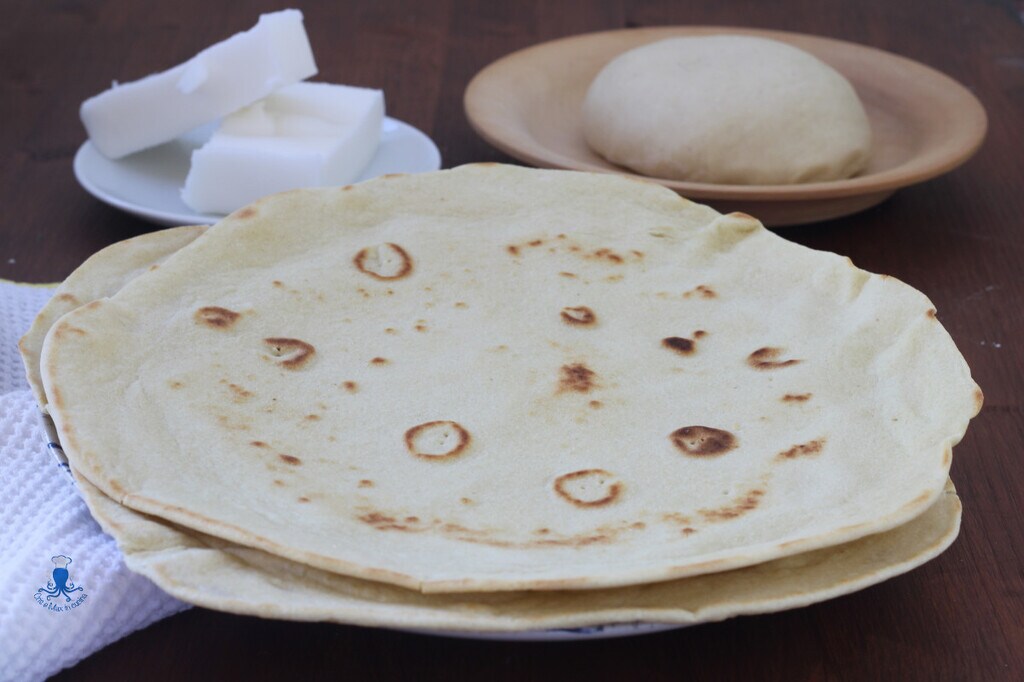
The Romagna flatbread with lard is one of the most authentic symbols of Romagna, a land rich in flavors and culinary traditions. This recipe is not just a simple dough of flour, water, and lard, but a true piece of history that has accompanied the daily life of Romagna families for centuries.
The first traces of the flatbread date back to Roman times, where they prepared a flatbread cooked on stone. Over time, this food has become the “bread of the Romagna people,” simple yet rich in meaning, passed down by the ‘azdore’ — housewives — who cooked it on the traditional terracotta or cast iron griddle.
Born as a poor man’s food, the flatbread has won everyone over thanks to its versatility: soft or crispy, thin or thick depending on the area, it’s perfect to enjoy with cured meats, typical cheeses like squacquerone, or with more rustic and hearty fillings.
Making the flatbread with lard means staying true to tradition, obtaining an elastic and fragrant dough, which when cooked gives off the typical aroma of real Romagna flatbread shops.
- Difficulty: Very easy
- Cost: Very cheap
- Rest time: 20 Minutes
- Preparation time: 10 Minutes
- Cooking time: 15 Minutes
- Portions: 5 flatbreads
- Cuisine: Italian
- Seasonality: All seasons
Ingredients for Romagna flatbread with lard:
- 4 cups all-purpose flour
- 1 cup lukewarm water
- 5 tbsp lard
- 2 tsp fine salt
- 1/2 tsp baking soda
Tools for Romagna flatbread with lard:
- 1 Pan non-stick
- 1 Bowl
- 1 Pastry Board wood
- 1 Rolling Pin
Steps for preparing and cooking the true Romagna flatbread with lard:
Place the flour in a mound in a large bowl and add the softened lard in the center, then add the salt and baking soda, and gradually pour the water while kneading with your hands.
Work the dough until smooth and elastic, then cover it and let it rest for 20 minutes.
Divide the dough into 5 portions and roll them into round disks about 9.5-10 inches in diameter and 0.15-0.2 inches thick.
Heat the non-stick pan well or a cast iron griddle or the traditional Romagna ‘testo’, cook the flatbread for 1-2 minutes per side: when bubbles appear, pierce them with a fork to keep the surface flat.
Once all are prepared, serve them hot and fill as desired.
The tips of the Romagna ‘azdore’:
– Always use medium-high heat: the flatbread must cook quickly.
– Pierce the bubbles with a fork as soon as they appear, so the flatbread remains flat and fillable.
– Roll out the disks one at a time, cooking them immediately: this way they won’t dry out before cooking.
– Roll out the disks one at a time, cooking them immediately: this way they won’t dry out before cooking.
FAQ (Questions and Answers)
What is the difference between Romagna flatbread with lard and the one with oil?
The version with lard is the traditional one: more fragrant, elastic, and flavorful. Extra virgin oil is a lighter and more modern alternative but with a less authentic result.
How is the true Romagna flatbread cooked?
Traditional cooking takes place on the ‘testo’, a terracotta or cast iron griddle. Alternatively, a well-heated non-stick pan is fine.
How thick should Romagna flatbread be?
It depends on the area: in Rimini, it is thin (2–3 mm), while in the Forlì-Cesena area, it is thicker (up to 8 mm). The traditional recipe allows for both versions.
Can I prepare the dough in advance?
Yes, you can knead it a few hours earlier and store it in the refrigerator wrapped in plastic wrap. Before rolling out the flatbread, bring the dough to room temperature.
How do you store the flatbread once cooked?
You can store it wrapped in a cloth to keep it soft. Alternatively, it can be frozen and reheated as needed.
