
Welcome to cooking with Dadcook!
If you’re looking for the right inspiration to bring the triumph of Sunday to the table, the one that makes the whole house smell of festivity and tradition, you’re in the right place.
Today we are not preparing a simple baked pasta, but a true monument of Southern cuisine.
My journey through flavors today starts with a pillar of conviviality that recalls the genuineness you love so much in my traditional dishes, like the SOFT CHESTNUT CAKE, a simple recipe that smells of home and that many of you have appreciated for its authenticity.
But Calabrian cuisine is also made of rich and hearty preparations.
If you are among those who love the bold flavors of the sea, like my BAKED SALMON WITH ASPARAGUS, or are looking for a fit but tasty main course like the LEMON AND HERB CHICKEN, you will love the texture and intense aroma of this “china” (full) pasta, where every forkful is a surprise between meatballs and boiled eggs.
After experiencing the freshness of the QUINOA AND GRILLED VEGETABLE SALAD, today we return to the roots with a dish that is a true symbol of Calabrian identity.
The secret of today?
A crispy crust and a cheesy heart.
Put on your apron and get ready: learn how to transform simple ingredients into a masterpiece of taste that will leave everyone speechless!
- Catanzarese Morzello: The Original Recipe of the Ancient Morzeddhu
- Baked Pasta with Artichokes and Sausage: The Clever Recipe "All Raw
- Mulled Wine: The Original Recipe and Secrets for Making it Perfect at Home
- Sausages and Turnip Greens: Grandma's Easy Recipe
- How to Cook Turnip Greens in a Pan: Easy and Quick Recipe
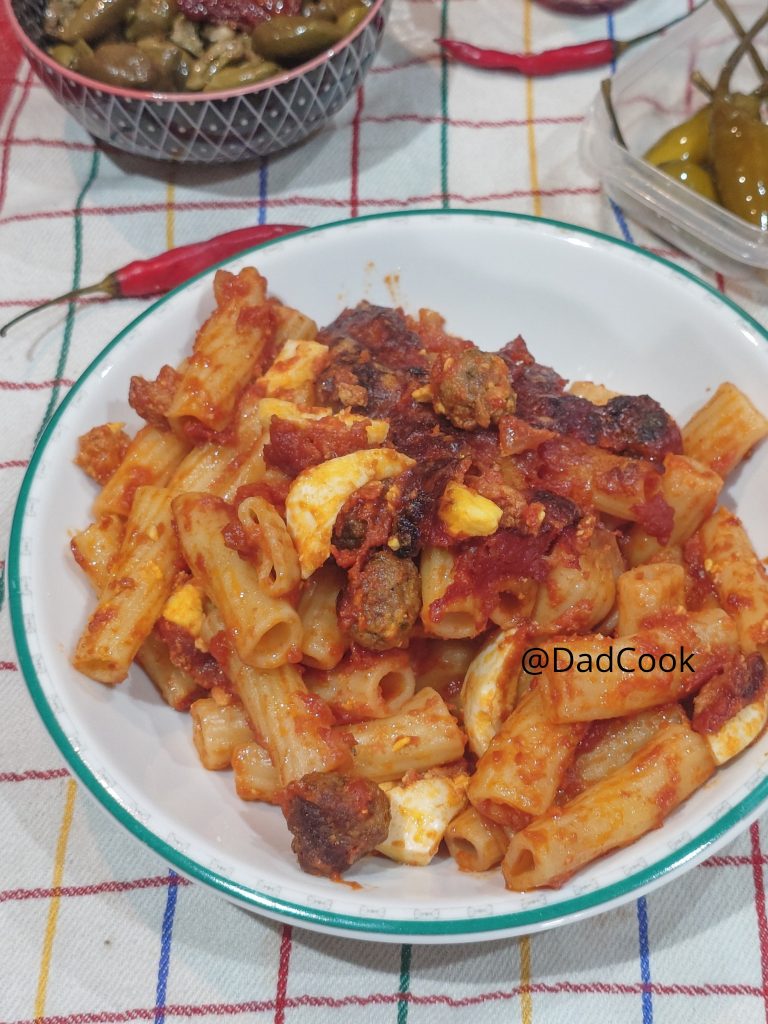
- Difficulty: Very easy
- Cost: Very economical
- Rest time: 10 Minutes
- Preparation time: 25 Minutes
- Portions: 8People
- Cooking methods: Oven
- Cuisine: Italian
- Seasonality: Autumn, Winter, Winter, Spring
- Energy 816.24 (Kcal)
- Carbohydrates 70.50 (g) of which sugars 2.76 (g)
- Proteins 47.20 (g)
- Fat 39.59 (g) of which saturated 15.04 (g)of which unsaturated 13.62 (g)
- Fibers 2.07 (g)
- Sodium 1,658.42 (mg)
Indicative values for a portion of 420 g processed in an automated way starting from the nutritional information available on the CREA* and FoodData Central** databases. It is not food and / or nutritional advice.
* CREATES Food and Nutrition Research Center: https://www.crea.gov.it/alimenti-e-nutrizione https://www.alimentinutrizione.it ** U.S. Department of Agriculture, Agricultural Research Service. FoodData Central, 2019. https://fdc.nal.usda.gov
Ingredients
- 28 oz rigatoni
- 6.3 cups tomato purée
- 10.6 oz Calabrian sausage (Semi-cured)
- 6 hard-boiled eggs
- 12.3 oz cheese (Silana provola)
- 3.5 oz grated parmesan (Or pecorino)
- as needed extra virgin olive oil
- 1 pinch salt
- 14 oz mixed ground meat
- 1 egg
- 2 tablespoons pecorino (Grated)
- 2.8 oz stale bread (Soaked)
- 1 bunch chopped parsley
- 1 pinch fine salt
- 1 pinch black pepper
- as needed seed oil (For frying)
Tools
- 1 Baking dish Porfoyo
- 1 Pot Florina
- 1 High-sided saucepan Lagostina
- 1 Frying pan Lagostina
- 1 Bowl Pyrex
Steps
Preparation and frying of the meatballs
Let’s start with the most delicious part: the meatballs.
In a bowl, combine the ground meat, egg, pecorino, and well-squeezed bread crumb.
Knead with your hands until you get a homogeneous mixture.
Form very small balls (the size of a hazelnut): it takes patience, but this is the secret to have one in every bite!
Fry them in plenty of hot oil until they are golden and crispy.
Drain them on absorbent paper and set aside, trying not to eat them all immediately!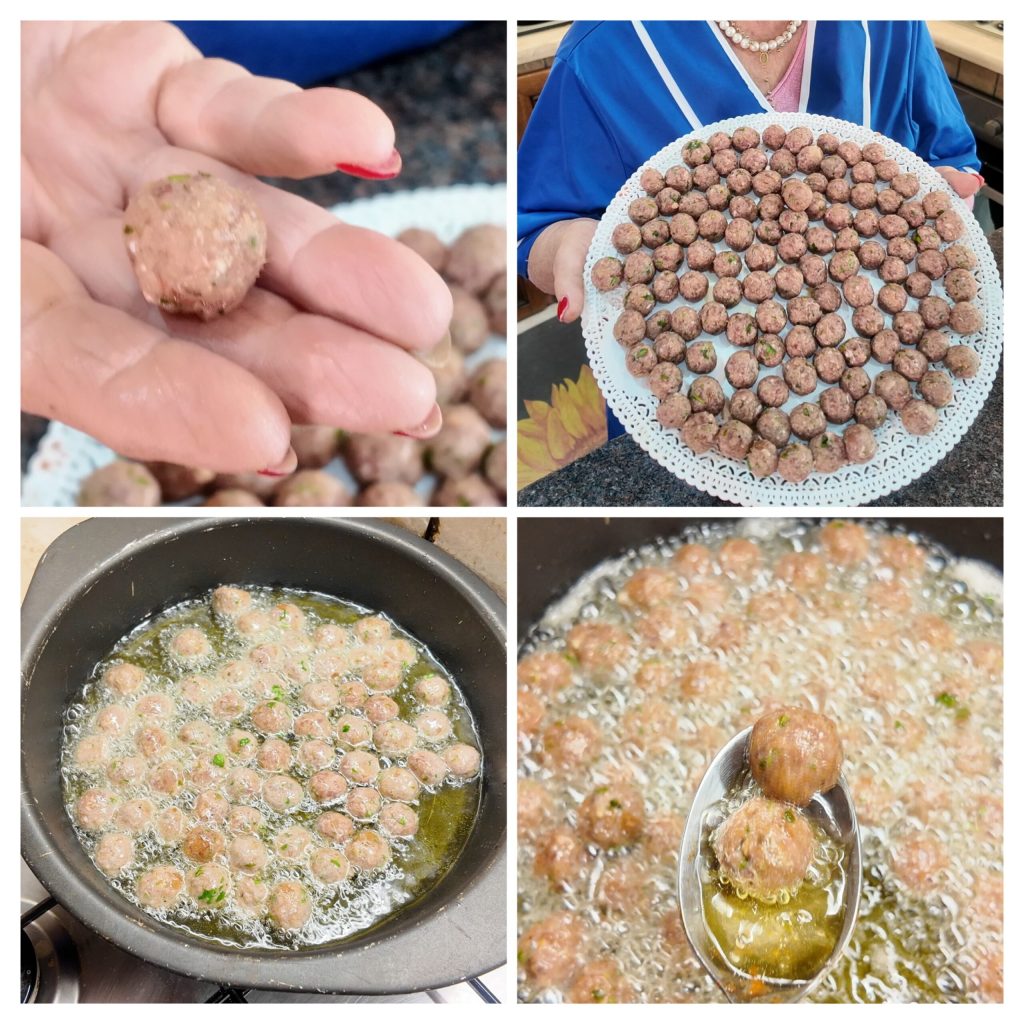
Preparation of sausage and hard-boiled eggs
While the meatballs rest, prepare the rest of the “treasure”.
Cook the eggs starting with cold water: calculate 9 minutes from boiling for them to be perfectly hard-boiled.
Once cold and peeled, cut them into pieces.
Take the semi-cured Calabrian sausage and reduce it to slices or cubes.
Now, in a large bowl, combine the meatballs, sausage, and eggs: mix gently to let the flavors meet.
This mix will be the soul of your baking dish.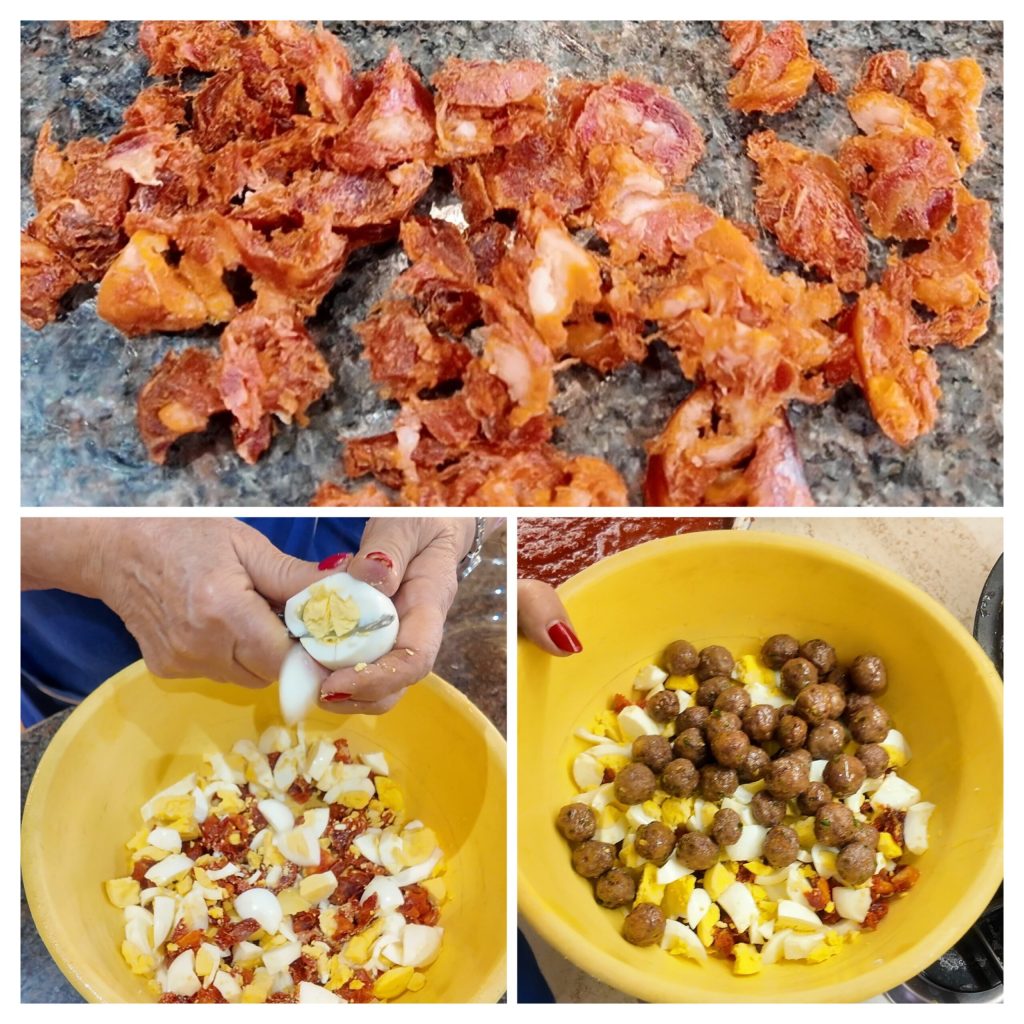
Cooking the pasta and seasoning with sauce
Cook the rigatoni in plenty of salted water and drain them very al dente (at least 3-4 minutes before the indicated time), because they will finish cooking in the oven.
Put them back in the pot and pour plenty of tomato sauce (which you would have prepared beforehand with a nice sauté of red onion).
Mix well: every single macaroni should be coated with the red sauce to keep it from drying out during cooking.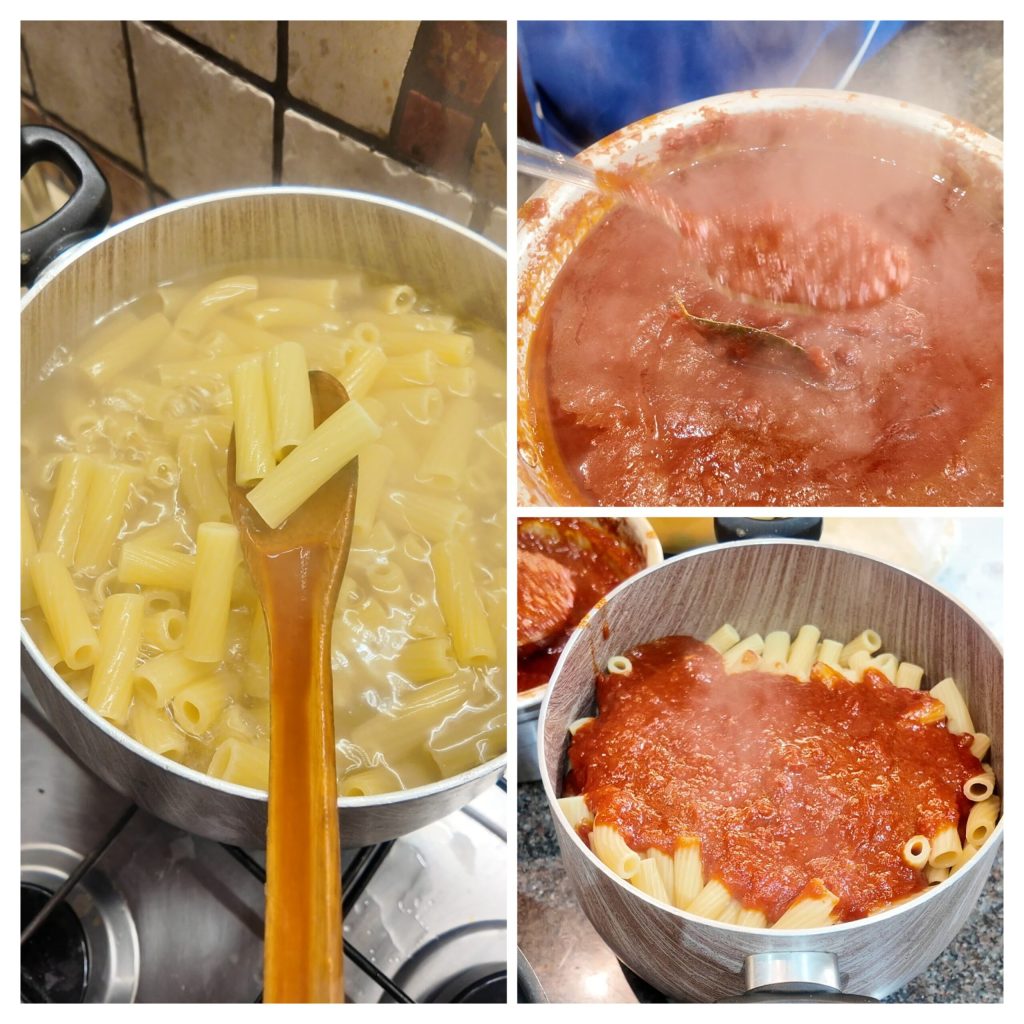
Layering the baked pasta
It’s time to create the layers.
Smear the bottom of the baking dish with a ladle of sauce.
Make a first layer of pasta, then generously distribute the mix of meatballs, eggs, and sausage.
If you want a cheesy result like I do, add cubes of Silana provola cheese.
Repeat until all ingredients are used up.
Close the last layer with plenty of tomato and a shower of grated Parmesan cheese: it will be the base for our crispy crown.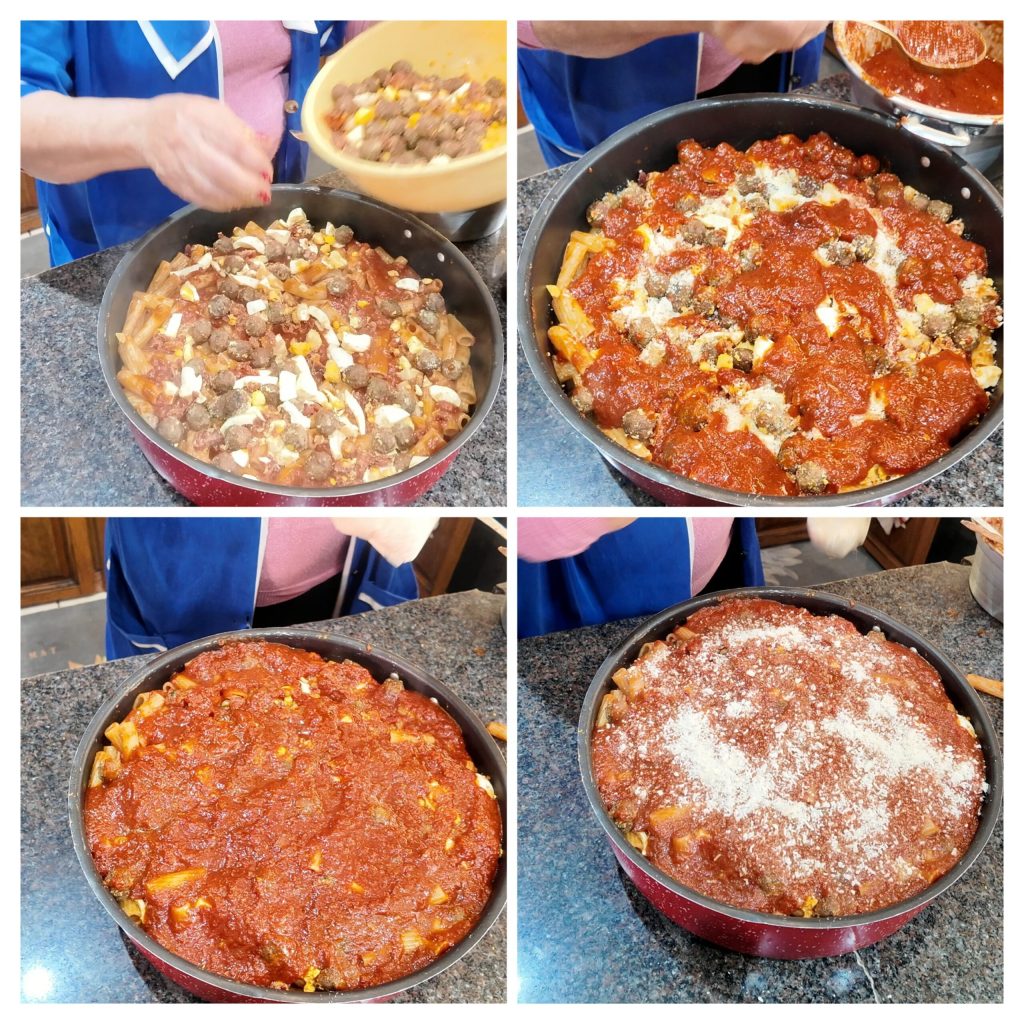
Layering the baked pasta
Bake at 356°F (static oven) for about 35-40 minutes.
The last 5 minutes switch to grill function: stay there and watch until an irresistible and slightly charred crust forms on the surface that will make your mouth water just by looking at it.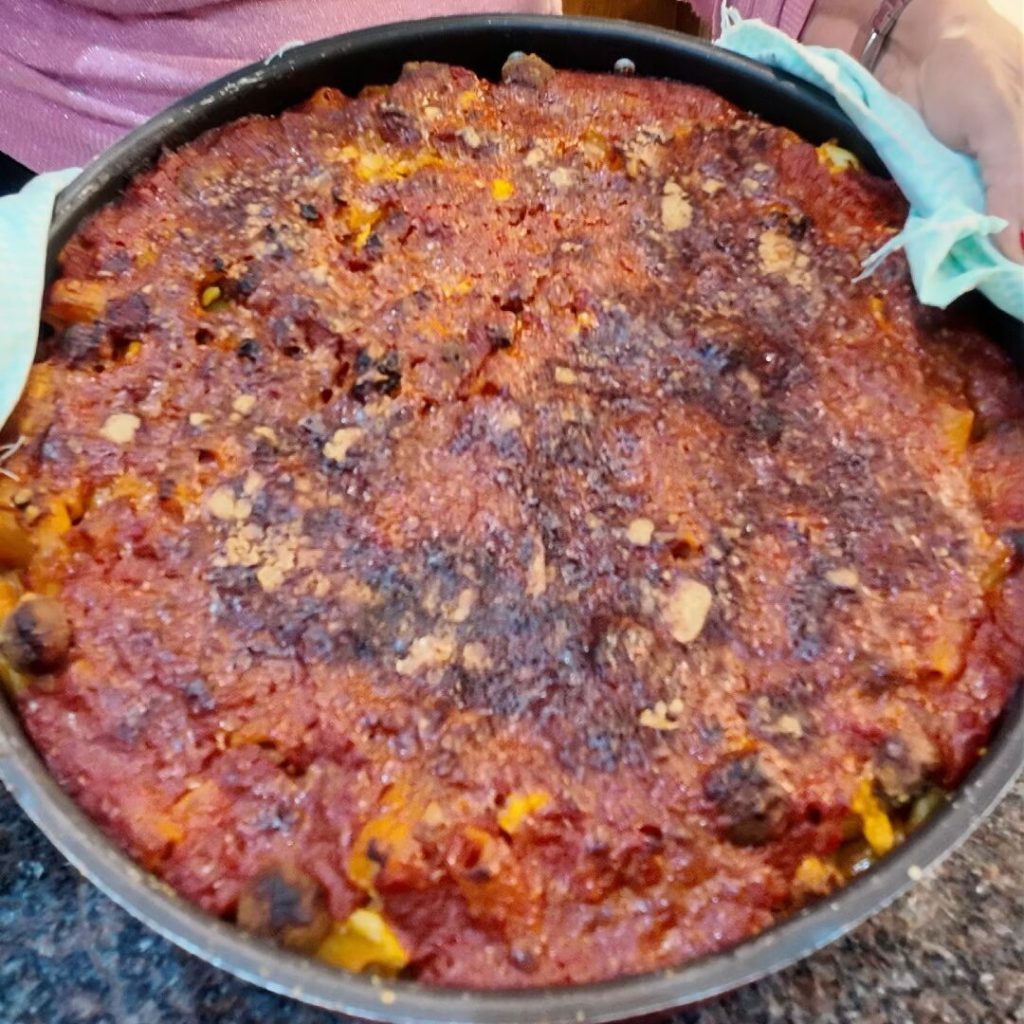
At the table: the most beautiful moment
Take out your baked pasta from the oven and, even though the aroma is overwhelming, let it rest for at least 10 minutes.
This will allow the flavors to settle and the slice to stay composed.
Bring the still steaming baking dish to the table and enjoy the show: this is not just a meal, it’s an embrace from Calabria!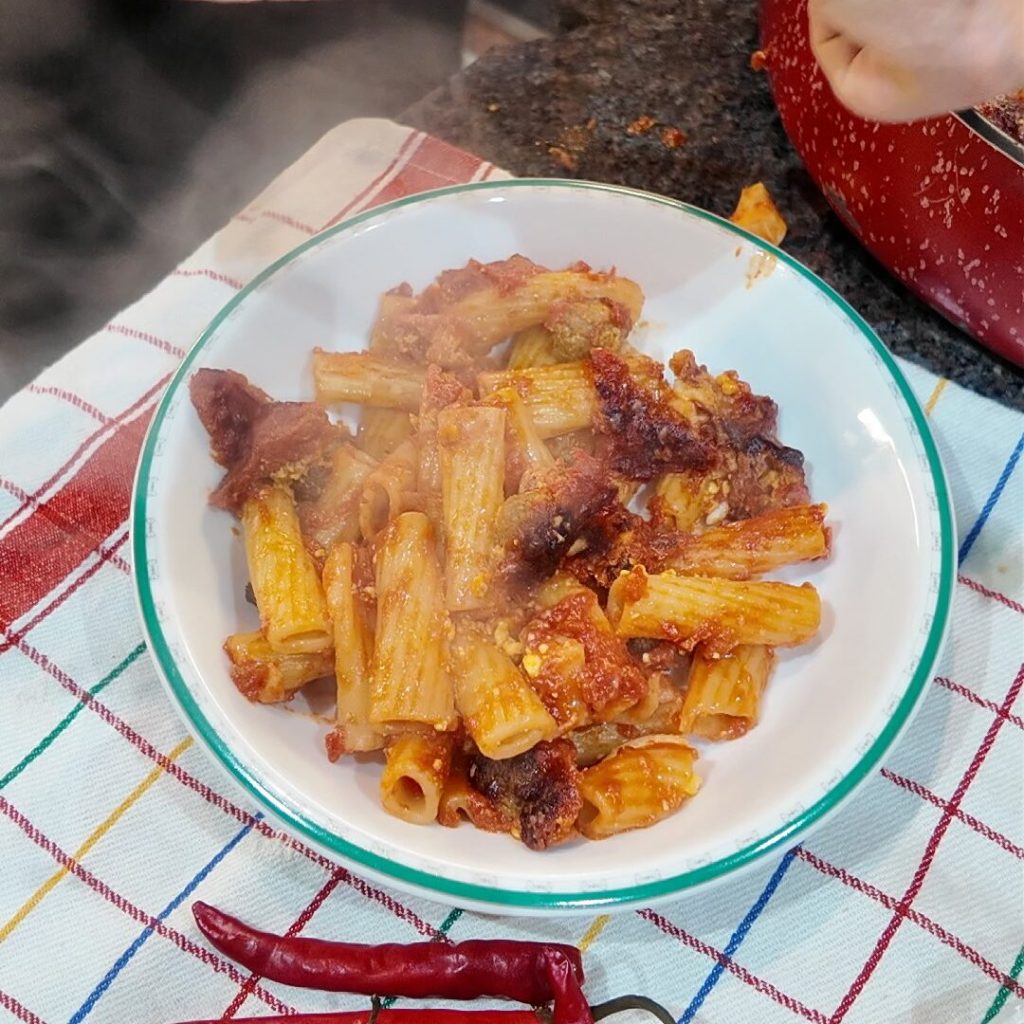
Storage
Calabrian Baked Pasta is the classic dish that “is even better the next day”.
In the fridge:
You can store it in an airtight container for 2-3 days. *
In the freezer:
If you used fresh (not defrosted) ingredients, you can freeze it already in portions.
It keeps perfectly for about 2 months.
How to reheat it:
To bring it back to life, heat it in the oven at 356°F with a drop of water on the bottom of the baking dish covered with aluminum, or pass it in a pan with a drizzle of oil to make it crispy.
Dadcook’s tips
The pasta:
Always choose ribbed shapes (rigatoni, penne, or tortiglioni).
The ridges hold the sauce better, and the meatballs stay “hooked” to the pasta.
The rest:
Never skip the 10 minutes of rest after cooking.
It’s the difference between a perfect slice and a mass of unlinked pasta.
The meatballs:
The smaller they are, the more refined the recipe is.
I know it takes time, but it’s worth it!
Variations
The “strong” variant:
If you love spicy food, add a teaspoon of ‘nduja from Spilinga in the sauce while it cooks.
The cheese:
If you can’t find Silana provola, you can use aged scamorza or fresh caciocavallo.
Avoid fresh mozzarella because it releases too much water during cooking.
Notes:
Remember that the salt in the sauce should be dosed with caution: Calabrian sausage and pecorino are already very salty.
Always taste before baking!
Always taste before baking!
Always taste before baking!
💬 Have you tried this recipe?
I hope this Calabrian Baked Pasta, with its heart full of meatballs and the fragrance of tradition, brings all the joy and warmth of Southern Sundays to your table!
It’s a dish that requires some dedication, especially for the handmade meatballs, but the result is a triumph of flavors that I’m sure will become the undisputed protagonist of your family lunches and special occasions.
If you have doubts about layering, curiosity about the original ingredients, or want to tell me your version of “Pasta China”, write to me in the comments below: I always read everything with immense pleasure and love seeing how you bring a piece of my Calabria into your kitchens.
And don’t forget to follow me on DadCook so you don’t miss the latest news and all the “rock” recipes I publish every week!
Frequently Asked Questions (FAQ)
Can I prepare the baked pasta the day before?
Absolutely yes!
In fact, preparing it in advance allows the flavors to blend perfectly.
You can assemble it all, cover it with plastic wrap, and keep it in the fridge, then bake it the next day.
In this case, add an extra ladle of sauce because the pasta will tend to absorb more moisture.What pasta shape is most suitable for Pasta China?
Traditionally, rigatoni or tortiglioni are used.
The ribbed surface is essential because it holds the sauce and allows the meatballs to sneak inside the pasta, creating a perfect bite.
Avoid smooth or too small shapes.Why are hard-boiled eggs added to baked pasta?
The hard-boiled egg is the symbolic ingredient of “Pasta China” (full pasta).
In addition to giving a unique texture, it historically served to make the dish a complete and filling meal for big family celebrations.Can I use mozzarella instead of provola?
It would be better not to.
Fresh mozzarella releases too much water during cooking, risking making the pasta “mushy”.
If you really want to use it, choose the one for pizza (the dry brick) or, to stay faithful to Dadcook’s recipe, use Silana provola or aged scamorza.How do I prevent the pasta from drying out in the oven?
The secret is to be generous with the sauce in the inner layers and to drain the pasta very al dente.
Covering the dish with a sheet of aluminum foil for the first 20 minutes of cooking will help retain moisture, removing it only at the end to create a crust.
