
Homemade egg pasta always brings back memories of those peaceful days when, as a child, I would watch my mother prepare the worktable, place the flour in a mound, crack the eggs inside, and then skillfully knead that formless mass of ingredients into wonderful fettuccine, cannelloni, or unforgettable lasagna. I remember her playfully threatening me with the rolling pin when I played with the flour, and I will never forget the slightly rough sensation of the floured pasta between my fingers.
What comes to your mind when you think of homemade egg pasta?
- Difficulty: Easy
- Cost: Cheap
- Rest time: 30 Minutes
- Preparation time: 15 Minutes
- Portions: 2
- Cooking methods: No Cooking
- Cuisine: Italian
- Seasonality: All Seasons
- Energy 201.82 (Kcal)
- Carbohydrates 35.80 (g) of which sugars 0.85 (g)
- Proteins 9.41 (g)
- Fat 3.09 (g) of which saturated 1.25 (g)of which unsaturated 1.51 (g)
- Fibers 1.10 (g)
- Sodium 44.66 (mg)
Indicative values for a portion of 5 g processed in an automated way starting from the nutritional information available on the CREA* and FoodData Central** databases. It is not food and / or nutritional advice.
* CREATES Food and Nutrition Research Center: https://www.crea.gov.it/alimenti-e-nutrizione https://www.alimentinutrizione.it ** U.S. Department of Agriculture, Agricultural Research Service. FoodData Central, 2019. https://fdc.nal.usda.gov
Ingredients
- 1 egg (large)
- 3/4 cup all-purpose flour
Tools
- 1 Rolling Pin
- 1 Fork
- 1 Tray
- 1 Work Surface
- 1 Cloth
Steps
Place the flour in a mound on the work table and make a large well in the center.
Break the egg into the center of the flour.
Start beating the egg slowly, incorporating the surrounding flour little by little.
When the dough becomes quite thick, begin kneading it vigorously with your hands until it’s smooth and soft.
Form it into a ball and let it rest for 30 minutes covered with a cloth.
Roll out the dough.
Start by flattening and spreading the dough with your fingers, making semi-turns with your hands.
Then start using the rolling pin after dusting the work surface and the dough surface with a little flour.
Roll the rolling pin over the dough until it’s thin enough to roll it around the pin.
At this point, besides rolling the pin to stretch the dough, start moving your hands back and forth towards the sides: this will help you stretch the dough outward.
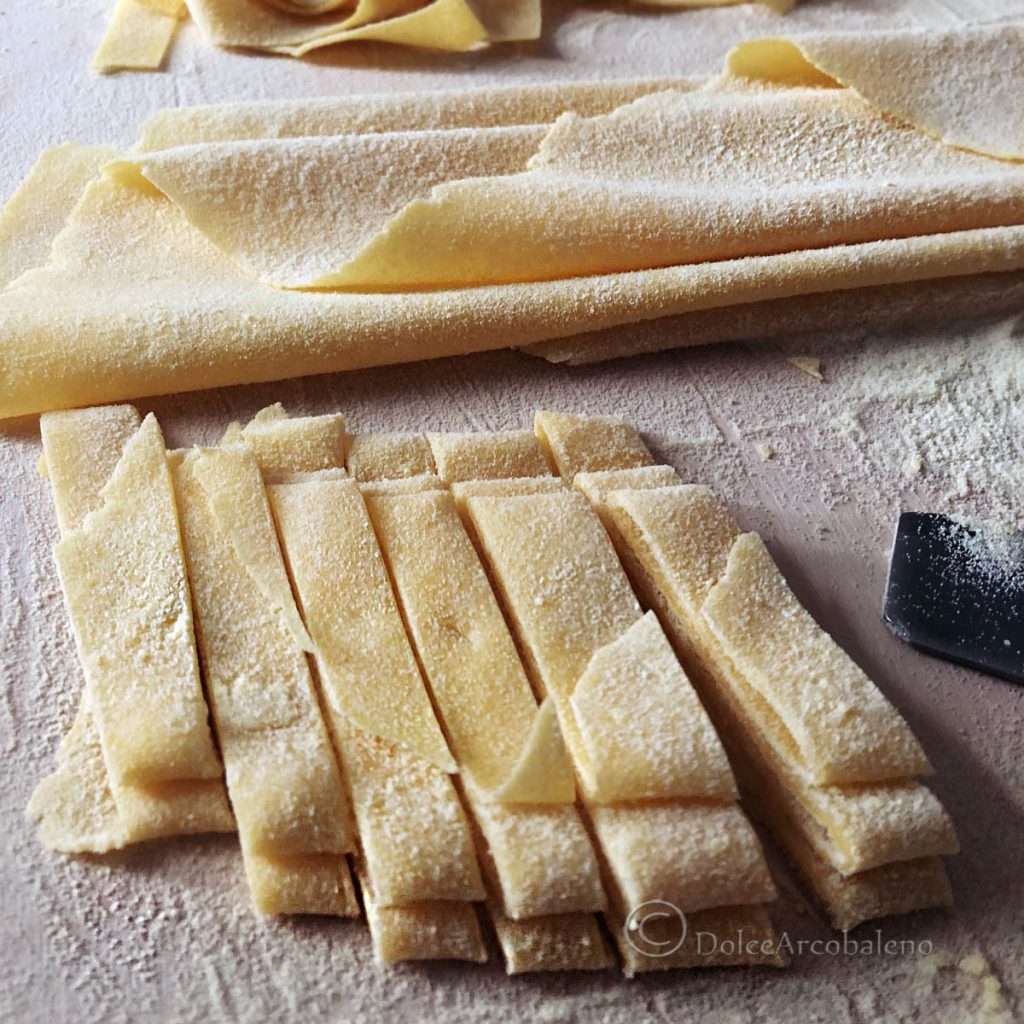
Once you have a dough sheet about 1/10 inch thick, you can proceed to cut it to make the pasta, following the instructions for the type, and then place it on a tray ready for cooking.
Notes:
This is the minimum possible quantity, yielding about 2 portions; but if you’re single, don’t worry: flour the remaining pasta and let it rest in the fridge on a tray covered with a cloth.
FAQ (Questions and Answers)
Can fresh egg pasta be frozen?
Yes, you can place it on a tray dusted with flour on top of parchment paper and covered with parchment paper.
Can fresh pasta be made at home without eggs?
Homemade pasta can be made without using eggs, and it is also possible to color it by adding vegetable puree to the dough.
Vegetables such as spinach, beets, or pumpkin are typically used, as they don’t significantly alter the flavor but allow us to create very scenic and delicious dishes.If I use vegetable puree instead of an egg, how much should I use?
If using vegetable puree in place of an egg, you should consider the weight of the egg (1 large egg weighs about 2.25 oz) and use a similar amount, so about 2.25 oz of puree. However, ensure the vegetable puree has a similar consistency to that of an egg so that the dough does not become too liquid or too hard.
