
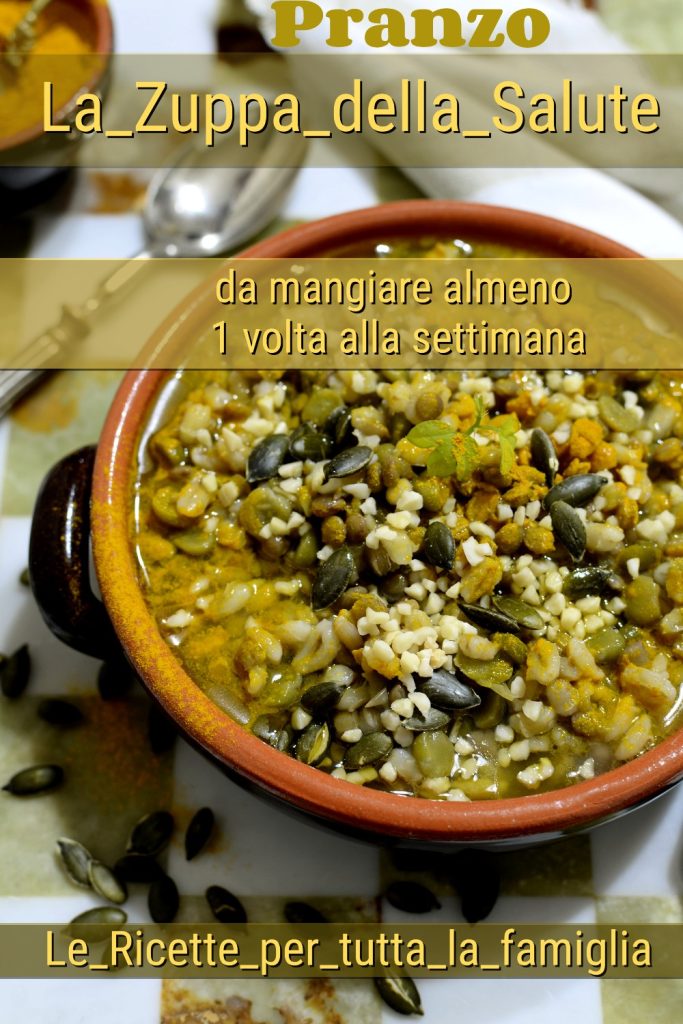
Today we make a delicious barley and legume soup, a healthy, economical, light first course with about 20 g of protein per serving and 350 calories. Carbohydrates are well balanced with the other macronutrients. Furthermore, it is an easy and quick recipe, ready with 5 minutes of actual work and only 25 minutes of undisturbed cooking. The package says 35 minutes, but adjust according to your tastes; for me 25 minutes are more than sufficient — I love it slightly al dente rather than mushy, so to speak.
Which soup to choose for this recipe
For today’s first course I used the Colfiorito soup mix, rich in protein and fiber, 400 g (5 servings total, so one package is enough for a family lunch). The package contains pearled barley, lentils and split peas — a well-balanced mix rich in taste and nutritional properties. The description from the source: “The goodness of barley and its rich, substantial flavor is combined with the classic legumes of tradition – all ingredients grown in Italy.”
Of course, there are many brands of barley and legume soup mixes on the market; you can choose the one you usually use or try our Colfiorito mix.
The barley and legume soup is already good on its own without adding anything beyond the usual seasonings, but try preparing this version as I do, with powdered turmeric, pumpkin seeds and almond crumbs — everything is added at the end, instead of the classic Parmesan. Imagine this healthy mix and the little touch of magic it gives to the soup. Try it, you’ll fall in love!
DELICIOUS AND NOURISHING!
If you like soups, below are 3 more recipes for you + 1 old cake (more than 100 years old), certainly original, found in my grandmother’s recipe book. A gift from me!
- Difficulty: Very easy
- Cost: Economical
- Preparation time: 5 Minutes
- Portions: 1
- Cooking methods: Stovetop
- Cuisine: Italian
- Seasonality: Winter
Ingredients
Ingredient list for 1 serving of soup, which you can double for 2 servings, triple for 3 servings, and so on.
- 3 oz barley and legume soup mix
- 2 tsp onion, minced
- 1 drizzle extra virgin olive oil
- 1 pinch ground turmeric
- 1/2 tsp almond crumbs (crumbs)
- 1/2 tsp pumpkin seeds
- 1 1/4 cup water
Tools
To prepare the barley and legume soup I used my beloved and indispensable wok
Steps
First of all, based on the portions needed, calculate (1 portion = 3 oz of soup mix) and weigh the correct amount. I set this recipe for 1 portion, so if you are 2 double all the ingredients, if you are 3 triple them, and so on.
As with all pre-packaged mixes, it is always recommended to put the required amount on a plate first, then check that there is nothing to remove (for example any discolored barley grain or legume), then rinse and drain them.
Meanwhile place the pot
 on the stove, add a drizzle of oil + 2 tsp of minced onion. Let it lightly brown but not too much, then add 1 1/4 cup of water (if during cooking too much liquid evaporates and the soup becomes too thick, add more hot water), finally add the prepared amount of barley and legumes. Stir and cook until done (I turned off the stove after 25 minutes).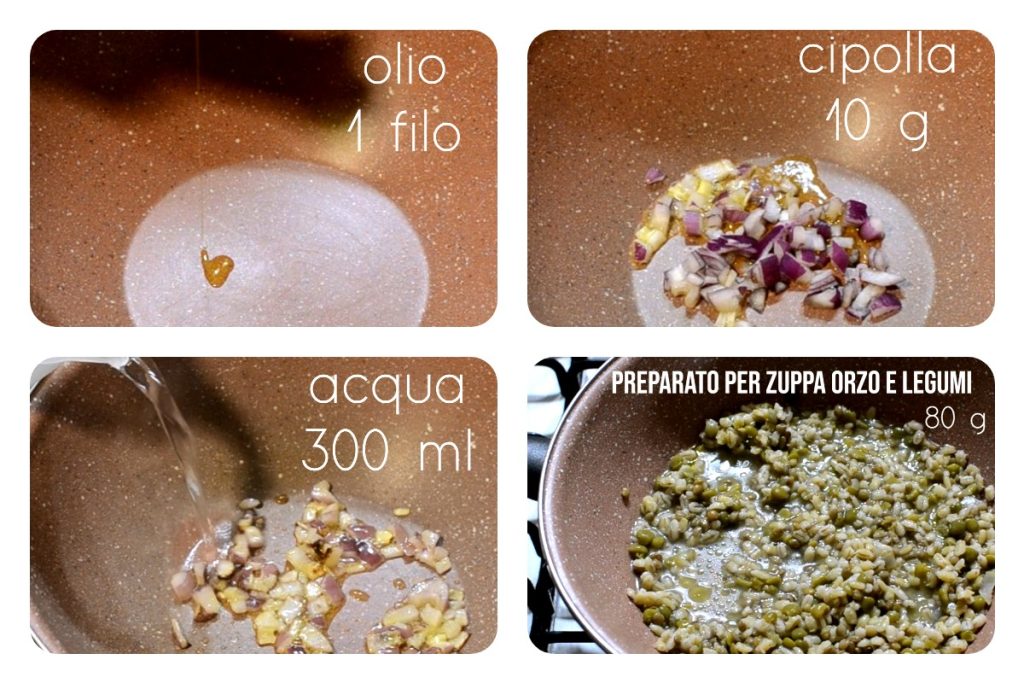
After plating the soup, dust it with turmeric, then finish with almond crumbs and pumpkin seeds (a drizzle of extra virgin olive oil at the end is optional).
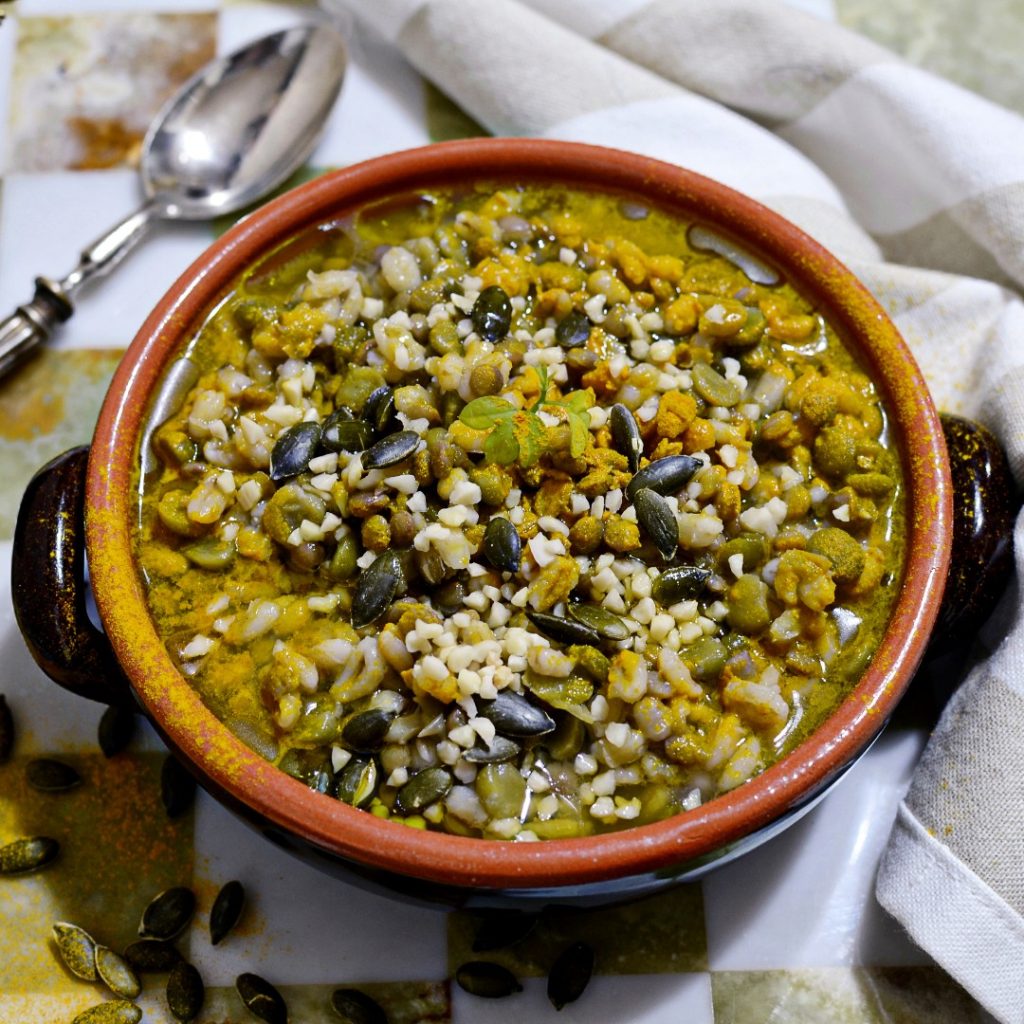
If you prefer not to use turmeric, pumpkin seeds and almond crumbs, you can replace them with a sprinkling of Parmesan; it remains a dish rich in beneficial properties for the whole body.
Enjoy your meal!
Some curiosities about this soup
The barley and legume soup is a first course made from ingredients designed and balanced to obtain a complete dish in terms of calories, fiber, macronutrients (carbohydrates, proteins and fats), minerals (magnesium, phosphorus, potassium, calcium and iron), vitamins (A, C, E, K and B group including B9 — folates).
Therefore we obtain a soup (prepared with these ingredients: barley, peas, lentils, turmeric, pumpkin seeds, almond crumbs, extra virgin olive oil) that is suitable even for people with diabetes, high blood pressure or high cholesterol. It’s really great for everyone.
Peas: properties
Glycemic index 35 – gluten free
Peas, besides being recommended for difficult digestion, can help regulate blood sugar, cholesterol, and diuresis; they also counteract water retention, the appearance of diverticula, constipation and help eliminate toxins from the colon, protecting it from disease (including tumors). They are true anti-inflammatories. They also contain folates, so they are suitable for pregnant women. Get used to eating healthily to feel good. Recommended dose 3 times a week: if weighed fresh consider about 1 cup (approx. 150 g), if weighed dry about 1/3 cup (approx. 50 g).
Not recommended in cases of gout or high uric acid.
Barley: properties
Glycemic index 25, glycemic load 11 – contains gluten
Lentils help regulate cholesterol, constipation, digestion and liver function. They are anti-inflammatory for the urinary tract. Importantly: the cooking liquid of barley can be used as a gargle because it is a powerful anti-inflammatory for the throat and mouth, and even the eyes. It can also be drunk to relieve heartburn. Barley is recommended for breastfeeding mothers as it helps regulate hormones (estrogens) that assist milk production. Finally, barley is a filling food that swells and fills the stomach, preventing sudden hunger pangs.
Lentils: properties
Glycemic index 32 – gluten free
Lentils are protein-rich, filling and full of many beneficial properties. Suitable for those with high blood pressure, high cholesterol and diabetes. They are energizing and detoxifying. Also recommended for pregnant women. A truly precious food that needs no further words.
Note: when using dried lentils and soaking them, water-soluble B vitamins can be lost into the soaking water. To limit this loss, it is recommended to add about 2 tsp of lemon juice (approx. 10 g) for every 4 1/4 cups (1 liter) of soaking water. Discard the soaking water — do not use it.
Turmeric: properties
Turmeric, known as the Saffron of India, is a precious food with incredible properties for our entire body. I wonder why most people are not in the habit of using it in the kitchen. Let’s look in detail.
Studies conducted in both India and Italy have shown that turmeric has antioxidant properties — it reduces free radicals that cause cell aging and deterioration of the body, skin, hair, vision, etc. It also reduces the proliferation of cancer cells and can help with degenerative diseases such as Alzheimer’s, Parkinson’s, sclerosis and rheumatoid arthritis. Turmeric can stimulate a pancreatic process that increases insulin (for this reason it is recommended in cases of type 2 diabetes).
If you start using turmeric in cooking, know that a pinch is not enough to feel all benefits; to notice effects you should reach about 2 teaspoons per day (some people take up to 6 teaspoons). But importantly, only about 6% of the curcumin in turmeric is actually absorbed by our body. To help absorption, add a pinch of black pepper and a drizzle of oil together with the turmeric powder.
Contraindications: better to avoid turmeric in cases of gallstones or while taking anticoagulants and anti-inflammatory drugs.
