
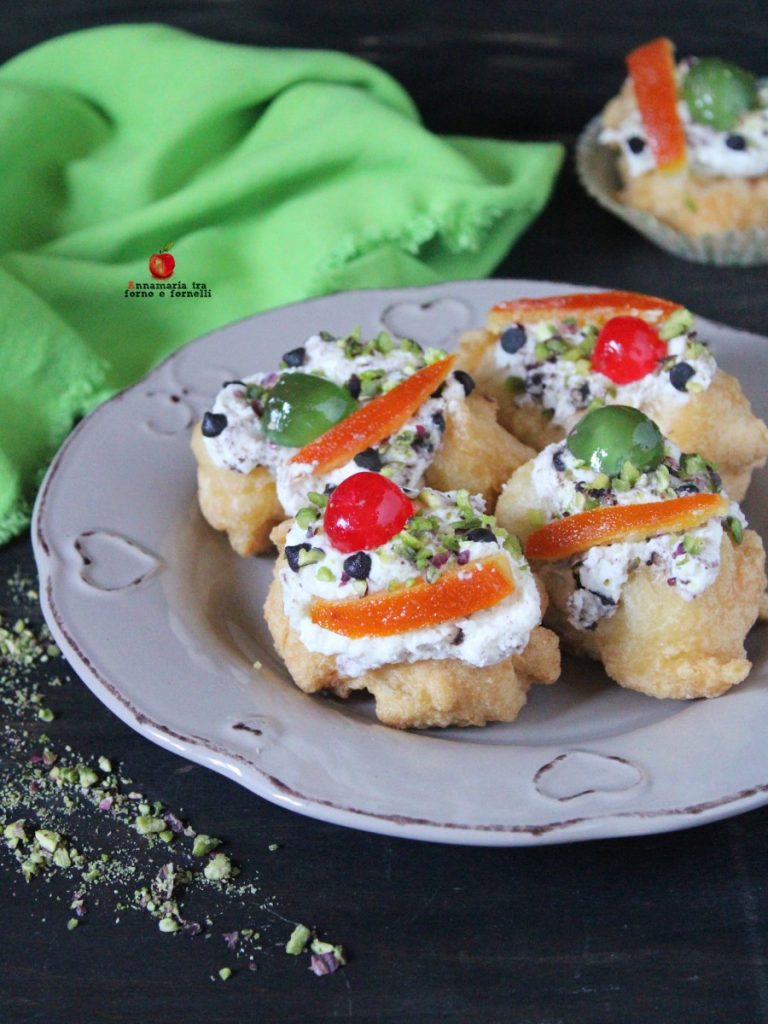
Sfinci of Saint Joseph are yet another recipe among fried desserts from Sicily, this time dedicated to the putative foster father of Jesus and therefore to all dads. The Sfinge of Saint Joseph were born in Palermo as a poor people’s dessert. The fried dough, soft, shapeless and very airy, like a “spongia” (an old term used for sponge), was covered with honey and enjoyed that way. But indulgence knows no limits, so the clever Palermo pastry chefs came up with the idea of making the sfincia extraordinarily rich, filling it with delicious sheep ricotta worked with sugar and chocolate chips and many other treats that add aroma and color, such as chopped pistachio, cherries and candied orange peels. Today Sfinci of Saint Joseph are enjoyed all year round. If I made you hungry, you certainly can’t back out from making them yourself, so come into my kitchen and I’ll show you how to do it.
- Difficulty: Very easy
- Cost: Inexpensive
- Rest time: 15 Minutes
- Preparation time: 40 Minutes
- Portions: 10
- Cooking methods: Stovetop
- Cuisine: Italian
- Energy 304.77 (Kcal)
- Carbohydrates 37.37 (g) of which sugars 25.71 (g)
- Proteins 9.30 (g)
- Fat 14.02 (g) of which saturated 6.96 (g)of which unsaturated 5.79 (g)
- Fibers 0.53 (g)
- Sodium 172.44 (mg)
Indicative values for a portion of 100 g processed in an automated way starting from the nutritional information available on the CREA* and FoodData Central** databases. It is not food and / or nutritional advice.
* CREATES Food and Nutrition Research Center: https://www.crea.gov.it/alimenti-e-nutrizione https://www.alimentinutrizione.it ** U.S. Department of Agriculture, Agricultural Research Service. FoodData Central, 2019. https://fdc.nal.usda.gov
Ingredients for Sfinci of Saint Joseph
- 2 cups all-purpose flour (≈8.8 oz)
- 1 cup + 2 tbsp water (≈250 ml)
- large eggs eggs (weighed after shelling; about 300 g total)
- 5 tbsp lard (strutto)
- 2/3 tsp salt
- 3 1/4 cups sheep ricotta (drained)
- 1 1/4 cups granulated sugar
- 1/2 cup chocolate chips (≈2.5 oz)
- to taste candied cherries
- to taste candied orange peels ((peels))
- 2 tbsp chopped pistachio
- cups sunflower oil for frying (≈34 fl oz)
What you need for Sfinci of Saint Joseph
- 2 Bowls
- 1 Saucepan
- 1 Skimmer
- Paper towels
- 1 Thermometer
- 1 Spoon
- 1 Mixer
- Pastry bag (disposable)
- 1 Small pan
- 1 Wooden spoon
Preparation of Sfinci of Saint Joseph
The ricotta should be processed after being left to drain of its whey for at least one night. Traditionally, ricotta was passed through a fine sieve; I refine it using electric whisks and the result is the same. I used the Severin mixer, which you can see here: another fantastic ally in my kitchen.
Take the ricotta out of the fridge and put it in a bowl, add the granulated sugar and work it for a few minutes with the electric whisks. Add the chocolate chips and fold them in with a spatula.
To incorporate the chocolate, do not use the whisks, otherwise brown streaks will form in the cream, which are not pleasant to see. Cover the cream with plastic wrap and refrigerate it until ready to use.
Move on to prepare the dough for the sfinci. In a small saucepan, put the water, salt and lard and heat on the stove. I used my fantastic Amzchef induction hob, which you can find here. When the fat has completely melted, add all the flour at once.
Stir quickly with a wooden spoon. Soon the dough will become a ball and will detach from the sides of the pot. Turn off the heat, transfer it to a bowl and wait for it to cool slightly.
Regarding the eggs, weigh them after shelling. The amount to add varies from 5 to 6, depending on their size. In my recipe I reached the required weight with 5 eggs. Up to 320 g (about 11.3 oz) is fine.
If necessary, to reach the indicated weight precisely, the last egg can be beaten and added little by little so as to easily reach the required amount.
The operation of incorporating the eggs can be done by hand, with a hand mixer or with a stand mixer. Add the eggs one at a time. Do not add the next egg until the previous one has been incorporated.
Put a pan with the oil on the heat and bring it to 338°F, measuring the temperature with a thermometer. If you don’t have a thermometer, test by putting a long skewer into the oil: if bubbles form all around it, the temperature is right.
Oil the spoon with a little oil, take a spoonful of dough and drop it into the hot oil, helping it slide off with your finger or with a teaspoon.
Depending on the size of the pan, add the amount of sfinci you can, bearing in mind they will increase considerably in volume, and let them cook, turning occasionally with a skimmer.
Even if they look golden, do not remove them yet. As the heat penetrates inside, the sfinci will puff up more and more, breaking the outer crust to let the inner dough escape.
Keep stirring and, when they are completely cooked, take them out of the oil with the skimmer and put them in a bowl lined with paper towels.
Once completely cool, take one sfincia at a time, make a small hole with your finger and fill with the ricotta cream, previously placed in a disposable pastry bag. I bought a lot of them; you can find them here and they are really handy. The internal filling makes the pastry more indulgent, but traditional Sfinci of Saint Joseph require only the ricotta cream on the surface.
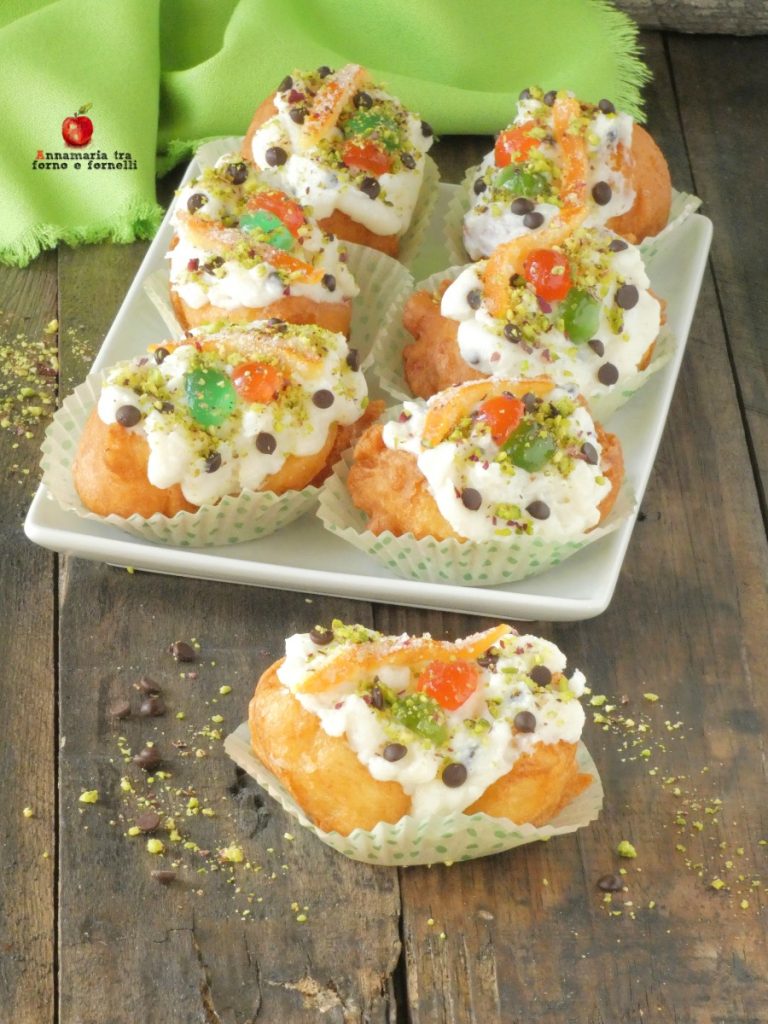
Add more cream on top and finish by decorating with chopped pistachio, a few extra chocolate chips set aside earlier, the cherries and the candied orange peels.
Arrange them on a tray or, if possible, portion each sfincia into a large paper cup (baking cup); I used the ones you see here. Now all that’s left is to enjoy this delight!
Annamaria’s tips
Sfinci of Saint Joseph keep in the fridge for a couple of days, provided that the ricotta is very fresh.
The recipe to make candied orange peels can be found by clicking here.
For other Desserts click Here.
This article contains commercial sponsorships.
