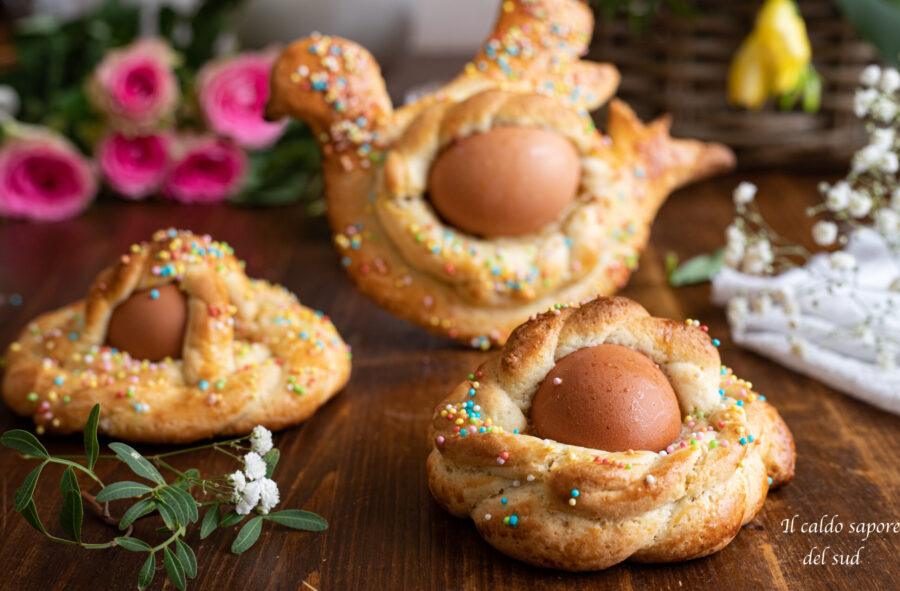
In Catania the cuddura ccu l’ovu also takes the form of the aceddu, a braided Easter sweet that encloses one or more hard-boiled eggs, a symbol of rebirth and celebration.
Among the sweets that were never missing from the traditional Easter Menu of Sicilian homes, Aceddu cu l’ovu holds a special place, as it does in our collection dedicated to Traditional Easter Sweets.
“Cuddura” derives from the Greek kollura and means crown. In Sicily many preparations are called cuddura or cudduredda, but what is most often identified by this name is a very ancient sweet, traditionally linked to Easter: the cuddura ccu l’ova.
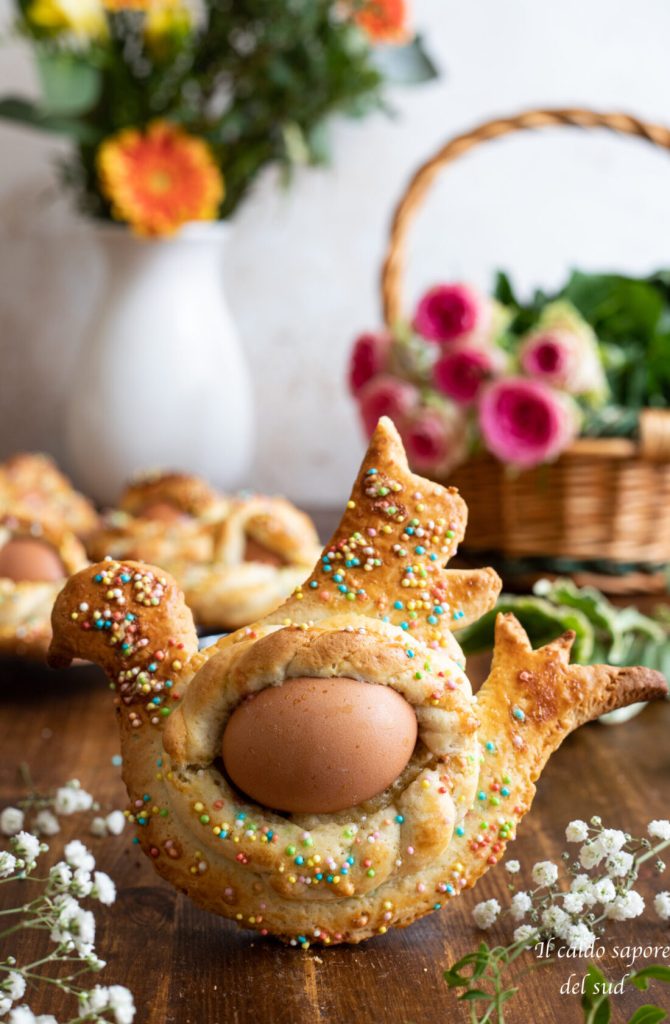
It is a ring of braided pastry that encloses one or more hard-boiled eggs. Over time this sweet, precisely because of the eggs and its connection to Easter, also gave rise to another version: the aceddu cu l’ovu, that is the bird with the egg, representing the dove, the quintessential Easter symbol.
Little by little other shapes were created as well, such as bells, baskets and hearts.
Until a few decades ago, before we were inundated with Easter eggs from January on, it was customary in Sicily to exchange these sweets on Easter Day itself, with the aim of consuming them on Easter Monday. This ancient Catanese Easter sweet is one of the traditional homemade Easter Sweets prepared to celebrate the most heartfelt holiday of the year, a symbol of affection and rebirth. Both the cuddure and the aceddi cu l’ova were gifts exchanged between fiancés, as well as between a future daughter-in-law and her future mother-in-law; the larger the gift, the more eggs it contained, as a sign of affection and the desire to make a good impression.
Today this typical sweet is falling into disuse, but it is nice to remember the traditions and, also this year, I will prepare them for my children. If these few words have piqued your curiosity, follow me and we’ll prepare our cuddure together, but not before taking a look at the recipe for Baked ricotta cassatelle, a Sicilian recipe, and the Cassatelle of Agira, an original Sicilian recipe. Remember that if you want to stay updated on all my recipes, you can follow my Facebook page (here) and my Instagram profile (here).
Also check these recipes for Sicilian Easter sweets:
- Difficulty: Easy
- Cost: Very inexpensive
- Preparation time: 30 Minutes
- Portions: 6 pieces
- Cooking methods: Oven
- Cuisine: Italian
- Seasonality: Easter
Cuddura and aceddu with the egg – Catanese Easter sweet
- 4 cups All-purpose flour
- 1 1/2 cups Powdered sugar (confectioners' sugar)
- 7 tbsp Lard
- 1 Egg (large, for the pastry)
- 1 tsp Baker's ammonia (ammonium bicarbonate) (about 1 teaspoon)
- 1 tbsp Vanilla extract (or vanilla sugar)
- 1/3 cup Milk (about)
- Colored sprinkles
- 1 Egg yolk (for finishing)
- 5 tbsp Milk
- 6 Hard-boiled eggs (about)
Tools
- Oven
- Baking sheet
- Parchment paper
- Knife
Preparation of the Aceddu with the Egg: ancient Easter sweet of the Catanese tradition
Boil the eggs at least two hours before making the dough so they are cold when you need them. They do not need to be completely hard-boiled at that point; just count 5 minutes from the moment the water boils — they will finish cooking in the oven.
Pour the flour onto a work surface, make a well, add the lard and mix it into the flour until you obtain a crumbly texture.
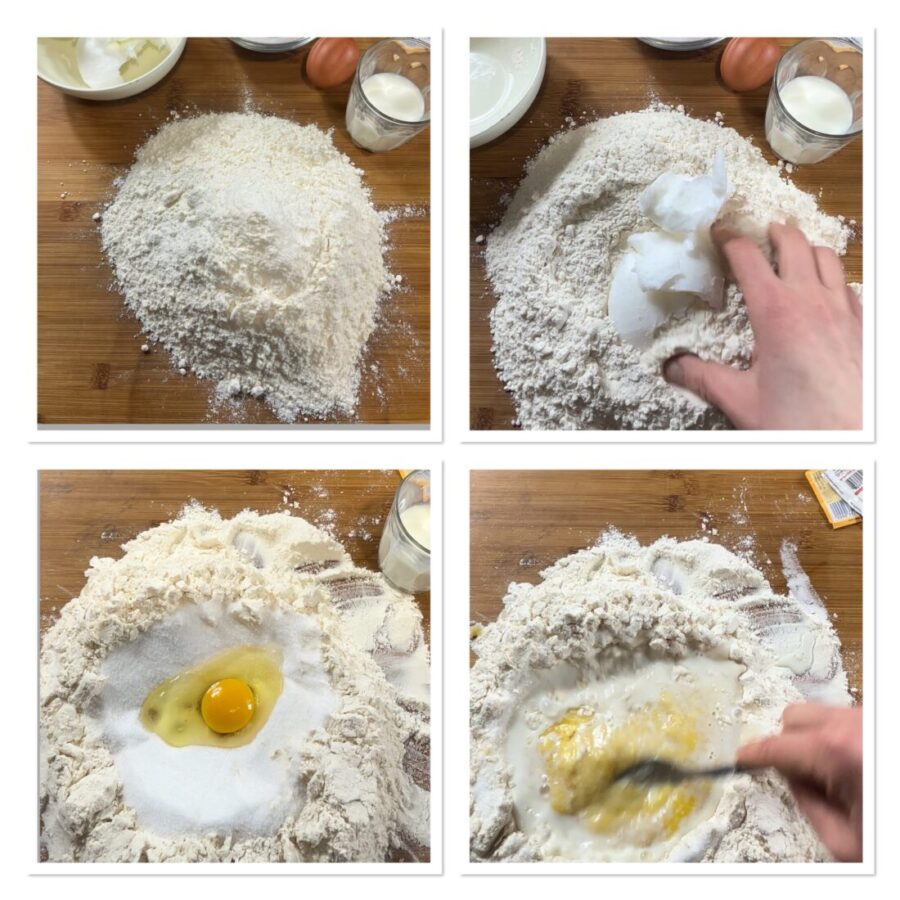
Reform the well, add the egg, the sugar and the milk, and work everything together until the sugar dissolves.
Also add the baker’s ammonia, the vanilla extract or vanilla sugar and knead everything together.
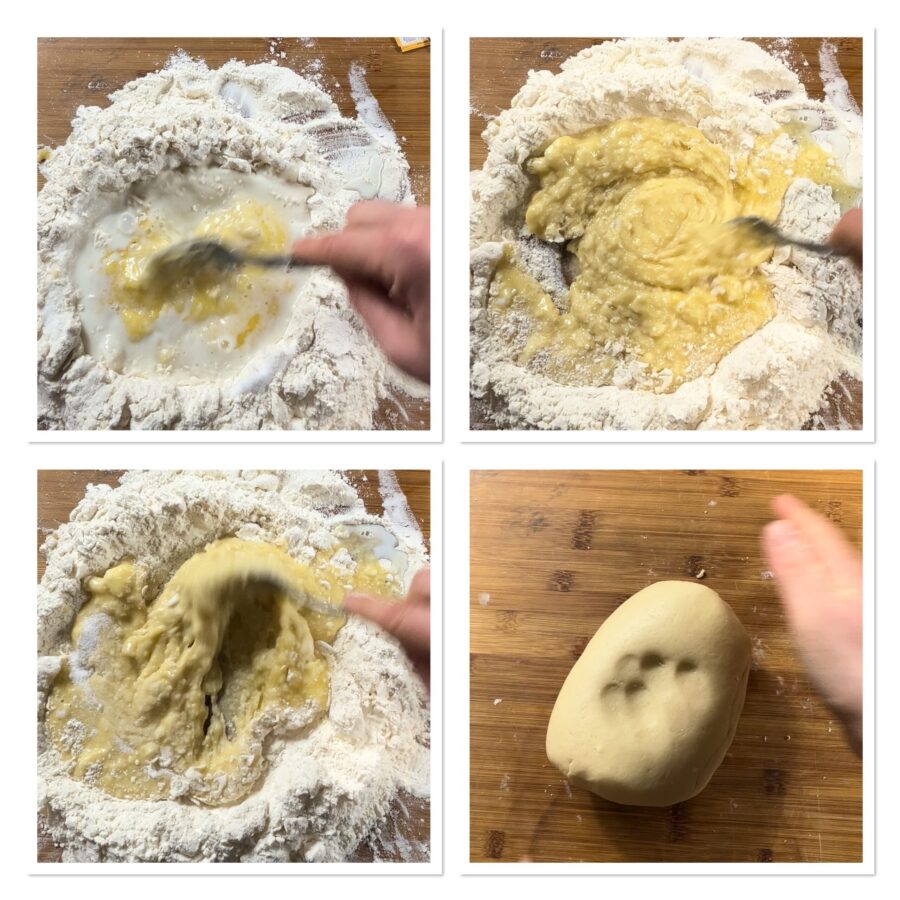
Once the dough is formed, let it rest in the refrigerator for 30 minutes if it has warmed up too much during mixing; otherwise leaving it at room temperature is fine.
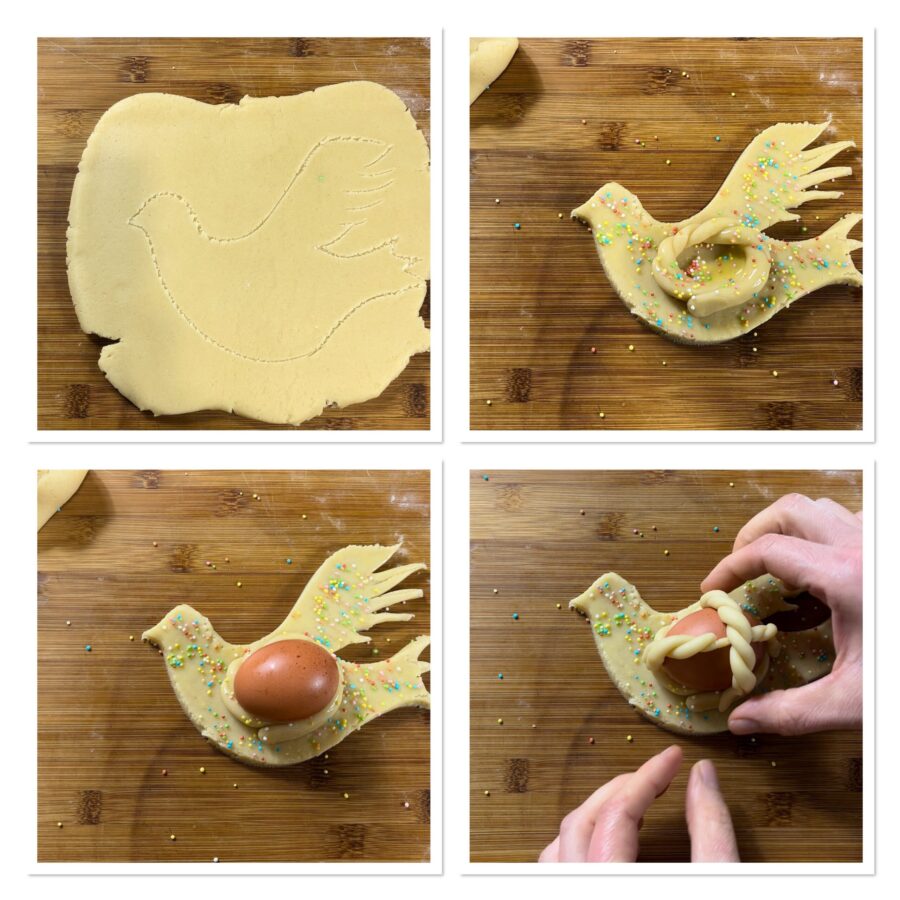
After resting, take a piece of shortcrust dough and roll it out to a thickness of about 1/4 inch (≈1/2 cm).
With the tip of a knife, trace the outline of the shape you intend to represent — a dove, a bell, a heart, or any Easter symbol.
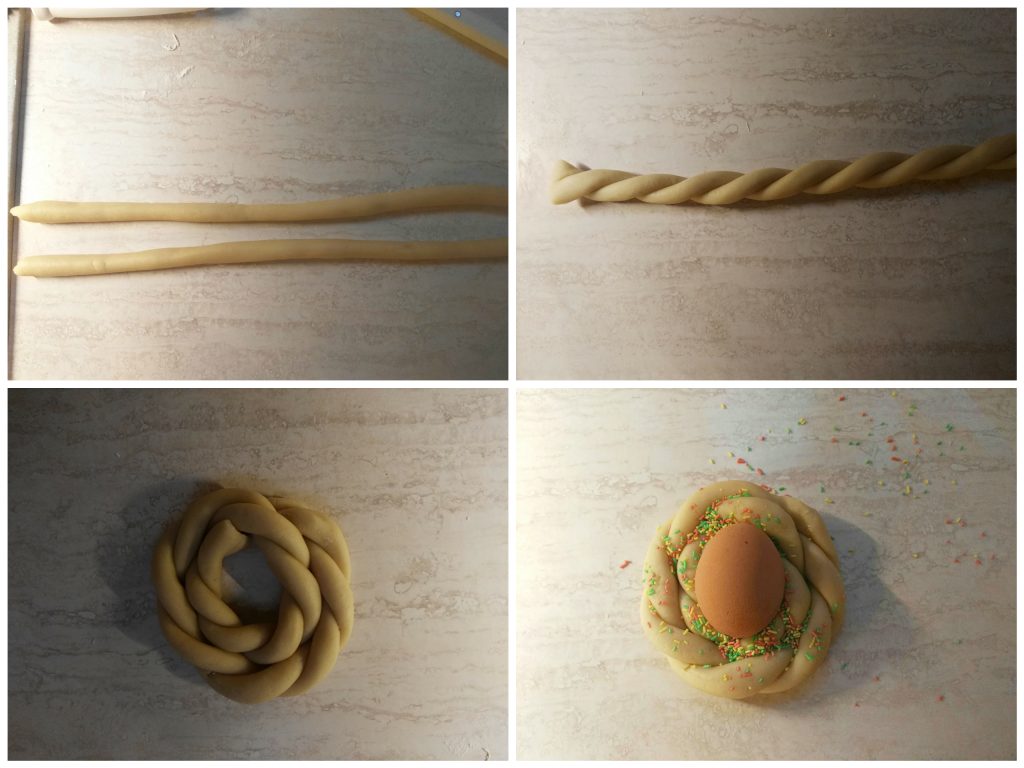
With another piece of dough make a two-strand braid, place it at the center of the cut shape and form a nest in which to place the egg.
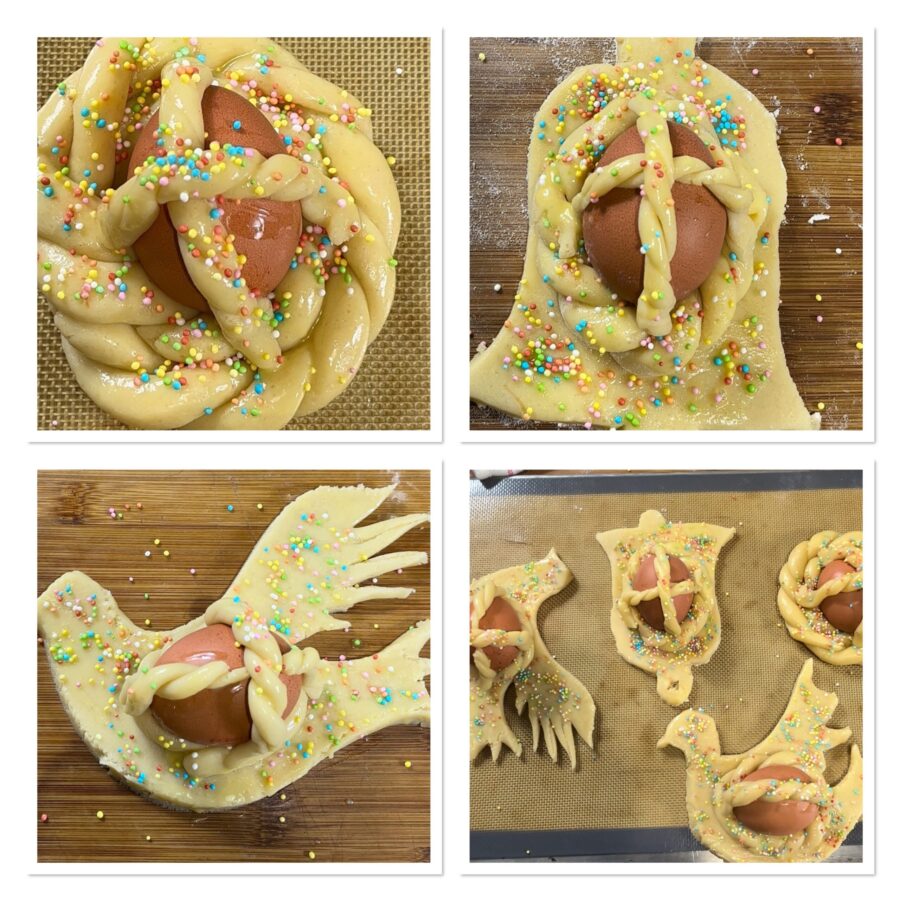
Decorate with other small strips of dough, placing them in a cross over the egg.
In the same way you can make simple nests and always place a hard-boiled egg in the center. You can also make a single larger piece and include several eggs, provided the number is odd (the Holy Trinity is odd).
When the shapes are ready, brush them with beaten egg to which you have added the 5 tablespoons of milk and decorate with the sprinkles. Bake at 356°F (convection) for 20 minutes, then turn the oven off and leave them in the oven for another 30 minutes; this will help the pastry dry better, since cookies that are still soft tend to go moldy.
Cuddure should be prepared a few days before the celebration, wrapped in food-grade cellophane and adorned with ribbons, and given as gifts on Easter Day. They keep at room temperature for two or three days, although because of the egg I personally recommend not exceeding two days.
Notes
If you want to stay updated on my recipes, follow me also on: Pinterest; Twitter; YouTube and TikTok.
From here you can return to the HOME and discover the new recipes!
How long do cuddure cu l’ovu keep?
Cuddure cu l’ovu keep at room temperature for 2 to 3 days, preferably wrapped in food paper or cellophane. Due to the presence of the hard-boiled egg, it is recommended to consume them within two days of preparation.
Can the eggs in the cuddure be eaten?
Yes, the eggs placed in the dough bake together with the sweet and become perfectly hard-boiled, ready to be eaten with the pastry.
Can they be prepared in advance for Easter lunch?
Yes, cuddure cu l’ovu can be prepared one or two days in advance and stored at room temperature until they are ready to be eaten.
Are cuddure cu l’ovu part of Sicilian Easter Sweets?
Yes, cuddure are among the traditional Sicilian Easter sweets, homemade recipes prepared to celebrate the holiday with symbolic dishes linked to rebirth and sharing.
Is it possible to make cuddure in different shapes?
Yes, in addition to the classic ring shape, cuddure cu l’ovu can be made in symbolic forms such as doves, baskets or hearts, typical of Sicilian Easter tradition.